

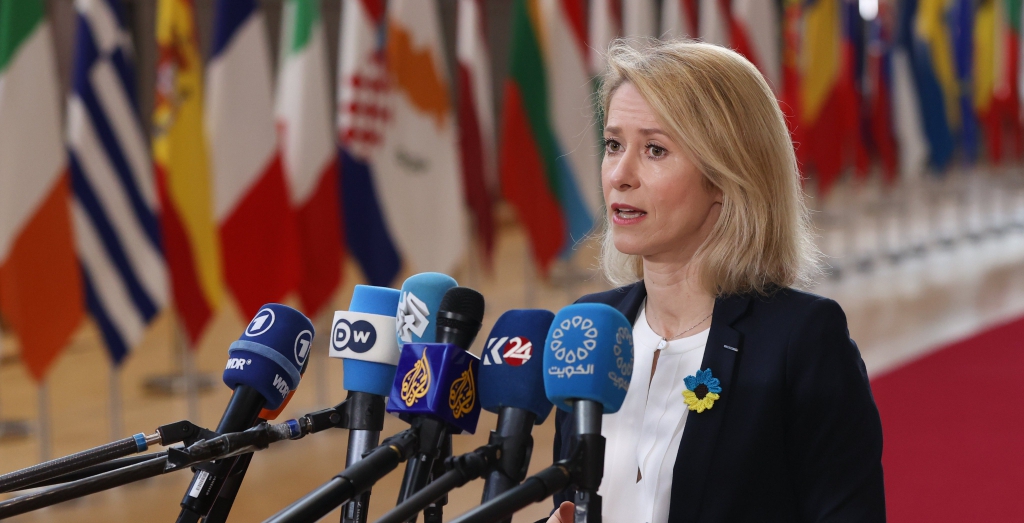
European Union High Representative Kaja Kallas on Thursday delivered a stark warning ahead of the European Council meeting, emphasizing the urgent need to end the escalating conflict in the Middle East and secure vital support for Ukraine.
Addressing reporters in Brussel, Kallas highlighted the interconnected nature of the two crises, noting that the ongoing war in the Middle East is inadvertently benefiting Russia.
She stressed that finding an exit strategy from the Middle East conflict is as crucial as ensuring Ukraine does not face a “complete surrender” to Russian forces.

Middle East: A Call for De-escalation and Safe Passage
Kallas pointed to recent Iranian attacks on Qatar’s energy infrastructure as a primary driver of further chaos in the region while confirmed the ongoing diplomatic outreach to Iran aimed at finding solutions and de-escalating the situation.
A significant concern raised by the High Representative is the safety of maritime routes, particularly the Strait of Hormuz. The EU is working closely with the United Nations to establish safe passage for ships.
The current instability in the strait poses a severe threat to global supply chains, disproportionately affecting Asia and Africa by disrupting the flow of oil, gas, fertilizers, and food.  Kallas noted that 85% of oil and gas traversing the strait is destined for Asia, while countries like Sudan rely on this route for 54% of their fertilizer imports.
When questioned about potential EU military involvement in the Strait of Hormuz, Kallas clarified that Member States currently lack the appetite for such action.
She cited the absence of an international legal basis, such as a UN Security Council resolution or a clear case of self-defense, and noted that Member States felt they were not consulted prior to the conflict’s initiation.  The EU’s current naval operation, ASPIDES, remains focused on guarding safe passage through the Red Sea.
Ukraine: Overcoming Internal Hurdles for Support
Turning to Ukraine, Kallas addressed the pressing issue of support loan agreed upon by EU leaders in December adding that the implementation of this crucial aid package has faced hurdles, notably from Hungary.
Kallas expressed frustration over Hungary’s retraction of its previous agreement, stating that such actions violate the EU treaty clause requiring cooperation in good faith.
She emphasized the need to find a way to enforce the December agreement, noting that Foreign Ministers had taken a strong stance on Monday, urging Hungary to agree, offering constructive solutions, such as utilizing oil supplies from neighboring Croatia.Despite the challenges, Kallas indicated that the European Council President António Costa is actively working to find a solution with Hungarian Prime Minister Viktor Orbán.
While acknowledging the difficulties, she maintained that alternatives exist but require “political courage from all of us.”
Looking Ahead
As the European Council convenes to discuss these critical issues, alongside the energy and the single market, the message from the High Representative is clear:
The EU must navigate internal divisions to provide unwavering support to Ukraine while simultaneously working with the international partners, including Gulf states, Egypt, and Jordan, to bring an end to the destabilizing conflict in the Middle East.