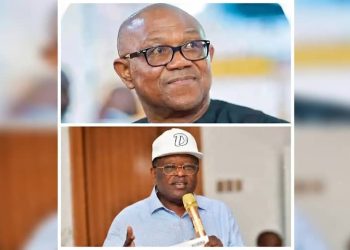


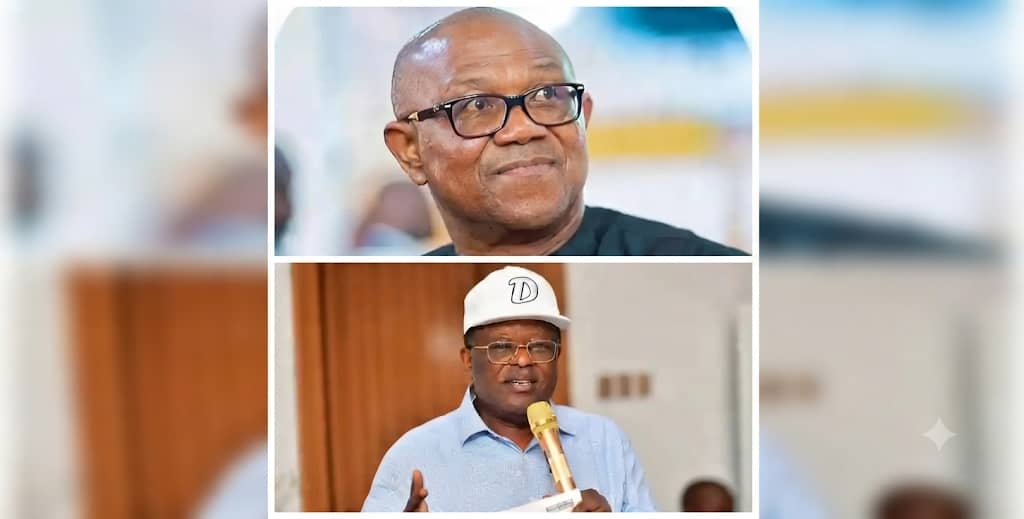
In the dynamic arena of Nigerian politics, where narratives often sway public opinion, a recent challenge from the Honourable Minister of Works, Senator Engr. David Umahi, to former Anambra State Governor, Mr. Peter Obi, sought to anchor discourse in verifiable records of service rather than rhetoric.
Umahi extended an invitation for a public debate, not on personalities or party lines, but on governance, leadership, and tangible results.
This proposed conversation, anticipated by many Nigerians as a potentially consequential examination of public service, was ultimately declined by Mr. Obi.
Mr. Obi cited his current status as a presidential candidate, contrasting it with Senator Umahi’s position.
However, the essence of Umahi’s challenge transcended electoral status;
it was a call for accountability, an opportunity for two former governors to present their administrative legacies and allow the public to discern whose leadership yielded greater impact.
The underlying premise was clear: if governance is fundamentally measured by performance, then political ambition should not preclude an honest comparison of records.
Senator Umahi’s camp posits that his public service career offers a breadth and depth rarely matched.
Before his foray into public office, Umahi established a successful private
sector career.
His subsequent roles include State Chairman of a ruling political party, Deputy Governor, Governor, Chairman of the South East Governors’ Forum, Co-Chairman of the Southern Governors’ Forum, Senator of the Federal Republic of Nigeria, and currently, the Honourable Minister of Works.
In this latest capacity, he oversees some of Nigeria’s most ambitious federal road infrastructure programs, including transformative projects across the nation.
This extensive record stands in contrast to Mr. Peter Obi’s public service experience, which, according to Umahi’s supporters, primarily centers on his tenure as Governor of.Anambra State.
Beyond this, Obi has not held other executive or legislative public offices
such as party chairman, minister, or senator.
Umahi’s journey, marked by elections, public scrutiny, and increasing national responsibilities, has consistently tested his leadership at every stage.
As Governor of Ebonyi State, Senator Umahi is credited with unprecedented transformation of the state’s physical infrastructure.
His administration delivered extensive
concrete road networks, multiple flyovers, bridges, urban renewal projects, and public institutions that remain visible today.
Landmark projects include the David Umahi Federal University of Health Sciences, the Chuba Okadigbo International Airport, the Ecumenical
Centre, and 23 flyovers, among others. These are projects that are physically verifiable and independently assessable.
Currently, as Minister of Works, Senator Umahi is spearheading significant infrastructure projects under President Bola Ahmed Tinubu’s Renewed Hope Agenda, such as the LagosCalabar Coastal Highway and the Sokoto-Badagry Super Highway.
These are presented not as mere campaign promises but as ongoing, visible projects across Nigeria.
Conversely, Mr. Obi has frequently highlighted the fiscal savings accumulated during his governorship as his primary achievement.
While fiscal responsibility is crucial, Umahi’s argument suggests that Nigerians are also entitled to evaluate the physical, institutional, and developmental legacies left by administrations.
The narrative from Umahi’s camp
questions whether merely accumulating savings, potentially at the expense of completing meaningful, life-impacting projects or leaving contractors unpaid, constitutes a complete measure of achievement.
They contend that leadership is ultimately defined by tangible
improvements in the lives of the populace.
Further scrutiny from Umahi’s perspective points to Mr. Obi’s governance of Anambra State
for nearly his entire eight-year tenure without democratically elected local government chairmen, relying instead on caretaker committees until a few months before leaving office.
This, Umahi’s team argues, underscores the importance of a holistic assessment of governance.
Senator Umahi’s proposal for a debate was thus not about personal attacks or political.affiliations but about verifiable outcomes: roads, bridges, hospitals, schools, public institutions, urban renewal, economic development, and the lasting impact of governance.
The statement concludes that one cannot credibly aspire to lead a nation as complex as Nigeria without a demonstrable record of performance, and that Nigerians deserve the opportunity to evaluate these records.
Senator Umahi remains ready for such a debate, convinced that leadership’s true measure lies in the enduring value created for the people.