

When the lights go out across Nigeria, the public reaction is swift and familiar: blame the grid.
The prevailing narrative is that the country has built a robust generation capacity— often cited as over 15,500 megawatts (MW)—but that the national transmission network is too weak to carry the load.
In this version of events, the power is there, but the wires are failing, leaving millions stranded in the dark.
However, an independent look at the audited data from the Nigerian Electricity Regulatory Commission (NERC) reveals a different reality.
The transmission network is not the
bottleneck. The real crisis is happening long before the power ever reaches the grid.
The Myth of the 4,500MW Bottleneck
The most persistent claim in the sector is that the grid is capped at 4,500MW, meaning thousands of megawatts of generated power are wasted daily due to “grid unreliability.”
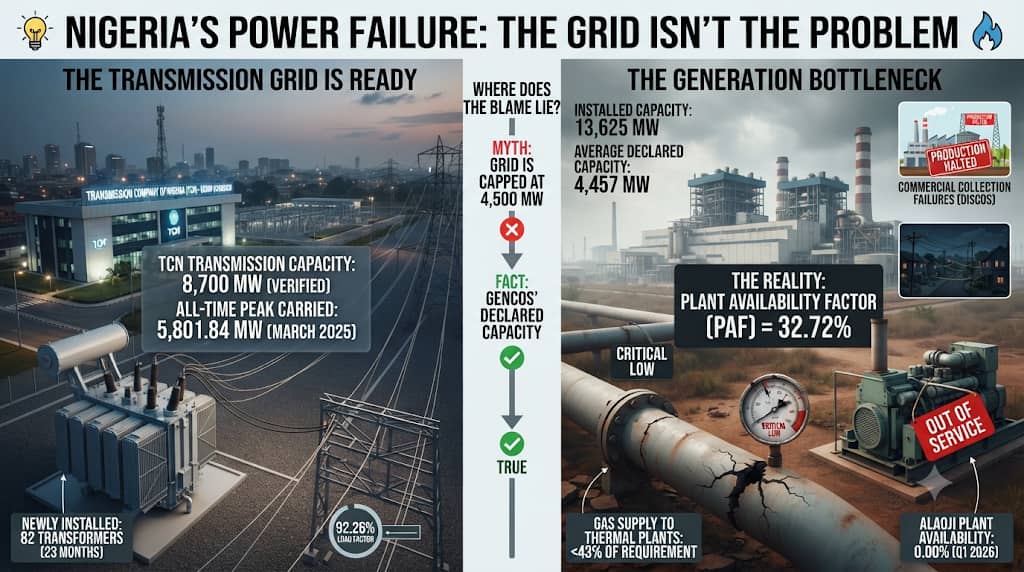
But the 4,500MW figure is not a transmission limit. According to NERC’s First Quarter 2026 Report, it is simply the average capacity that Generation Companies (GenCos) actually declared available to the market.
Furthermore, the total installed capacity across the 28 plants connected to the grid is 13,625MW—not the 15,500MW often touted.
Before anyone can claim the grid is failing to carry the load, the reality of how much power is actually being generated must be addressed.
The Grid is Ready and Waiting
Contrary to the image of a fragile network, the Transmission Company of Nigeria (TCN) has made massive strides in fortifying the grid.
The company’s verified transmission capacity currently stands at 8,700MW—almost double the claimed “4,500MW ceiling.”
This isn’t just theoretical capacity. In March 2025, the grid carried an all-time peak of 5,801.84MW in a single day, delivering a record volume of energy.
Over a 23-month period, TCN commissioned 82 new power transformers and upgraded numerous transmission lines.
As recently as April 2026, new 330kV lines were added to the Benin corridor, unlocking the ability to move up to 1.5 gigawatts (GW) of power from specific plants. The wires are ready, waiting for the power that isn’t coming.
The Real Breakdown: At the Plant Gate
If the grid can carry 8,700MW and the plants are only declaring 4,457MW available, where is the real failure? It turns out to be on the generation side.
NERC’s data reveals a Plant Availability Factor (PAF) of just 32.72% for the first quarter of 2026. This means over two- thirds of the installed capacity was completely unavailable for dispatch.
Some major plants, like Alaoji, recorded a 0.00% availability rate for the entire
quarter. Others operated at a mere fraction of their capacity.
This isn’t a transmission failure; it is a severe fuel supply and mechanical breakdown crisis.
In fact, representatives from the Association of Power Generation Companies (APGC) have admitted that gas supply to thermal plants has plummeted to under 43% of the daily
requirement.
Furthermore, when a plant is available and ready to generate, it gets dispatched almost entirely.
The grid operated at a 92.26% load factor in Q1 2026, meaning only about 345MW of available power went unused on average—far less than the 2,500MW to 4,000MW claimed to be wasted daily. Five plants even hit a literal 100% dispatch rate.
Shifting the Blame
When a blackout occurs, the immediate reaction is often to blame the “grid.” However, NERC’s findings show that major system collapses are usually tied to generation issues— specifically, a lack of reactive power to support voltage margins, which is managed by the system operator and generation companies.
While TCN admits responsibility for localized asset failures, like a recent busbar separation at Sapele, these are distinct events rather than a systemic grid collapse.
Even the massive financial shortfalls faced by generation companies are being misattributed. The ₦2.28 trillion capacity payment loss is less about the inability to evacuate power and more about commercial collection failures.
Under the current system, electricity distribution companies (DisCos) must pay for available capacity whether they
take it or not. Yet, DisCos recorded massive losses of 37.44% and failed to remit ₦24.95 billion to the market operator in just one quarter.
The Path Forward
TCN does not deny that the Nigerian electricity supply industry is under severe strain. Outages devastate businesses and citizens, and the grid requires constant investment.
But shifting the blame to transmission infrastructure distracts from the actual, urgent problems: chronic gas shortages, falling mechanical availability at power plants, and severe revenue collection failures by distribution companies.
Nigeria’s power problem is real, and it is devastating. But as long as the conversation remains focused on a broken grid that doesn’t exist, the actual bottlenecks—fuel, plant maintenance, and commercial failures—will continue to keep the country in the dark.