


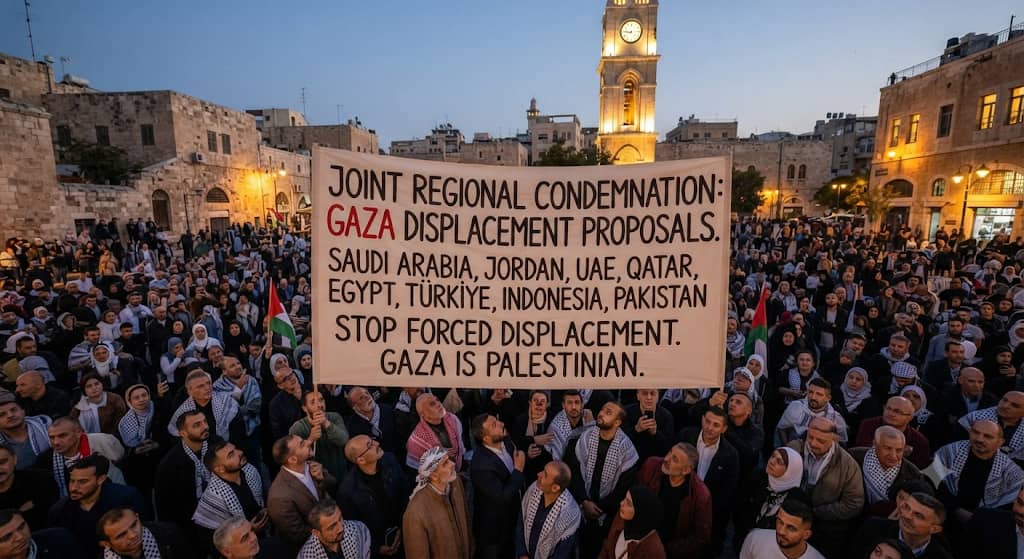
Eight governments have jointly condemned recent remarks by Israel’s national security and defense ministers concerning the possible departure of Palestinians from the Gaza
Strip.
The statement, issued by the foreign ministers of Saudi Arabia, Jordan, the United Arab Emirates, Qatar, Egypt, Türkiye, Indonesia and Pakistan, warns that turning such proposals into policy or practical measures could amount to forced displacement and damage efforts to end the Gaza conflict.
The governments said Gaza is an integral part of the Occupied Palestinian Territory and called for the preservation of Palestinian territorial unity between Gaza and the West Bank, including East Jerusalem.
They reiterated support for a two-state settlement based on the lines of 4 June 1967, with East Jerusalem as the capital of a future Palestinian state.
The statement is a significant diplomatic intervention, but it does not establish that a finalized Israeli government policy to forcibly expel Gaza’s population exists.
Israeli ministers have described their proposals as facilitating voluntary emigration, while the United States has said it knows of no plan to remove Palestinians from Gaza against their
will.
The central dispute is therefore both legal and factual: whether an apparently
voluntary departure could remain genuinely voluntary under wartime and humanitarian conditions, and whether the proposals represent official state policy or political campaigning by individual ministers.
What the statement says
The joint statement strongly condemns comments by National Security Minister Itamar BenGvir and Defense Minister Israel Katz.
It says their proposals include plans or mechanisms aimed at forcibly removing Palestinians from their land, describes those proposals as inconsistent with international law, including international humanitarian law.
The ministers reject displacement of Palestinians either inside or outside the Occupied Palestinian Territory “under any pretext or justification.”
They also urge the international community, particularly the United Nations Security Council, to oppose attempts to impose a new demographic or geographic reality in the territory.
The document links its objection to the United States President Donald Trump’s Comprehensive Plan to End the Gaza Conflict, which the eight governments say contains an unequivocal rejection of forced displacement.
A related August statement by the same governments called for implementation of a Gaza road map involving disarmament, an Israeli withdrawal, an international stabilization force, transitional administration and reconstruction.
The statement does not announce sanctions or other immediate measures. Its practical demands are diplomatic: international scrutiny, Security Council action and continued support for Palestinians remaining on their land.
The proposals that triggered the response
Ben-Gvir has presented what he calls a plan for “voluntary emigration” from Gaza. Reporting by The Guardian said the plan would seek the departure of about 250,000 Palestinians in its first year and the remainder of Gaza’s roughly two million residents over the following six years.
Ben-Gvir reportedly said he wanted a government ministry dedicated to the policy and described the proposal as realistic and concrete.
Katz has separately said Israel was prepared to facilitate Palestinian departures by land, sea and air.
According to reporting cited by AFP, Katz said the issue remained under discussion and had been frozen by Trump, while also asserting—without publicly cited evidence—that a large majority of Gaza residents wanted to leave.
The available reporting does not show that Israel has adopted a completed operational plan, secured destination countries for a mass movement, or begun a government administered transfer of Gaza’s population.
The proposals have instead emerged through public statements by senior ministers during a politically charged period ahead of Israel’s October elections.
The Israeli and American response
The strongest public U.S. response came from Ambassador to Israel Mike Huckabee, who said on 5 September that there was categorically no Israeli plan to force Palestinians out of Gaza.
He said people should have the right to leave if they wished, but denied that Israel or the United States supported forced displacement.
That position draws a distinction between voluntary movement and forcible transfer.
Israel’s ministers have used the language of choice and emigration, while critics argue that choice cannot be considered free if civilians face destruction, deprivation, insecurity, loss of housing and no realistic prospect of safe return.
The distinction matters because a government can exert coercion without physically ordering every individual onto a vehicle.
Threats, military pressure, deprivation or the creation of conditions in which remaining is effectively impossible can be relevant to assessing whether a departure was voluntary.
Whether that threshold is met would require evidence about the conditions, intent, implementation and freedom of choice surrounding any actual transfer.
No evidence cited in the sources reviewed shows that a mass transfer under the ministers’ proposals has begun.
The available facts instead show a sharp dispute over the direction of policy and the implications of statements made by senior officials.
What international law says
Article 49 of the Fourth Geneva Convention prohibits individual or mass forcible transfers and deportations of protected persons from occupied territory, regardless of motive.
It permits limited evacuations only when civilian security or imperative military reasons require them, with safeguards including proper accommodation, family unity and return when hostilities end.
The Rome Statute of the International Criminal Court defines deportation or forcible transfer as the forced displacement of people from an area where they are lawfully present through expulsion or other coercive acts, without grounds permitted under international law.
The statute lists deportation or forcible transfer as a crime against humanity when committed as part of a widespread or systematic attack directed against a civilian population.
These provisions do not mean that every person who leaves an active conflict zone has been forcibly transferred.
International law recognizes narrow circumstances for temporary evacuation and protects the possibility of genuinely voluntary movement.
The legal question is whether people have meaningful freedom of choice, whether coercion is present, whether the movement is temporary or permanent, and whether the stated security justification is genuine and lawful.
Why Gaza’s territorial status is central
The eight governments’ statement emphasizes that Gaza and the West Bank, including East Jerusalem, form a single Palestinian territorial unit.
Their position rejects any plan that
would remove Gaza’s population, permanently alter its demographic composition or separate the territory from the broader framework of Palestinian statehood.
The governments’ preferred diplomatic outcome is an independent Palestinian state along the 1967 lines with East Jerusalem as its capital.
That position is also reflected in the
August statement published by Türkiye’s Foreign Ministry and reproduced by the United Nations as a non-UN document.
The earlier statement supports Gaza-West Bank unity, Palestinian self-determination and implementation of the U.S.-backed road map.
Israel has not accepted all elements of that framework, and the future governance, security and reconstruction of Gaza remain contested.
The disagreement over population movement is therefore part of a wider argument over who will govern Gaza, whether Israel will retain control over territory, the role of Hamas, the status of Palestinian statehood and the conditions for reconstruction.
Political and humanitarian stakes
The dispute comes after a war that has already displaced most of Gaza’s population internally. The scale of existing displacement makes any proposal for external relocation
especially sensitive.
A plan presented as voluntary could still face serious practical questions: where people would go, how consent would be verified, whether families could remain together, whether they could return, and who would guarantee their safety and
legal status.
For Israel’s far-right ministers, emigration proposals appeal to voters who favor a permanent reduction of the Palestinian population in Gaza and the expansion of Israeli control.
For the Arab and Muslim governments that signed the statement, the same
proposals are viewed as a threat to Palestinian national rights and to the principle that the population of occupied territory cannot be removed for political or demographic purposes.
For Washington, the issue presents a policy tension. The ambassador’s rejection of forced displacement is consistent with the regional statement’s reference to Trump’s peace plan.
At the same time, the administration’s stated openness to Palestinians leaving
voluntarily leaves unresolved how genuine consent would be protected under conditions of war and occupation.
Assessment
The joint statement is best understood as a coordinated diplomatic warning rather than proof that a mass expulsion has already been ordered.
It accurately reflects the signatories’ rejection of any policy that would empty Gaza or permanently alter demographic character. It also places the issue within established international-law rules
on forcible transfer.
The countervailing facts are that the Israeli proposals have been publicly framed as voluntary, no completed implementation plan has been documented in the sources reviewed, and the U.S. ambassador has explicitly denied an Israeli plan to remove
Palestinians against their will.
Those denials do not resolve the legal or humanitarian concerns, but they are material to a balanced account.
The next decisive facts would be whether Israel’s cabinet formally adopts a relocation policy, whether funds and institutions are created to implement it, whether receiving countries agree to accept Palestinians, whether residents are offered a safe and realistic alternative to remaining, and whether any movement is temporary with a guaranteed right of return.
Until those questions are answered, the dispute remains a serious policy and
legal confrontation over proposals that have been announced publicly but not shown to have been implemented as a mass transfer.