

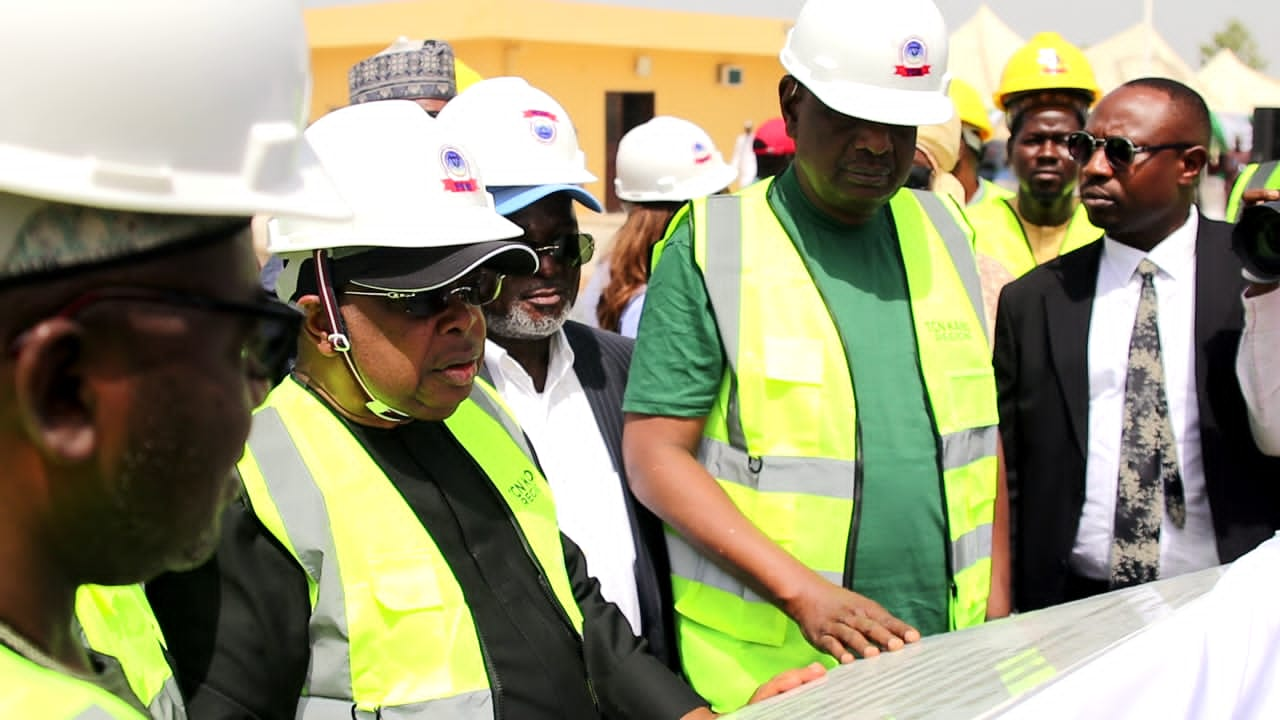
The Federal Government has commissioned upgraded transmission facilities at four substations in Kano State, a move expected to improve electricity supply to homes, businesses and industries across Kano metropolis and neighbouring communities.

The projects at Walalambe, Kumbotso, Dakata and Dan-Agundi substations were commissioned on Thursday by the Minister of Power, Joseph Tegbe, in partnership with the Kano State Government and the Transmission Company of Nigeria (TCN).
The upgrades are designed to increase electricity-wheeling capacity, relieve pressure on existing transmission infrastructure and provide alternative supply routes across the network.
At Walalambe, the government installed two 40 MVA, 132/33 kV transformers, providing a combined capacity of 80 MVA—equivalent to approximately 64 megawatts.
The project is expected to strengthen power supply to the Tokarawa Industrial Area, Eastern Bypass, Maiduguri Road, Hadejia Road and adjoining communities.
The facility also includes six outgoing 33 kV feeders and alternative supply arrangements for the Mariri, Jogana, Farm Centre and Zaria Road injection substations.
Tegbe said the Walalambe project would also connect the Lee Group of Companies to the national grid through a dedicated 33 kV feeder. The company, he noted, had operated off-grid for more than 30 years.
“Reliable electricity is essential for productive businesses to sustain operations, expand and create jobs,” the minister said.
At Kumbotso, a 150 MVA transformer was replaced with a 300 MVA, 330/132/33 kV unit, while an existing 40 MVA transformer was upgraded to a 100 MVA, 132/33 kV transformer.
The intervention increased the substation’s upstream transformation capacity from 600 MVA to 750 MVA, representing a 25 per cent increase. Downstream capacity also rose from 220 MVA to 280 MVA, an increase of approximately 27.3 per cent.
According to the minister, the Kumbotso upgrade has the potential to benefit at least 220,000 households and provide a stronger electricity base for manufacturing, commerce, agricultural processing and small businesses.
At Dakata, the installation of an additional 100 MVA transformer increased the substation’s capacity from 150 MVA to 250 MVA—an increase of 66.7 per cent.
The project is expected to support the Dakata Industrial Complex and surrounding communities, with an estimated 70,000 households set to benefit.
The project also included the replacement of analogue control and protection panels with digital systems, improving equipment monitoring, fault detection and maintenance.
At Dan-Agundi, a new 100 MVA transformer restored and expanded capacity after a fire damaged two of the substation’s three original transformers. Available capacity rose from 60 MVA to 160 MVA, equivalent to an increase from 48MW to 128MW.
The Dan-Agundi upgrade is expected to improve supply to the Emir’s Palace, Kano ancient town, homes, businesses and public institutions, potentially benefiting about 80,330 people.
TCN Managing Director Sule Ahmed Abdulaziz described the projects as significant investments in Kano’s transmission network, saying they would improve the delivery of bulk electricity to distribution companies for onward supply to consumers.
He said the interventions would give operators greater flexibility, strengthen network reliability and support rising electricity demand across Kano.
The Walalambe, Kumbotso, Dakata and Dan-Agundi projects were financed or supported by the World Bank and executed by TCN in collaboration with the Federal Ministry of Power and project contractors.
Tegbe urged host communities to protect the facilities from vandalism, warning that damage to electricity infrastructure could disrupt businesses, cause lost working hours and affect household activities.
“Public infrastructure serves all of us, and its protection requires the vigilance of all of us,” he said.