

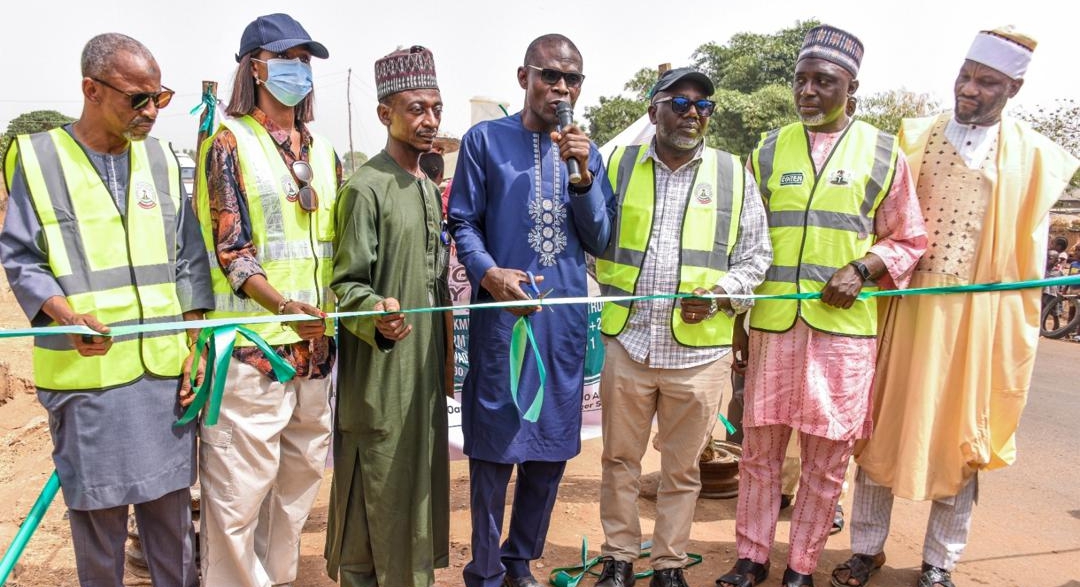
The Federal Government has officially commissioned the completed critically failed sections of the Gwada–Shiroro Road Section 1 in Niger State, alongside Emergency Repairs of Embankment Washouts and the Construction of a 2-Cell Box Culvert on the same alignment.
The projects are part of the 260 Emergency/Special Intervention Projects carried out, nationwide, by the Renewed Hope Administration of His Excellency, President Bola Ahmed Tinubu, GCFR in order to salvage the nation’s road network.
In a statement released by the Works Ministry stated that the road signals a significant milestone in restoring connectivity, safety, and economic activities in the affected areas.

Speaking at the commissioning ceremony, which forms an integral component of a National Media Tour, the Federal Controller of Works (FCW) in Niger State, Engineer Eyitayo Aluko, welcomed members of the Council for the Regulation of Engineering in Nigeria (COREN), Nigerian Society of Engineers (NSE), Civil Society Organisations (CSOs), community leaders, residents, members of the press, and other stakeholders.
He informed the gathering that he represents the Honourable Minister of Works, His Excellency, Sen. (Engr.) David Umahi in the State, describing the intervention as “two projects in one.”
Engineer Aluko explained that the ceremony site was previously a critical failure point on the road, where a one-cell pipe culvert had collapsed due to its flawed design and overburdenedness.  The collapse of the culvert severely disrupted the movement of people, goods, and services, moving in and out of Gwada town into a major challenge for commuters and residents.
“Before our intervention, movement through Gwada was a nightmare. The pipe cover here was inadequate and eventually collapsed. We had to intervene urgently,” said the Controller.
According to him, the Ministry improved the infrastructure by replacing the collapsed one-cell pipe culvert with a two-cell box culvert measuring 2.0m x 2.0m, significantly enhancing water flow capacity and structural stability, and durability.  He noted that the project has since been completed and traffic has fully resumed.
In addition to the construction of the culvert, the FCW disclosed that several failed sections of the Gwada–Shiroro Road were rehabilitated to improve travel time, road safety and reduce wear and tear of vehicles.
The scope of work included embankment washout remediation, construction of the box culvert, laying of stone base, granular course, and asphalt surfacing.
The projects were awarded to Messrs Wise Spin Limited and Messrs High Dee Construction Limited, and have been substantially completed and put to use.
Also speaking at the occasion, the Representative of COREN, Engineer Dr. Bala Saliu, who is also the Chairman of the Engineering Regulation Committee of COREN, Niger State Chapter, commended the intervention, describing it as professional, timely, and impactful.
“This intervention speaks for itself. The project has been put to use, and you can see the community’s happiness. Despite how remote this area is, its economic and social importance cannot be overemphasised,” he further noted.He added that similar critical areas exist across Niger State and expressed confidence that the Federal Government would continue to intervene to ease the challenges faced by commuters and residents.
The Secretary General, NSE, Minna Branch, Engineer Abubakar Kawu also praised the delivery of the two projects. He described the Gwada–Shiroro Road as a strategic route that required urgent attention.
“This timely intervention has significantly reduced road accidents and increased socioeconomic activities. This road leads to the Shiroro Hydroelectric Power Station, a major contributor to power generation in Nigeria,” he recalled.
He further stated that the road rehabilitation would positively impact the power and energy sectors, while affirming that the project meets required engineering standards and professional regulations.The Mai Anguwa (Ward Head) of the immediate benefiting community, Alhaji Alhassan Zarumi, expressed deep appreciation to the Federal Government for extending the nationwide road intervention initiative to his people.
He described the road as a former “death trap” and emphasised its importance as a link to the Shiroro Power Station and other surrounding towns and villages.
“If this place were not repaired, I wonder if we would be passing here today. Now, we can move freely and safely. We thank the Federal Government, the Engineers, and the contractors for a job well done,” he said.
In his remarks before performing the ribbon-cutting ceremony, the Vice Chairman of the Nigeria Union of Journalists (NUJ), Niger State Chapter, Comrade Uriah Tsado Gana, thanked President Tinubu and the Minister of Works for ensuring the successful completion of the project.The Team visited ongoing works on the Bida–Lemu–Wushishi–Zungeru Road, Phase 1, which commences from Yesso Junction in Bida Town to Yazhigi.
Giving an update on the progress of work, the FCW revealed that the road shoulders are being constructed with 200mm thick concrete, and that approximately 16 kilometers of asphaltic binder course have been completed out of the 29.5-kilometer project length – representing about 40 percent completion.
He added that the contractor is actively on site and is expected to complete the binder course within the next two months, after which the asphaltic wearing course will be applied.
The Project Manager of Gerawa Global Engineering Limited, Engineer Adam S. Adam, corroborated the update and highlighted initial challenges faced during project execution, including security concerns and attempted kidnappings. He disclosed that with the support of the Ministry, community leaders, and security stakeholders, these issues have been fully resolved and work is ongoing. “We are now working day and night. The problems have been resolved completely, and the quality of work speaks for itself,” he stated.
Also present was the NSE official, Engineer Aliyu, who attested to the project’s compliance with engineering standards and professional ethics, giving kudos to the company handling the work.
The Ministry continues to demonstrate its commitment to enhancing national road infrastructure with the execution of major highway projects across Niger State, aimed at improving connectivity between the Northern and Southern parts of the country, guaranteeing safety, and enabling socio-economic development.
Another strategic project underway in the State is the Jebba–Mokwa–Bokani Junction Road (Section II), which forms part of the Trans-Sahara Road Network, linking Lagos in the South West geopolitical zone to Northern Nigeria through Kwara State.The route is a vital artery that carries heavy volumes of articulated traffic on a daily basis. And the project is redesigned as a Dual Carriageway with a pavement structure consisting of 7.3-metre-wide asphaltic concrete carriageways on each side, complemented by 3.0m and 2.75m wide surface-dressed shoulders.
The pavement layers include a 200mm thick sub-base, 275mm stone base, and two asphaltic concrete layers of 75mm binder course and 50mm wearing course.
The road section commences at the northern end of the River Niger Bridge in Jebba and terminates at the Bokani Junction, with a total length of 46.0 kilometres.
It involves the construction of an additional carriageway that intersects the existing one at various alignments, traversing farmlands, settlements, and diverse terrains, including hills, valleys, streams, and ridges. Interchanges will also be constructed at major intersections to facilitate free-traffic flow. The project is being executed by Messrs CGC (Nigeria) Limited.
In addition, the Federal Government is presently rehabilitating the Minna– Zungeru–Tegina Road (Section I), also a major transportation link connecting Northern and Southern Nigeria and a vital route for the movement of industrial and agricultural goods.
The road has suffered severe deterioration over the years, characterized by deep potholes, failed carriageway sections, frequent accidents, and prolonged travel time.
Section I of the project stretches 94.987 kilometres from Minna to Tegina, comprising a 10.90km dualised urban section within Minna town and an 84.087-kilometre single carriageway through inter-urban and non-urban areas.
The scope of work includes the rehabilitation of the single-carriageway sections and overlay of the existing dual carriageway, which remains in fair condition. The road traverses about eighteen communities, including Maikonlele, Kuyi, Gusase, Zungeru, Akusu, Garum Gabas, and Gatako, terminating at Tegina.
The existing infrastructure includes several pipe and box culverts, as well as seven bridges, many of which are slated for repair and maintenance due to siltation and structural degradation.
The project is being handled by Messrs Develevo (Nigeria) Limited in partnership with Messrs HMF Construction Limited.
Similarly, Section II of the Minna–Zungeru–Tegina Road, covering the Tegina–Kontagora axis, is also receiving intervention.
This section is a single carriageway extending from Tegina to Kontagora, with its zero chainage at a Y-Junction off the Mokwa–Makera–Kaduna State border road and terminating at the Kontagora roundabout. The road passes through several semi-rural communities, including Gimi, Babban Gona, Mariga, Bobi, Beri, Tungan Ahmadu, Tadali, and Machanga.
The existing carriageway, though originally constructed to standard specifications, has suffered erosion of shoulders and deterioration of pavement in several sections.
The project includes the replacement of substandard culverts, desilting of existing drainage structures, and maintenance works on six bridges along the corridor to ensure structural integrity and improved hydraulic performance. The contractor handling this section is Glamor Engineering Nigeria Limited.
Upon completion, these projects are expected to significantly reduce road accidents, shorten travel time, improve the movement of goods, both industrial and agricultural, and strengthen economic activities across Niger State and its neighbours.
The Administration remains committed to delivering quality road infrastructure that enablers of national growth and improves the quality of life of Nigerians. Road users, members of the benefiting communities along the corridors visited, and different stakeholders were full of praises to Mr. President’s infrastructure renaissance.