

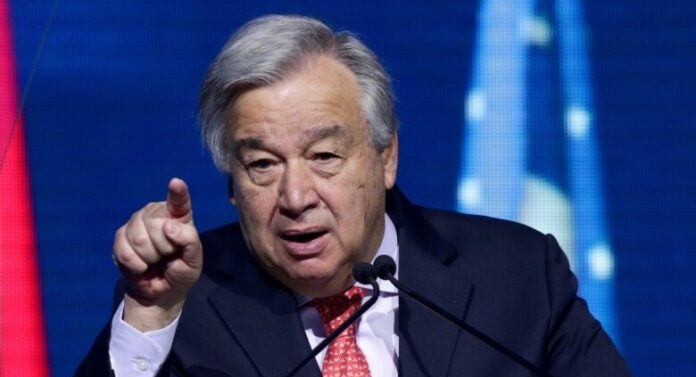
Following weeks of escalating destruction and distress in the Middle East, the United Nations via Secretary- General, Antonio Guterres emphasized that a military solution to the ongoing conflict is unattainable.
Spokesperson for the Secretary-General, Stéphane Dujarric, delivered a poignant statement underscoring the critical need for sustained diplomatic engagement and adherence to a ceasefire.
While drawn attention to the far- reaching global economic consequences of the regional instability.

The statement highlighted recent talks hosted by Pakistan between the United States and the Islamic Republic of Iran in Islamabad.
Despite the absence of an immediate agreement, these discussions were characterize as “positive and meaningful step toward renewed dialogue,” reflecting the seriousness of both parties’ engagement.
Guterres urged for these constructive talks to continue, recognizing that a deeply rooted agreement cannot be achieved overnight. A central plea from the Secretary-General was the absolute necessity of preserving the current ceasefire and ensuring that all violations cease.
He extended gratitude to the mediating efforts of Pakistan, Saudi Arabia, Egypt, and Türkiye, calling upon international community to lend its full support to these crucial endeavors.
Furthermore, the UN Chief stressed the imperative for all parties to the conflict to respect freedom of navigation, particularly in the strategically vital Strait of Hormuz, in accordance with international law.
The humanitarian plight of approximately 20,000 seafarers, currently stranded on ships and facing daily hardships due to the conflict, was brought to the forefront.  The disruptions to maritime trade through the Strait of Hormuz have already triggered significant global economic fragility and insecurity across various sectors, extending well beyond the immediate region.
Of particular concern is the disruption of fertilizer and its inputs, exacerbates food insecurity for millions worldwide which added to the rising cost of living, compounded by impacts on fuel, transportation, and supply chains.
In response to these challenges, Jorge Moreira da Silva, Executive Director of the UN Office for Project Services (UNOPS), in collaboration with UN Trade and the Development (UNCTAD), the International Maritime Organization (IMO), and the International Chamber of Commerce, is actively working to design operationalize a mechanism for the Strait of Hormuz, initially announced on March 27.
Meanwhile, Jean Arnault, the Secretary-General’s Personal Envoy, remains deeply involved in the region, engaging closely with key stakeholders and continuing outreach efforts aimed at fostering a comprehensive and durable agreement for peace and stability.