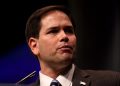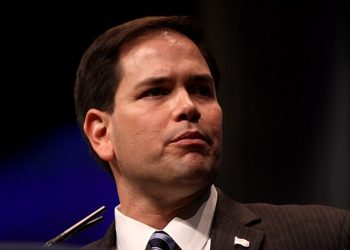


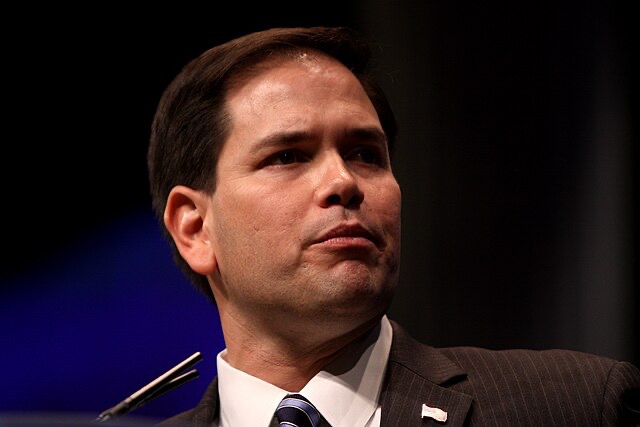
The Secretary of State, Marco Rubio declared on Friday that United States military operations against Iran are “on or ahead of schedule,” predicting the war will conclude within weeks as the Biden- Trump transition-era foreign policy shifts into a high-intensity phase.
Speaking to reporters at Le Bourget Airport following a series of G7 meetings, Rubio outlined a vision of a “weaker” Iran and issued a stern warning against any attempt by Tehran to “toll” international waterways.
The Final Blow to Tehran
The Secretary was explicit about the mission’s scope, which he described as a systematic dismantling of Iran’s strategic military assets.

The primary objectives, according to Rubio, remain the total destruction of Iran’s navy and air force, alongside the elimination of factories producing the missiles and drones that have long fueled regional instability.
“We are going to dramatically reduce the number of missile launchers so that they cannot hide behind these things to build a nuclear weapon and threaten the world,” Rubio stated. “We expect to conclude it… in a matter of weeks, not months.”
Despite questions regarding the deployment of ground troops, Rubio maintained that the US could achieve its goals through air and sea power alone.  However, he noted that recent troop movements were intended to provide the President with “maximum optionality” for
unforeseen contingencies.
A New Crisis in the Strait?
Even as the current kinetic phase nears its end, Rubio warned of a looming diplomatic and economic showdown in the Strait of Hormuz.
He claimed that elements within the “radical clerical regime” are considering a permanent tolling system for the vital waterway—a move he labeled “illegal” and “unacceptable.” Rubio called for a multinational coalition to secure Strait post-conflict, suggesting that while the U.S. is prepared to assist, the countries most dependent on the passage— particularly those in Asia and Europe—must take the lead.
“The world better step up,” he warned, noting that insurance for tankers would be impossible without such security guarantees.
Diplomatic Friction and “America First”
The Secretary’s remarks also touched on the ongoing war in Ukraine, where he pushed back against claims that the U.S. had pressured President Volodymyr Zelenskyy to cede territory in exchange for security guarantees. Rubio characterized such reports as “a lie,” insisting that any decision regarding the Donbas remains solely with Kyiv.
However, he struck a pragmatic, “America First” tone regarding military aid. While denying that weapons have yet been diverted from Ukraine to the Middle East, he made it clear that U.S. national interests would dictate future allocations.
“If the United States has a military
need… we’re always going to come first when it comes to our stuff,” he said.
Global Flashpoints: Cuba and the West Bank
In a characteristically blunt exchange, Rubio addressed the deteriorating situation in Cuba, dismissing reports of a naval blockade and blaming the island’s frequent blackouts on “incompetent communists” and aging infrastructure. He reaffirmed his long-standing support for regime change, arguing that the economic prosperity is impossible under the current system.
Closer to the current conflict zone, Rubio expressed “concern” over settler violence against Palestinians in the West Bank, noting that such actions also targeted Israeli security forces.
He indicated that the U.S. expects the Israeli government to suppress “street thugs” and maintain the status quo.
As Rubio departed the freezing tarmac in Paris, his message was clear: the United States is moving with speed to reshape the Middle East, but it expects its allies to shoulder the burden of the peace that follows.