

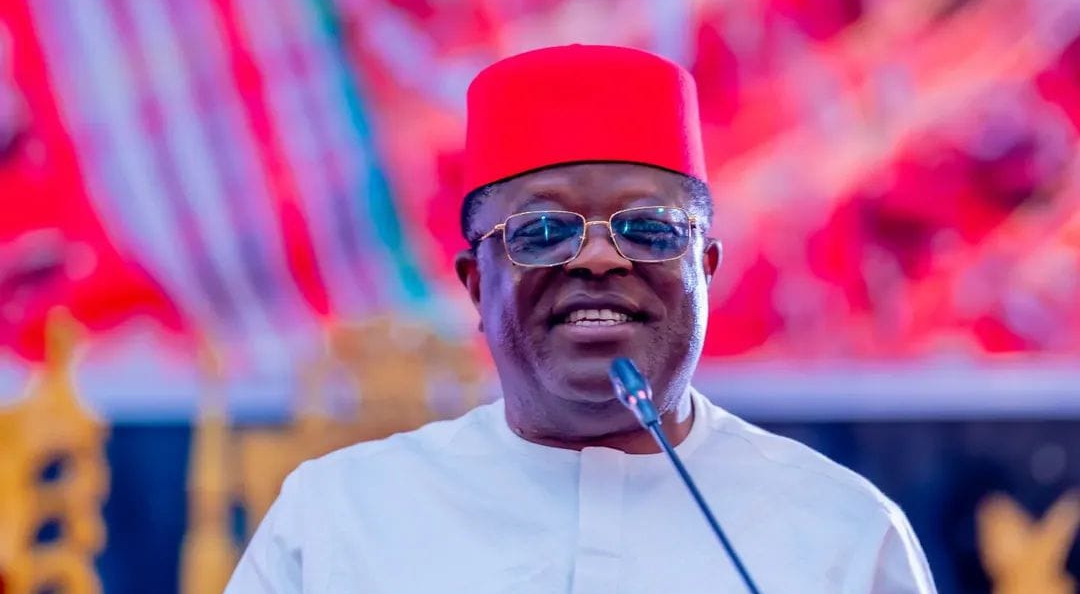
The Minister of Works, David Umahi has defended the records of President Bola Ahmed Tinubu’s administration on infrastructural development in the Southeast of Nigeria.
In a Press Briefing on Wednesday in Abuja, Umahi countered Senator Enyinnaya Abaribe’s claim of marginalisation by the current administration.
He stressed that several infrastructure projects had been either initiated, revived, or funded substantially in the Southeast by President Tinubu’s administration.

In view of this, the Minister cited some of the projects which includes the Lagos– Calabar Coastal Highway, sections of the Trans-Sahara Road passing via Ebonyi State.
Also, the Second Niger Bridge bypass, the dualisation of the Enugu–Abakaliki Road, and ongoing work on the Enugu– Onitsha and Enugu–Port Harcourt Expressways.
He also listed completed and ongoing projects such as the reconstruction and commissioning of the Atani Bridge in Enugu State, the Emene flyover, and improved travel times on major federal highways across the region. Umahi argued that the Abia State Governor, Alex Otti, who is an opposition party governor, acknowledged the enabling environment provided by the Federal government to assist him perform.
After listing some ongoing road projects in the zone, Umahi said, “All of the South East governments are supporting the president, because the president has provided inclusive governance in the country.”
Reaction to Abaribe’s suggestion that President Tinubu would not be supported in 2027, Umahi said the Senator was speaking for himself and not for the South-East. According to him, Governors and many residents of the region were grateful to the President and would support him based on performance.
He said: “Let me use the opportunity to talk about what a Senator from my zone has said, talking about the President, and he mentioned me, and that’s Senator Abaribe.
“Incidentally, he’s my in-law, and I sent him a text that I’m going to reply to him, and he said to me that he spoke as an opposition and nothing personal.“I’m also going to speak on behalf of the government as far as the issues he raised are concerned, and there will be nothing personal about it.
“First and foremost, I boasted, and I still boast that all the Southeast governors are supporting the president because the President has provided inclusive governance in the country”, he said.
Speaking on the procurement of the Lagos-Calabar Highway, Umahi said Senator Abaribe needs to know and be corrected.He said, “In the first instance, he’s a lawmaker, and he has been in the Senate for a very long time. I don’t want to ask what he has achieved for his people because I’m not part of his people.
“But if we put together what he has achieved, and he’s questioning me, then I have to question what he has achieved because by saying that I didn’t care about the procurement process, it’s an attack on my personality and integrity.
“And I think that after correcting him, he has to withdraw his statement because if he doesn’t, I will say more”, the Minister added.Umahi stressed that all statutory requirements of the project, including the Environmental and Social Impact Assessment (ESIA), were met.
He explained that there are three categories of procurement recognised by the Procurement Act, asking the Senator, Abaribe to go and study it and come back to tell Nigerians whether there was any infringement in the Lagos–Calabar coastal highway.
He said the project was openly advertised, subjected to stakeholder engagement, and certified after an internationally recognised ESIA process.The Minister stated that international financiers later adjudged the project properly packaged, of very high quality, and even undervalued.
“The project was so credible that when it was presented to foreign financial institutions, it was oversubscribed by over 100 million dollars,” Umahi said.
He used this opportunity to urge Southeast citizens to reject narratives of exclusion and embrace national unity, saying, “This country belongs to all of us. No one is a stranger. We all have equal rights.”
The Minister also defended the administration’s economic reforms, citing improvements in currency stability, inflation moderation and enhanced security operations.