

A Federal High Court in Lokoja has nullified its earlier judgment that directed the Independent National Electoral Commission (INEC) to register Nigeria Democratic Congress (NDC) as a political party.
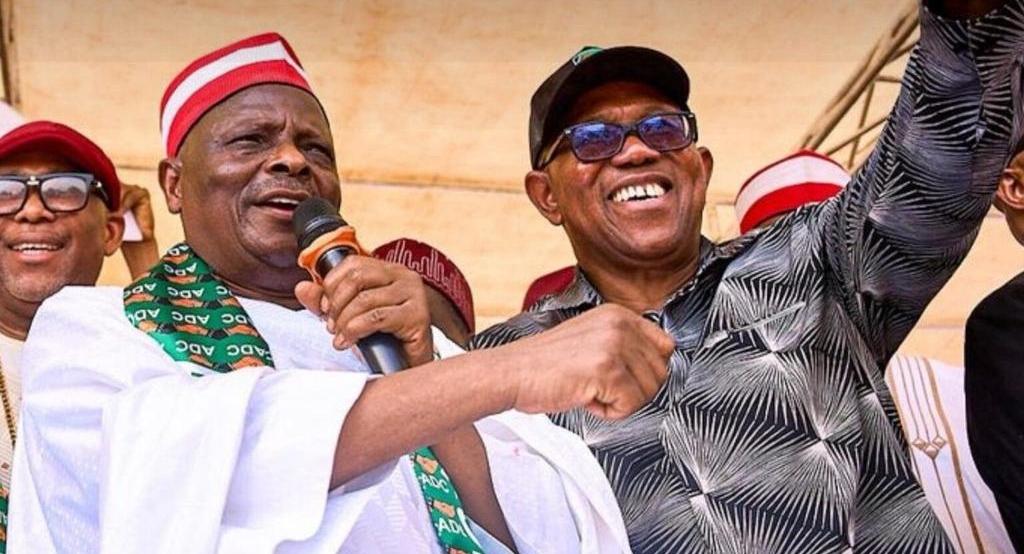
The ruling, delivered by Justice Isah Dashen on Friday, June 26, 2026, marks a significant development for the NDC, whose Presidential ticket features Peter Obi and Rabiu Kwankwaso for the upcoming 2027 general elections.
Justice Dashen’s decision to set aside the December 10, 2025, judgment was based on an application filed by the Peace Movement Party (PMP).
The PMP argued that its rights were
affected as it was not included in the initial case, despite claiming ownership of the logo used by the NDC.
The court held that the failure to join the PMP amounted to a denial of fair
hearing, rendering the previous judgment invalid.
According to C.S. Ekeocha, counsel to the Peace Movement Party PMP, the court has ordered all parties to revert to their positions before the December 10, 2025, judgment.
This implies that all actions taken by INEC based on the earlier judgment, including the recognition of the NDC and the issuance of certificate of registration, are to be withdrawn pending the final determination of the substantive suit.
Ekeocha emphasized that the main case is still ongoing, and a fresh hearing will be conducted with all relevant parties participating.
Reactions from the Nigeria Democratic Congress
Peter Obi, the presidential candidate of the NDC, expressed strong disapproval of the court’s decision, describing it as a
major blow to Nigeria’s democracy and a “setback for Nigerian democracy”.
Obi, who was informed of the ruling by his running mate, Rabiu Kwankwaso, while at Madonna University, warned that the country’s key institutions are being systematically weakened for political interests.
He stated that those destroying Nigeria’s democratic institutions will ultimately fail while further lamented the erosion of the independence of both the legislature and the judiciary, asserting that “Democracy cannot thrive where institutions lose their independence and credibility.”
He reiterated his consistent opposition to actions that weaken the democratic institutions, recalling his earlier criticism of similar developments involving the African Democratic Congress (ADC).
Obi emphasized that his political mission transcends personal ambition, focusing instead on building a functional Nigerian state founded on justice, strong institutions, the rule of law, and equal opportunity.
He urged Nigerians to set aside partisan interests and defend the nation’s democratic institutions.
In a separate statement, Senator Moses Cleopas Zuwoghe, National Chairman of the NDC, vowed to challenge the Federal High Court ruling.
He described the Lokoja court’s decision as “legally flawed” and confirmed that the party has instructed its lawyers to file an appeal.
Zuwoghe assured the public and NDC candidates for the 2027 elections that the party remains “on course” and has not been deregistered.
The NDC argued that the court lacked jurisdiction to revisit its own final judgment, as the matter had already been conclusively determined.
The party highlighted that it had become fully integrated into Nigeria’s electoral process, having registered members nationwide, conducted congresses, held party primaries, and even participated in recent bye-elections.
The NDC also noted that the Peace Movement Party was neither a registered political party nor one currently seeking registration, and that its approach through a motion rather than substantive suit or appeal was an “outright abuse of court process”.
The party accused unnamed political interests of attempting to use the judiciary to weaken opposition forces ahead of the 2027 elections, warning against efforts to shrink Nigeria’s
democratic space.
The Party who expressed confidence that the Court of Appeal would overturn the ruling, urged members, candidates, and supporters to remain calm while the legal process unfolds.