


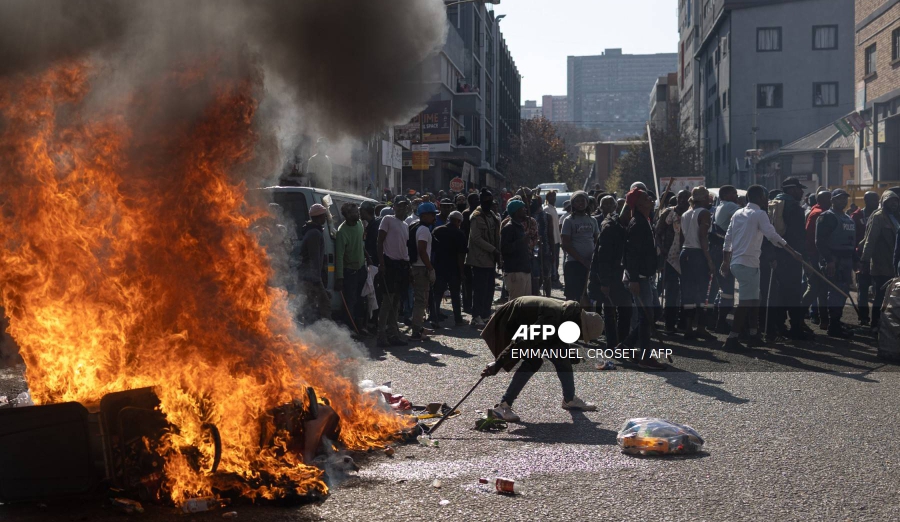
As the unauthorized June 30 “deadline” for undocumented migrants to leave South Africa arrived yesterday, the nation was marked by a complex landscape of widespread protests, sporadic violence, and a firm government response.
While thousands marched across the country, the South African government issued a formal statement commending the largely peaceful conduct of the demonstrations, reaffirming commitment to a comprehensive migration management strategy.
The Pulse of the Streets: Nationwide Marches and Tensions
Throughout the day, major cities including Johannesburg, Durban, and Cape Town saw thousands of South Africans take to the streets.
Many protesters, organized by groups such as “March and March,” carried South African flags and traditional wooden weapons, demanding stricter enforcement of immigration laws and the deportation of undocumented foreign nationals.
• Sporadic Violence: Despite the largely peaceful nature of the marches, police reported isolated incidents of looting and attempted looting in several areas.
In Tembisa, rioters clashed with police, and in Soweto, the looting of shacks belonging to foreign nationals was reported.
• Police Intervention: Law enforcement agencies were out in full force, utilizing armored vehicles and helicopters to monitor the crowds.
In Germiston, police fired rubber bullets to disperse crowds as tensions escalated, and in Benoni, tactical units were deployed following threats against officers.
• Impact on Migrants: The atmosphere of fear led many foreign nationals to stay indoors or seek refuge at consulates and repatriation centers.
Reports emerged of illegal evictions by landlords in urban centers, fearing retaliatory vandalism against their properties.
The Government’s Official Stance:
Appreciation and Accountability: In a formal statement released this evening, the South African Government expressed its appreciation to the citizens who exercised their constitutional right to protest “peacefully and responsibly.”
The govt commended community leaders, law enforcement, and civil society for their restraint and commitment to the rule of law.
However, the statement was clear on the consequences of criminality: “Those who chose to exploit the marches to commit criminal acts will face the full might of the law. Police will continue to identify, arrest and prosecute those responsible for criminal conduct”.
The government acknowledged that the concerns raised by citizens—including economic opportunities, service delivery, and border management—are genuine, deserve to be addressed systematically through lawful democratic processes.
Reaffirming the Five-Point Migration Plan
Central to the government’s response is the Comprehensive Approach for the Migration Management, as outlined by President Ramaphosa.
This five-point plan remains cornerstone of the state’s strategy to address the irregular migration:
1. Strengthening Enforcement: Rigorous application of immigration and labor laws.
2. Border Security: Enhancing the security of national borders to prevent illegal entry.
3. System Improvements: Modernizing migration management systems for better.efficiency.
4. Policy Gaps: Closing legislative and policy loopholes that allow for irregular migration.
5. Continental Cooperation: Working with other African nations to manage migration in a.coordinated manner.
Progress in Repatriation and Deportation
The government also provided updated statistics on its enforcement efforts. To date, authorities have successfully repatriated 4,286 foreign nationals and deported a further 419 in the past few days alone.
This follows a broader trend where deportations have risen by 46% over the last two financial years. As the sun sets on this pivotal day, the South African government has called for calm and
the rejection of misinformation and xenophobia.
The objective remains a South Africa
where the rule of law is respected, borders are secure, and human dignity is upheld for all.