

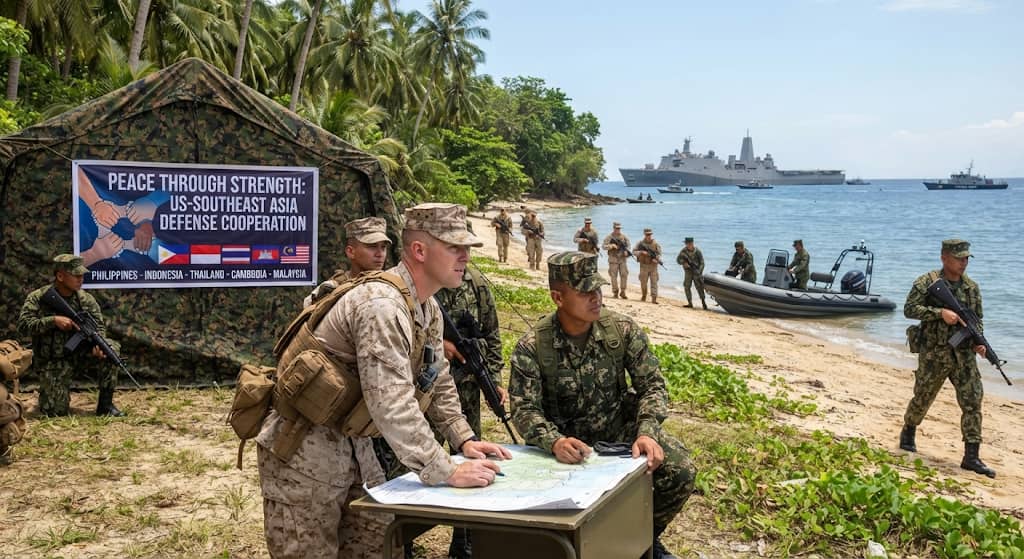
The United States has deepened defense ties across the Southeast Asia while assuring regional governments that the expanded military cooperation intended to reinforce—not erode their sovereignty, a senior U.S. defense official said on Thursday.
Speaking to reporters during a tour of the Philippines, Indonesia, Thailand and Cambodia, Under Secretary of War for Policy Elbridge A.
Colby said Washington was pursuing a “pragmatic, results- oriented” strategy centered on stronger local defense capabilities, increased access and closer military collaboration.
Colby described the Philippines as a “model ally,” saying progress had been made at sites covered by the Enhanced Defense Cooperation Agreement, or EDCA, over the past 18 months.
He said further improvements were expected, but emphasized that the work was being conducted closely with Manila and in support of Philippine sovereignty.
In Indonesia, Colby said Washington would work with President Prabowo Subianto’s government to develop programs under the countries’ defense cooperation framework.
He indicated that the partnership could include more than arms purchases, but offered no specific commitments on technology transfer or individual projects.
Responding to concerns in Indonesia over a recent blanket overflight arrangement, Colby said the United States had no territorial ambitions and was not seeking to expand its borders.
Instead, he said, Washington wanted to help Indonesia protect its territorial integrity and maintain a regional balance of power.
“We’re not looking to try to undermine or compromise Indonesia’s sovereignty; we’re looking to strengthen it,” Colby said.
The official also called for deeper security cooperation with Malaysia, particularly around the Strait of Malacca and disputed waters in the South China Sea.
He said the United States wanted to help ASEAN countries build their own defense capacity in line with the region’s preference for consensus and non-alignment.
Colby rejected reports that Thailand was preparing to scale back military cooperation, including the Cobra Gold exercises, in response to steep U.S. tariffs.
He said Washington had not received such a warning and argued that economic negotiations would be handled separately from security ties.
The administration, he said, would no longer trade away U.S. economic interests for what it considered uncertain security gains.
At the same time, he presented Southeast Asia as a strategic priority, arguing that the region’s rising economies and maritime position made it too important for Washington to treat as secondary.
In Cambodia, Colby said the United States welcomed the planned resumption of joint military exercises next year and hoped to expand the bilateral defense partnership.
He said the goal was to help Phnom Penh protect its sovereignty and territorial integrity, while leaving open the possibility of broader cooperation.
Colby said Washington’s approach would be “strong and clear, but quiet,” with an emphasis on building military capabilities rather than issuing frequent public warnings.
Although China and the South China Sea were not central themes of his recent speech in Manila, he said the United States’ position was already well known and that the administration preferred “quietly, relentlessly increasing deterrent strength.”
The message offered regional governments a partnership without a demand for exclusive alignment: stronger U.S. engagement, Colby said, should enable Southeast Asian countries to defend their own interests while preserving the balance of power that has supported decades of economic growth.