

A live television interview is not a private conversation arranged on a guest’s preferred terms.
It is an exchange in which the interviewer is entitled to ask relevant questions, and the guest is entitled to answer, qualify, decline, or leave.
What happened on ARISE News’
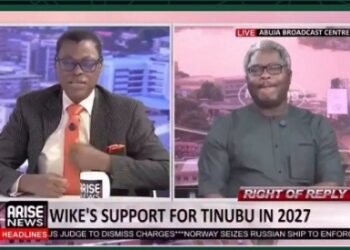
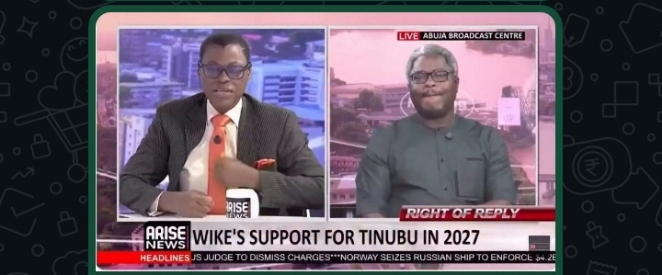
The Morning Show on Friday, September 4, 2026, became contentious because Lere Olayinka, a media aide to Federal Capital Territory Minister Nyesom Wike, appeared willing to discuss the subject but unwilling to take questions from one of the programme’s anchors, Rufai Oseni.
According to reports by Vanguard and Metro Daily, Oseni asked Olayinka to explain why former Humanitarian Affairs Minister Betta Edu, who has faced corruption allegations, was included in President Bola Tinubu’s 2027 campaign council.
Olayinka did not answer that question. Instead, he said he did not want to answer questions from Oseni and wanted the conversation to be among “reasonable human beings.”
He connected that objection to an earlier description, attributed to Oseni, of certain people using a Yoruba term “Gbewudani” in Metro Daily”—so the exact wording should not be presented as settled without reviewing the full broadcast recording.
The programme then moved from political substance to professional boundaries.
Ayo Mairo, another anchor, reminded Olayinka that The Morning Show has three anchors and that a guest appearing on the programme was expected to engage the panel rather than select which presenter could question him.
Mairo ended the interview, saying the station would welcome Olayinka back when he was ready to speak to all three anchors.
The viral post supplied by the user, published on X at 8:47 a.m. on September 4, had recorded more than 430,000 views when accessed for this report, illustrating the clip’s rapid circulation rather than independently proving every claim made in the post.
The central issue is not who “won” the exchange
The spectacle invites a familiar social- media question: did the guest expose a rude interviewer, or did a public official’s aide attempt to dictate the terms of accountability?
The stronger editorial conclusion is that both media conduct and guest conduct deserve scrutiny, but they are not equivalent questions.
If Oseni used a derogatory or needlessly personal label, ARISE should address that language directly. A journalist’s right to ask difficult questions does not include a licence to insult.
Precision, fairness and restraint are especially important when discussing
politicians, public officials and people associated with them.

A station that expects guests to answer responsibly must also expect its presenters to speak responsibly.
That concern, however, does not turn a guest’s refusal into an answer. Olayinka was invited in his capacity as a govt spokesperson.
The question reported by the newspapers concerned a public political appointment and was plainly relevant to the interview’s subject.
He could have challenged the wording, requested correction, answered through the chair, or stated that he would not comment.
What he could not reasonably demand was a panel without the anchor whose questions he disliked while continuing to use the station’s platform.
ARISE’s decision to stop the interview was therefore defensible as a matter of format and editorial control. The station did not censor a completed answer or prevent Olayinka from publishing his position elsewhere.
It declined to continue a segment after the guest rejected the programme’s basic interviewing arrangement. That is a proportionate response to a breakdown in the conditions of a live discussion.
The political meaning is larger than the clip
The incident matters because it reflects a widening problem in public communication: political actors increasingly treat interviews as controlled appearances rather than
accountability encounters.
A spokesperson may want the reach and legitimacy of an independent news platform while resisting the independence that gives the platform its
value. When that happens, a programme risks becoming a stage-managed endorsement exercise.
The answer is not for broadcasters to become hostile or performatively combative. Nor is it for guests to be ambushed with irrelevant provocation.
The public interest lies in a clear bargain: the host asks relevant questions in professional language; the guest answers them in good faith; either side may object, but neither side gets to redefine the interview unilaterally once it is underway.
There is also a caution for audiences. Viral clips compress context, reward outrage and encourage viewers to choose a winner before establishing what was asked, what was answered and what preceded the confrontation.
In this case, the available reporting
supports the basic sequence, but the precise disputed term remains inconsistent across accounts.
Claims that the episode was premeditated or directly caused by an earlier on-air dispute should be treated as commentary unless supported by direct evidence.
ARISE News’ most useful follow-up would be simple: release or point viewers to the full segment, clarify the station’s standards for guest participation and presenter language, and allow the substantive political question to return to the centre of the debate.
The public does not need another television quarrel. It needs public officials and their representatives to face questions—and journalists to ask them without sacrificing civility.
Bottom line
Lere Olayinka had the right to object to language he considered offensive. ARISE TV had the right to end an interview when he refused to engage one of its anchors.
The clip went viral because it dramatized a deeper contest over who controls political accountability: the spokesperson, the interviewer or the audience. The answer should remain with the public interest, not with whoever speaks loudest in the studio.