

The European Union has condemned a wave of Houthi missile and drone attacks on southern Saudi Arabia that injured 73 civilians, including women and children, warning that the strikes risk widening the Yemen conflict and undermining efforts to restore a political settlement.
In a statement issued on September 8, the European External Action Service said the attacks targeted civilian and economic infrastructure.
It expressed solidarity with Saudi Arabia, called the targeting of civilians and civilian facilities unacceptable, and urged the Houthis to halt attacks inside and outside Yemen, including assaults on commercial shipping in the Red Sea.
What happened
Saudi authorities and the Saudi-led coalition fighting in Yemen said the attacks struck the southern cities of Abha, Khamis Mushait, Jazan and Najran.
Houthi military spokesman Yahya Saree claimed that the group used ballistic missiles and drones against oil and
economic facilities and a Saudi air base.
The claimed targets included Aramco facilities in Abha, Jazan and Najran, the Jazan City for Primary and Downstream Industries complex, and King Khalid Air Base in Khamis Mushait.
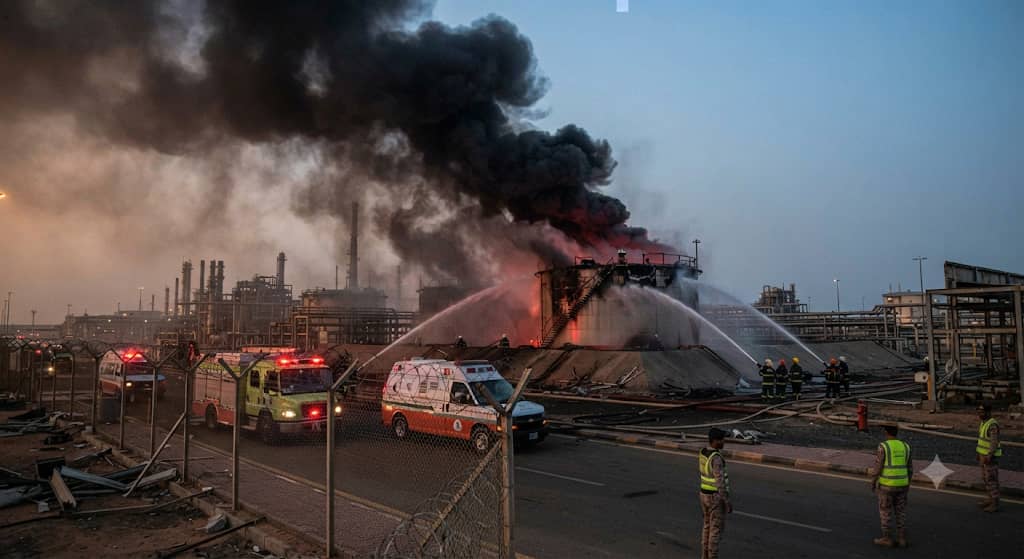
Saudi Arabia’s Energy Ministry said fires broke out at several oil facilities and utilities and that operations at some sites were temporarily suspended while emergency teams fought the fires and assessed damage.
The Jazan region contains a major refinery with a processing capacity of about 400,000 barrels per day, making the attacks significant beyond their immediate security impact.
The casualty total cited by the EU and Saudi authorities was 73 wounded. Saudi officials said those injured included women and children.
No deaths were reported in the accounts reviewed for this report. Reuters said it could not immediately independently verify an earlier report that Aramco’s Jazan facilities had been hit, while Saudi authorities separately confirmed fires and operational disruptions at energy facilities.
Competing accounts and retaliation risk
The Houthis claimed responsibility and portrayed the attacks as retaliation for Saudibacked military operations against them inside Yemen.
Their statements followed Houthi
allegations that a Saudi airstrike had hit a prison in Yemen’s northern Al-Jawf province, killing at least seven people and wounding seven others.
Those allegations were not independently verified in the sources reviewed. Saudi coalition spokesman Turki al-Malki described the attacks as a serious escalation and a direct threat to the safety of residents.
He said the coalition would take “all necessary operational measures” against the Houthis.
The Houthi spokesman, in turn, said the strikes were a response to what he called Saudi aggression and warned that further attacks would follow if operations against the group continued.
The exchange raises the prospect of a renewed cycle of strikes across the Saudi-Yemeni border.
Reuters reported that Saudi-backed Yemeni government forces had recently
launched operations on several fronts against the Houthis, while the Houthis have continued attacks on Saudi-linked vessels and energy interests.
Why the escalation matters
The attacks come after a period in which Yemen’s front lines had been relatively quieter.
The conflict began in 2014, when the Houthis seized the capital, Sana’a, and large parts of northern Yemen. Saudi Arabia led a regional coalition that intervened in 2015 in support of
Yemen’s internationally recognized government.
A United Nations-brokered truce in 2022 sharply reduced large-scale fighting, but it did not produce a final peace agreement. The Houthis retained control over much of Yemen’s most populous territory, and the conflict remained vulnerable to regional shocks.
Recent fighting between Houthi forces and Saudi-backed government forces has now placed that fragile calm under renewed pressure. The confrontation also extends beyond the land war.
Houthi attacks on commercial vessels
in and near the Red Sea have threatened a major route linking the Indian Ocean, the Suez Canal and European markets.
Disruption in the Red Sea can increase shipping costs, lengthen transit routes and add pressure to already volatile energy markets.
The attacks on Saudi energy infrastructure therefore carry both a security and an economic risk. Reuters reported that oil prices rose after the strikes, with Brent crude approaching
$98 a barrel in early trading.
Further attacks on refineries, distribution centers, ports or shipping could compound concerns over energy supplies and maritime access.
The UN resolutions cited by the EU
The EU specifically referred to United Nations Security Council Resolution 2722 (2024) and Resolution 2826 (2026).
Resolution 2722 established a monthly reporting mechanism on Houthi attacks against merchant and commercial vessels in the Red Sea.
Resolution 2826, adopted on July 14 by 13 votes to none, with China and Russia abstaining, extended that reporting mandate through January 15, 2027.
The 2026 resolution is primarily a monitoring and reporting measure rather than a new authorization for military action.
During the Security Council debate, China emphasized that the resolutions did not authorize the use of force against Yemen.
Council members nevertheless described continued reporting as important for maritime security, freedom of navigation, global trade and supply chains.
By invoking both resolutions, the EU linked the attacks on Saudi territory to the wider pattern of Houthi attacks affecting civilian shipping and regional security.
Its statement framed the latest strikes as violations of international law and as a threat to the diplomatic process, rather than as an isolated bilateral confrontation.
Diplomatic stakes
The EU said peace and stability in Yemen are essential to the security of the Gulf and the Red Sea.
It pledged to work with the United Nations, regional partners and the wider international community toward de-escalation and a “comprehensive, inclusive, and sustainable peace.”
The immediate challenge is to prevent the Saudi-Houthi confrontation from becoming a broader regional escalation.
A firm Saudi military response could intensify fighting inside Yemen and increase the risk to Red Sea shipping.
Continued Houthi attacks on civilian infrastructure and commercial vessels could also harden international opposition to the group and make negotiations more difficult.
For civilians, the latest violence threatens to reopen a conflict that has already produced mass displacement, severe humanitarian needs and years of economic destruction.
The EU’s appeal for an end to attacks reflects the central diplomatic dilemma: regional security measures may reduce immediate threats, but without a renewed political process they are unlikely to resolve the underlying war.

Editor’s note: Details of the attacks are based primarily on statements from Saudi authorities, the Saudi-led coalition and the Houthis, with additional reporting by Reuters and the Associated Press.