

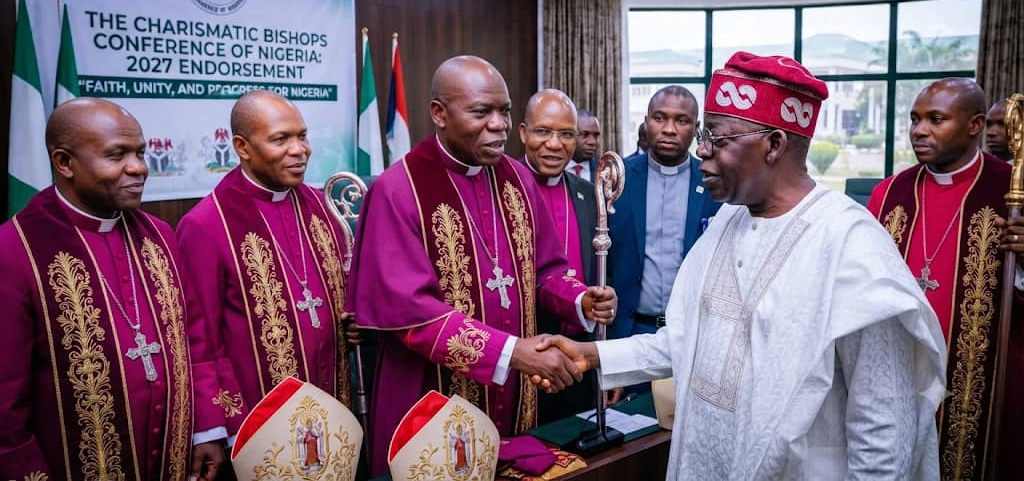
The Charismatic Bishops Conference of Nigeria’s endorsement of President Bola Ahmed Tinubu is unlikely to determine the 2027 presidential election by itself.
Its greater importance is symbolic and organisational: it offers the Tinubu campaign a Christian endorsement of its record, helps address criticism of the administration’s Muslim–Muslim ticket, and may strengthen the ruling party’s coalition-building efforts.
The endorsement’s practical electoral value will depend on whether the CBCN can convert public support into voter mobilisation, political messaging, grassroots advocacy, and turnout.
It will also depend on how voters weigh religious appeals against the cost of living, insecurity, unemployment, electricity, healthcare, education, and governance—issues identified as central to the 2027 contest.
1. It gives Tinubu a Christian validation narrative
The CBCN’s stated justification is politically significant. Archbishop Leonard Bature Kawas argued that Tinubu had not acted with religious bias in his appointments and pointed to the administration’s relationship with Christian governors and the President’s Christian wife.
That allows the Tinubu campaign to advance a broader argument: The Muslim–Muslim ticket should be judged by governance and inclusion rather than by religious composition alone.
This message could be useful among Christian voters who were uncomfortable with the 2023 APC ticket but are open to reassessing the administration’s record. It may also help Tinubu’s campaign present itself as more religiously inclusive than critics suggest.
However, the endorsement cannot automatically be treated as the position of all Nigerian Christians. The CBCN is one religious organisation within a diverse Christian landscape.
Its influence should not be equated with that of the Christian Association of Nigeria, the Catholic Bishops’ Conference, the Pentecostal Fellowship of Nigeria, or the country’s many independent church networks unless those bodies separately endorse the position.
2. It could strengthen Tinubu’s coalition-building beyond the South-West
Tinubu’s 2023 victory depended on more than his South-West base. Premium Times’ analysis of the official results found that he won the South-West, North-West, and North-Central zones, secured at least 25 percent of the vote in 29 states, and came second in the three zones he did not win.
The CBCN endorsement could help the administration reinforce that geographically broad coalition, particularly in areas where Christian communities are politically important, including parts of the North-Central, South-South, South-East, and southern Kaduna.
Its value would be greatest if church leaders frame the endorsement around national inclusion and policy performance, rather than as a purely religious mobilisation against opposition candidates.
The endorsement may also complement support from Muslim clerics and northern political networks. A campaign that can display backing from both Christian and Muslim constituencies could portray Tinubu as a national candidate rather than a sectional one.
3. Its capacity to change votes may be limited by voter independence
Religious leaders can shape political narratives, but their endorsements do not necessarily translate directly into votes. Nigerian voters are not a single bloc, and church members may reject a cleric’s political preference because of economic hardship, local interests, ethnic identity, candidate reputation, or dissatisfaction with government performance.
The 2023 election also demonstrated the importance of turnout. Premium Times reported that fewer than half of eligible voters participated in every state, while turnout was particularly low in Lagos, Rivers, Bayelsa, and other major electoral areas.
This means that an endorsement could matter more by encouraging supporters to register, collect their permanent voter cards, attend rallies, and vote than by persuading committed voters to change candidates.
The CBCN would therefore need a structured mobilisation effort to produce a measurable electoral effect. A declaration from a national conference, without sustained local engagement, is more likely to generate publicity than votes.
4. It gives APC a stronger response to opposition attacks on religion
The opposition is likely to argue that the endorsement reflects political patronage or the use of religious authority for partisan purposes. That criticism may resonate with voters who believe religious leaders should remain neutral or focus on accountability.
At the same time, the endorsement gives APC an opportunity to accuse opponents of exaggerating religious concerns for political gain.
Tinubu’s campaign may use the CBCN statement to argue that influential Christian leaders have assessed the administration and found evidence of inclusion.
Competing Political Narratives
The Tinubu campaign is likely to argue that the administration has governed inclusively despite operating under a Muslim–Muslim presidential ticket. It may present the bishops’ endorsement as evidence that Christian leaders recognise the government’s efforts in national development, security, and inclusion.
The opposition, however, may argue that the endorsement is primarily political and does not reflect the daily experiences of ordinary Nigerians. Opposition parties are also likely to stress that religious backing cannot replace measurable improvements in economic conditions, public accountability, and governance.
While the Tinubu campaign may present continuity as necessary for national stability and the completion of ongoing reforms, the opposition is likely to frame the 2027 election as a referendum on the administration’s record. Its campaign may focus on the cost of living, insecurity, unemployment, and the broader quality of governance.
The effectiveness of each narrative will depend on whether voters experience improvements in their daily lives before the election.
5. It may increase religious polarisation if handled carelessly
The endorsement could reduce religious tension if the bishops use their influence to promote peaceful participation, interfaith dialogue, and responsible citizenship.
That interpretation is consistent with Information Minister Mohammed Idris’s appeal for religious leaders to prevent the election from becoming a Christian-versus-Muslim or North-versus-South contest.
It could have the opposite effect if campaign actors present it as evidence that “the Church” has collectively chosen Tinubu. Such language could provoke rival religious mobilisation and encourage opposition parties to seek counter-endorsements from other clerics.
The result would be an electoral competition increasingly organised around religious identity rather than policy.
This risk is significant because Nigeria’s 2027 election environment already faces insecurity, political realignment, declining trust, premature campaigning, and concerns about shrinking political competition.
The International Republican Institute warned that these pressures could weaken meaningful democratic participation.
6. It raises the accountability burden on both the bishops and the President
The endorsement is not politically cost-free for either side. For President Tinubu, it creates an expectation that the administration will deliver measurable progress on the issues used to justify the support.
If inflation, unemployment, insecurity, and hardship remain severe, opponents may portray the endorsement as evidence that religious leaders prioritised access to government over public welfare.
For the CBCN, the endorsement creates a responsibility to maintain its independence. Its credibility will be tested by whether it continues to criticise policy failures, defend vulnerable citizens, and demand transparency after publicly supporting the President.
In this respect, the endorsement may become more consequential after the election than before it. If Tinubu wins, the bishops may be expected to help defend the administration. If he loses, the endorsement may expose limits to the political reach of religious organisations.
7. The endorsement will not substitute for electoral credibility
The decisive institutional question will remain whether voters trust the election process. IRI identified concerns involving results transmission, insecurity, political violence, voter intimidation, vote-buying, and public confidence in electoral institutions.
A religious endorsement can encourage participation, but it cannot resolve doubts about the Independent National Electoral Commission, ballot secrecy, security neutrality, or the credibility of collation and results transmission. If voters believe that their ballots will not count, moral appeals from religious leaders may have limited effect.
The CBCN could have a stronger democratic impact if it uses its endorsement to demand:
– transparent electoral administration;
– peaceful campaigns;
– protection of ballot secrecy;
– equal treatment of parties;
– non-violence by supporters;
– issue-based campaigning; and
– public accountability from the administration it supports.
Possible Electoral Scenarios
The endorsement may have a limited symbolic effect. It could dominate political headlines without producing a significant change in voting intentions, particularly if economic hardship, insecurity, unemployment, and poor public services remain more important to voters than religious endorsements.
A second possibility is a moderate mobilisation effect. The CBCN’s church networks could help increase voter participation among some Christian communities, especially in selected states. This may strengthen Tinubu’s existing coalition without fundamentally changing the overall direction of the race.
The endorsement could also contribute to a broader coalition effect. If it is combined with support from Muslim leaders, the APC’s party structures, and the advantages of incumbency, it may reinforce Tinubu’s image as a nationally acceptable candidate. It could also weaken opposition arguments that the administration’s Muslim–Muslim ticket has excluded or marginalised Christians.
However, the endorsement may produce a backlash effect. Some voters and civil-society groups may interpret it as evidence that religious leaders have been drawn into partisan politics or have been politically co-opted. This could encourage counter-mobilisation and increase public scepticism about the role of religious institutions in elections.
Finally, it could contribute to a polarisation effect. Rival parties may seek their own endorsements from prominent Christian and Muslim leaders. If this develops into a competition among religious blocs, the campaign could become more focused on Christian– Muslim and regional identity than on economic policy, security, governance, and the performance of the incumbent administration.
Overall Assessment
The CBCN endorsement is best understood as a coalition-building and narrative-management advantage for Tinubu, not as a guaranteed block of Christian votes.
It may help the President soften the political damage associated with the Muslim–Muslim ticket, reassure sections of the Christian electorate, and reinforce the APC’s claim to national inclusiveness.
Its impact will be strongest if it is accompanied by credible improvements in security and living conditions, disciplined grassroots mobilisation, and a broad-based message of national unity. It will be weakest if voters regard it as an elite religious declaration disconnected from everyday hardship.
The central electoral test will therefore not be whether the bishops have endorsed Tinubu. It will be whether their endorsement can persuade voters that the administration’s record deserves another term—and whether Nigerians believe the 2027 election will allow them to express that judgment freely.