

The United States is positioning itself as Asia’s leading energy supplier, offering increased exports of liquefied natural gas, nuclear technology and other energy resources as countries across the region confront rapidly rising demand and infrastructure constraints.
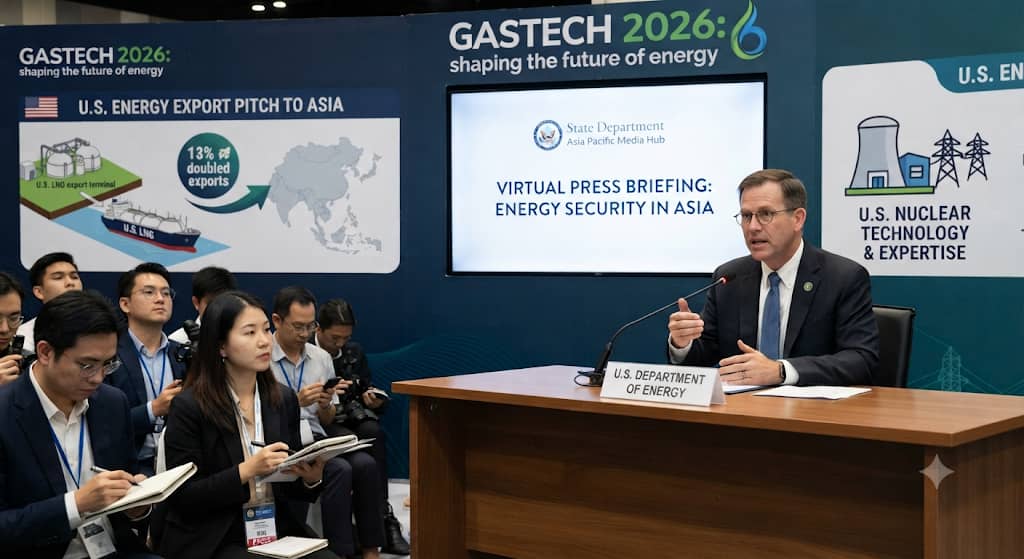
Speaking from Bangkok during the Gastech conference, U.S. Energy Deputy Secretary James P. Danly said the administration’s “energy dominance” agenda was focused on expanding domestic production and making American energy available to allies and partners on commercial terms.
“We are open for business and we want to be a partner to the region,” Danly said during a virtual briefing hosted by the State Department’s Asia Pacific Media Hub.
Danly said U.S. LNG exports had doubled and were expected to double again, while the administration would continue authorizing additional exports.
He also pointed to American nuclear technology and electricity-transmission expertise as potential tools for meeting Asia’s growing energy needs.
The pitch comes as countries including Japan, South Korea, Taiwan, Vietnam and Indonesia seek to secure supplies while balancing their economic relationships with the United States and China.
Taiwan, Danly said, had signed a long-term LNG contract with Cheniere Energy earlier this year and would remain among the buyers of American energy.
He described Taiwan’s trade with the United States as part of a broader effort to make U.S. energy supplies available to friends and allies.
For Southeast Asia, however, the most immediate obstacle may be the lack of infrastructure needed to receive and distribute imported fuel. In Vietnam, Danly identified a shortage of LNG import terminals, regasification facilities and pipelines as key barriers to expanding U.S. energy trade.
“Vietnam needs to have more import terminals,” he said. “We are ready to send LNG in large quantities.”
Danly also challenged the practical contribution of Indonesia’s plan to build 100 gigawatts of solar capacity within three years, arguing that its effective output would be significantly lower because of intermittency.
He said countries facing rising electricity demand would also need dispatchable generation, including gas and nuclear power.
The comments reflect Washington’s effort to link energy exports with broader economic and strategic engagement in the Indo-Pacific.
Danly said the region’s energy consumption was expected to rise sharply over the next several years, but warned that infrastructure bottlenecks could slow industrial development.
The United States is also seeking closer cooperation with Japan, Australia and India through a Quad Fuel Security Forum being held in Texas, which Danly described as an effort to protect the region from market volatility and supply disruptions.
Beyond fuel exports, Danly promoted the Department of Energy’s Genesis Mission, an initiative aimed at using artificial intelligence to accelerate scientific research.
Japan is the first international partner in the program, he said, and other countries could join research collaborations involving U.S. national laboratories.
The briefing underscored the administration’s central message: Washington intends to use American energy abundance—and the technology supporting it—as both an economic offering and a strategic instrument across Asia.