

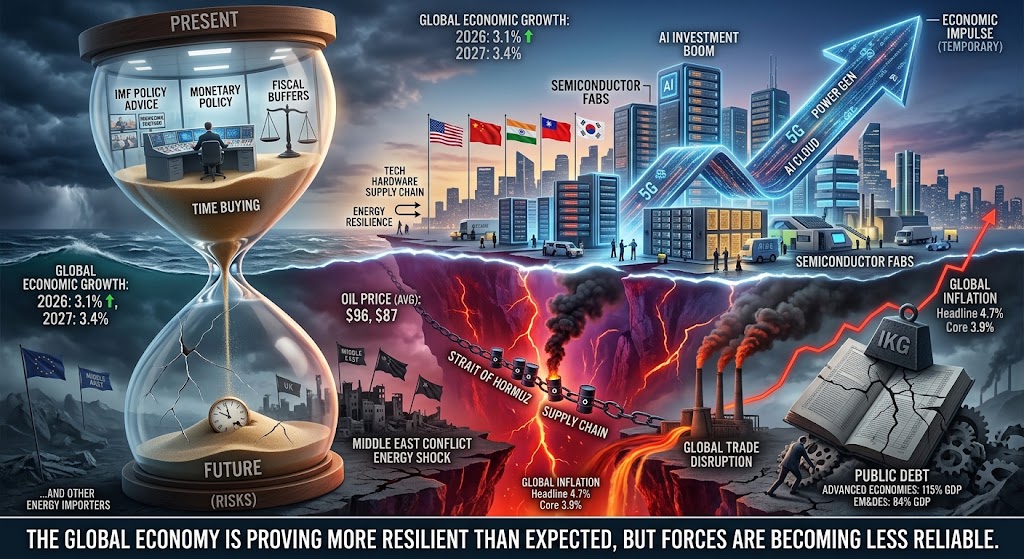
The global economy is proving more resilient than expected, but International Monetary Fund warned in its latest press briefing that the forces supporting growth are becoming less reliable.

A surge in artificial-intelligence investment has helped offset the economic damage from the war in the Middle East and higher energy costs.
Yet the same investment boom is concentrating financial risks, while elevated public debt and persistent inflation are leaving governments with less room to respond to the next shock.
The IMF’s October World Economic Outlook, released during the IMF‒World Bank Annual Meetings in Bangkok, projects global economic activity will expand 3.1% in 2026 and 3.4% in 2027.
The 2026 forecast is an upgrade from the Fund’s July projection of 3.0%, but it
remains below 2025 growth of 3.5%. The 2027 forecast is unchanged from July. The headline numbers mask a sharp reallocation of growth among countries.
According to the IMF, only 32 economies now account for 95% of global growth, compared with 54 in April.
Countries linked to the AI supply chain or less exposed to the energy shock are
outperforming, while energy importers and economies directly affected by the conflict are falling further behind.
AI investment offsets the energy shock
The IMF attributes much of the economy’s better-than-expected performance to a wave of spending on semiconductors, data centers and power generation. That investment created a strong demand impulse before the productivity gains from AI have fully appeared.
It also supported international trade and lifted the outlook for several economies supplying AI hardware or participating in related production chains.
The United States is forecast to grow 2.3% in both 2026 and 2027, supported by household consumption, fiscal policy and technology investment.
China’s growth is projected at 4.5% in 2026 and 4.0% in 2027, although higher oil prices, weak domestic demand and
property-sector strains remain obstacles. India is expected to remain the fastest -growing major economy, expanding 7.0% in both years.
The technology cycle is also lifting some Asian exporters. Taiwan is forecast to grow 10.7% this year, while South Korea is projected at 3.3%, according to reporting on the IMF’s outlook.
The euro area is expected to grow just 1.1% in 2026, despite an upgrade from July, as higher energy costs and weak consumer confidence continue to weigh on activity. But the IMF cautioned that AI is not a free or evenly distributed source of resilience.
Investment is arriving before broad productivity gains, and its benefits are concentrated in a relatively small number of firms, sectors and countries.
A reassessment of expected AI profits could trigger a retreat from investment, falling equity prices and tighter financial
conditions. In one downside scenario cited in the outlook, global output could be 1.1% below baseline by 2028 if anticipated productivity gains fail to materialize.
Inflation falls later, not immediately
The IMF expects global headline inflation to rise to 4.7% in 2026, mainly because of higher commodity and energy prices, before easing to 4.1% in 2027.
Core inflation is projected at 3.9% this year and 3.7% next year. The forecasts assume the Strait of Hormuz will reopen in March 2027, that shipping conditions will broadly return to pre-war levels by October. That assumption is central to the outlook.
The Fund estimates an average oil price of $96 a barrel in 2026 and $87 in 2027. If the conflict worsens and oil rises to $130 a barrel through the first quarter of 2027, global growth could be reduced by 0.2 percentage point in 2026 and 0.5 percentage point in 2027.
Inflation in 2027 could rise by an additional 1.1 percentage point, reaching 5.2% in the scenario described by Reuters.
The IMF said economies have so far absorbed much of the energy shock by redirecting supplies, drawing down inventories, increasing production elsewhere, substituting other energy sources and improving efficiency.
Those adjustments prevented a sharper
slowdown. But inventories are being depleted, and the Fund warned that the cushion is narrowing as the conflict continues.
Lower-income countries and households are particularly exposed. Higher transport and fertilizer costs, food-price pressures, export restrictions and extreme weather could compound the effects of the energy disruption.
Countries outside the main technology
supply chains face a more difficult combination of higher import bills, weaker real incomes and reduced fiscal capacity.
Debt leaves less room for manoeuvre
The IMF’s other central warning concerns public finances. Borrowing costs have risen in major advanced economies as inflation risks, expectations for interest rates and concerns about fiscal sustainability push up bond yields.
Public debt is projected to reach 115% of GDP in advanced economies by 2031, up from 108% in 2025. In emerging and developing economies, debt is forecast to rise to 84% of GDP from 74% over the same period.
The Fund is urging governments to rebuild fiscal buffers rather than rely indefinitely on emergency support.
Its advice is for fiscal policy to contain demand pressures, bring debt onto a credible medium-term path and keep assistance for households facing higher food, energy costs temporary, targeted and designed to avoid distorting the economy.
The IMF also called on central banks to keep their focus on price stability. Where commodity prices, tight labor markets or technology investment generate persistent inflation, monetary policy may need to remain restrictive or tighten further.
The appropriate stance will differ by country, but the Fund stressed that central-bank independence is essential.
A more uneven global outlook
The regional picture illustrates the divergence. The Middle East and Central Asia are.projected to contract 0.3% in 2026, with several Gulf economies facing deep recessions before projected rebounds in 2027.
Saudi Arabia’s economy is forecast to shrink 3.3% this year, while Reuters reported even steeper contractions for Iran, Iraq, Kuwait and Qatar.
Europe faces a milder but still weak outlook. Euro-area growth is forecast at 1.1% in 2026, while Britain’s forecast was upgraded to 1.3% as AI investment and defense spending provide some support.
China’s slowdown reflects domestic weaknesses as well as the impact of more expensive energy.
The IMF’s message is therefore not that the global economy is safely through the current shocks. It is that adaptability has bought time.
The challenge now is to use that time to restore fiscal space, strengthen energy and supply-chain resilience, protect financial stability and ensure that AI’s gains are not limited to a narrow group of economies.
As IMF Chief Economist Silvana Tenreyro put it at the news conference, “The global economy has been resilient, but that resilience is reaching its limits, so we need to move from just coping to rebuilding.”
The Fund argues that no country can manage these risks alone. It is calling for predictable trade rules, cooperation on energy security and critical supply chains, and international coordination over rapidly changing technologies.
Its broader conclusion is that resilience
must become a policy objective, not merely a description of how economies have survived the latest shock.