


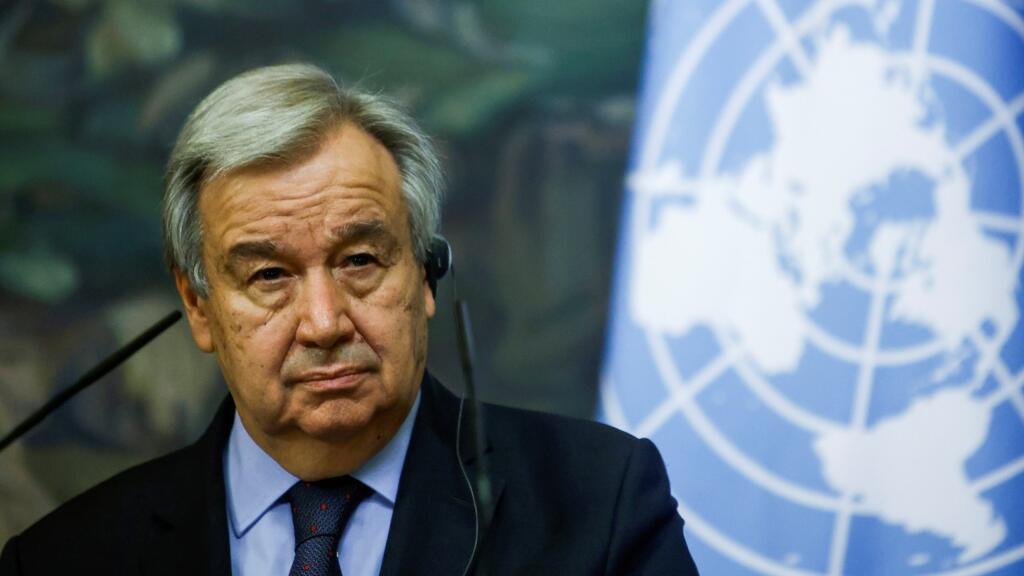
The United Nations Secretary-General, António Guterres has warned that the world is on course for prolonged breach of the 1.5°C warming limit while urged governments to make immediate, drastic emissions cuts to prevent climate catastrophe.

Speaking at a press conference during COP31 in Antalya on 13 November, Guterres said a temporary overshoot of the Paris Agreement’s most ambitious temperature target was now “inevitable.”
He called on countries to keep the overshoot as limited and brief as possible, insisting that global temperatures must be brought back below 1.5°C as quickly as possible.
“An overshoot of 1.5 degrees is now inevitable,” Guterres said. “Our responsibility is to keep it as small as possible, for as short a time as possible, and bring temperatures back below 1.5 degrees as quickly as we can.”
He said achieving that goal would require emissions reductions of about 6 per cent every year over the next few years.
“Current national climate plans, however, put the world on a trajectory toward temperatures exceeding 2.5°C by the end of the century. That’s a recipe for catastrophe,” Guterres warned.
Fossil fuels at the centre of the crisis
Guterres identified fossil fuels as the primary driver of climate change and said there could be no credible route to a safe climate without moving away from coal, oil and gas.
“We need an accelerated transition away from fossil fuels that is just, orderly and equitable,” he said, arguing that the shift was necessary not only for the climate but also for economic and national security.
Continued dependence on fossil fuels leaves countries vulnerable to price shocks, geopolitical instability and supply disruptions, Guterres said.
“Simply changing suppliers, he added, would not address the underlying risk.
Reducing dependence does,” he said.
The UN chief called for a major expansion of clean energy, electricity grids, energy storage, efficiency measures and clean electrification.
He stressed that renewable-energy growth must result in actual reductions in fossil-fuel production, consumption and emissions rather than merely adding new energy capacity alongside existing fossil-fuel use.
He also criticized the influence of fossil-fuel companies and their representatives in climate policymaking.
“The future of our planet cannot be negotiated on the terms of those profiting from its destruction,” Guterres said.
Developing countries face finance shortfall
A central theme of Guterres’s remarks was the widening climate-finance gap confronting developing countries, particularly those that have contributed least to global warming but face some of its most severe consequences.
Climate change, he said, is driving hunger, displacement, debt, competition over land and water, instability and the loss of development gains achieved over decades. It is also placing some communities and countries at risk of survival.
Guterres said developed countries must deliver the climate finance they have pledged at previous UN climate conferences.
“Even if the commitment to triple adaptation finance were fully implemented, he said, it would cover less than 30 per cent of estimated needs.
In response to a question about barriers to climate justice, he said developing countries faced both inadequate funding and cumbersome procedures for accessing existing funds.
Countries with limited administrative capacity are often confronted by complex and bureaucratic application processes, he said.
Guterres called on climate funds to simplify access and make it easier for vulnerable countries to secure support for adaptation, resilience and loss and damage.
“There is a structural injustice in our climate situation,” he said, arguing that countries responsible for the greatest share of pollution have failed to provide sufficient resources to those suffering the worst effects.
Calls for financial innovation
Guterres also urged governments and development banks to make better use of existing resources rather than relying exclusively on new budgetary commitments.
He said a dollar invested directly in a project could remain a dollar, while the same dollar placed in the capital of a multilateral or national development bank could potentially be leveraged into eight or ten dollars through market financing.
Similarly, special drawing rights channelled through multilateral development banks could generate significantly more financing than if they were distributed without such leverage, he said.
Guterres encouraged development banks to expand the use of guarantees, which can attract substantially larger amounts of private capital than conventional lending alone.
He acknowledged that such reforms would require governments and financial institutions to overcome entrenched bureaucracies and change established policies, but said the mechanisms for multiplying climate finance already existed.
Climate action linked to peace and development
Guterres described climate action as central to the entire UN agenda rather than an issue separate from peace, development and human rights.
“You cannot build peace on a burning planet,” he said. “You cannot eradicate poverty when climate disasters keep throwing people back into it.”
He also warned that the burden of climate change falls most heavily on those who have contributed least to the problem, making climate action a matter of justice as well as environmental protection.
“No country can protect itself from climate change alone,” Guterres said. “We share one planet — and whether we like it or not, we share one fate.”
COP process must deliver faster action
While negotiations remained necessary, Guterres said the success of the COP process should ultimately be measured by whether decisions accelerate implementation and improve people’s lives.
He welcomed several initiatives discussed at COP31, including roadmaps on transitioning away from fossil fuels and ending deforestation, efforts to advance clean electrification, a global commitment to zero waste, faster development of electricity grids and continued work under the Early Warnings for All initiative.
But he said responsibility ultimately rested with national governments, especially the world’s largest emitters.
“They must recognize the need for an immediate and drastic reduction in emissions to keep the 1.5 goal still possible by the end of the century,” he said.
Guterres also called for the next report of the Intergovernmental Panel on Climate Change to be completed as quickly as possible, ideally before the next global stocktake.
He praised the IPCC for providing the scientific evidence underpinning international climate policy, while noting that its work is affected by the geopolitical divisions among governments.
Early-warning systems need more funding
Asked about the future of the Early Warnings for All initiative beyond 2027, Guterres said the programme should continue.
The initiative has so far raised about $2 billion, he said, but requires approximately $6 billion to meet its goals.
It has already helped strengthen disaster forecasting capacity in a number of countries, but many others still lack adequate systems for warning people about climate-related hazards.
Guterres said he hoped the UN would maintain the initiative after 2027 and continue expanding early-warning coverage, including through media and broadcasting networks capable of reaching vulnerable communities.
Final COP as UN chief
The Antalya press conference was Guterres’s final COP as UN secretary- general. Reflecting on nearly a decade in office, he rejected the idea that his climate warnings had been excessively outspoken.
“I say simply what is true,” he said, arguing that the scientific evidence shows the world remains on a dangerous path.
Guterres acknowledged that the gap between what climate science demands and what governments are delivering remains “dangerously wide.”
Nevertheless, he said renewable energy had moved from the margins into the mainstream, supported by falling costs, technological progress and growing political awareness.
“A cleaner, safer and more secure energy future is in our hands,” he said. “The question is whether we have the courage and speed to reach for it.”
He ended with a direct appeal to govts and the public: “Face the facts. Follow the science. Choose the future. And never give up.”