

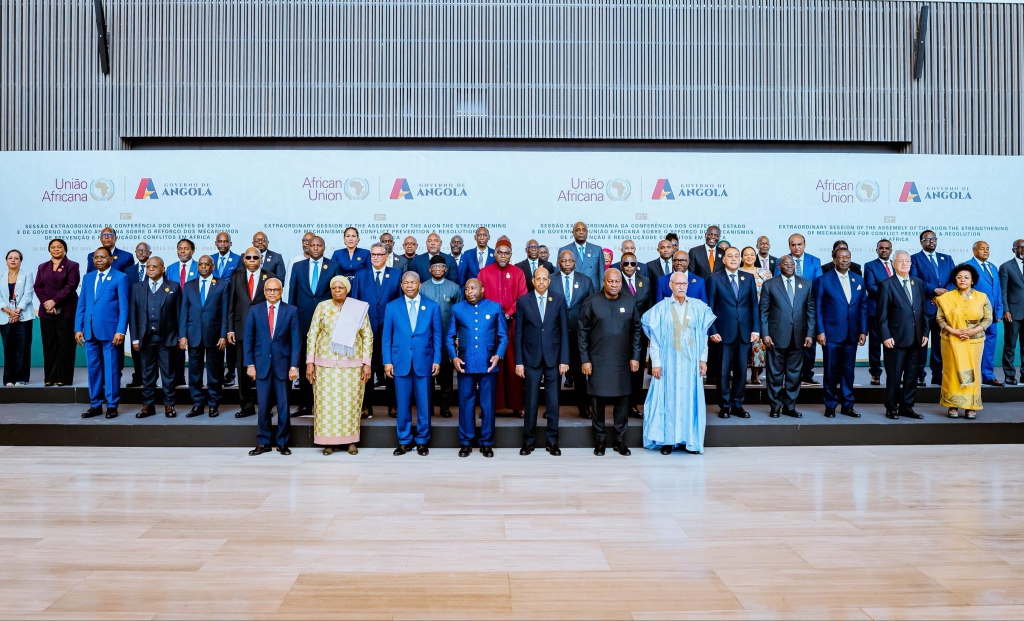
African Union leaders meeting in Luanda called for a decisive shift from reacting to armed conflicts to preventing them before violence escalates, urging stronger early-warning systems, faster intervention and more reliable African financing for peace operations.
Opening the African Union’s 21st Extraordinary Session, held under the theme.“Strengthening Conflict Prevention and Resolution Mechanisms in Africa,” Angolan President João Manuel Gonçalves Lourenço said the summit should produce concrete measures, clearly assigned responsibilities and effective monitoring mechanisms.
He argued that peace and security are prerequisites for sustainable development, economic integration and the realization of Agenda 2063, the AU’s blueprint for “The Africa We Want.”
The summit brings together African heads of state and government, the AU Commission leadership, regional organizations, international partners and members of the diplomatic corps.
Lourenço, who serves as the AU Champion for Peace and Reconciliation in Africa, said Angola’s experience and its commitment to dialogue positioned it to host a meeting focused on the continent’s most urgent security challenges.
From early warning to rapid action
Burundian President Évariste Ndayishimiye, the AU chairperson- in-office, said Africa already possesses an extensive peace and security architecture but has repeatedly failed to translate warnings into timely action.
The mechanisms include the AU Peace and Security Council, the Continental Early Warning System, the Panel of the Wise, the African Standby Force, the AU Peace Fund and a range of mediation and preventive-diplomacy instruments.
The central weakness, he said, is not the
absence of institutions but the tendency to intervene only after crises have become difficult to control.
“Our responsibility is now to ensure that early warning effectively translates into rapid response.” — Ndayishimiye, President of Burundi and AU chairperson-in-office.
Ndayishimiye pointed to the war in Sudan as an example of a conflict whose deterioration was visible over time, warning of the human and material costs of delayed action.
He also cited continuing insecurity in the Sahel and fighting in the Democratic Republic of the Congo, where violence has persisted despite peace agreements and ongoing diplomatic processes.
The Burundian leader called for a stronger preventive role for the Peace and Security Council, greater strategic foresight and closer coordination between the African Peace and Security Architecture and the African Governance Architecture.
He said the AU must be able to identify political and social risks early and respond before they develop into full- scale wars.
Leaders link conflict to governance failures
The speeches emphasized that armed violence is often the outcome of deeper political and socioeconomic grievances. Ndayishimiye said conflicts can be rooted in weak institutions, political exclusion, inequality, social injustice and a lack of opportunities, particularly for
young people.
He argued that durable prevention requires governments and regional institutions to address these underlying conditions rather than focusing only on the immediate symptoms of crisis.
Poverty, he said, may not by itself cause conflict, but deprivation, unequal
distribution of resources and poor public management can create conditions in which people become vulnerable to mobilization for violence.
His proposed response included a continent-wide effort against poverty, stronger guarantees of equality and social justice, and protection for citizens without discrimination.
Such measures, he said, could reduce the risk of renewed violence by addressing the grievances that make societies unstable.
Burundi presents reconciliation as a model
Ndayishimiye used Burundi’s post-conflict experience to illustrate the importance of political inclusion and reconciliation.
He pointed to the 2000 Arusha Agreement for Peace and Reconciliation as a historic foundation for confronting past divisions and building a state in which citizens could live with dignity and security.
He said reconciliation does not mean erasing history, but acknowledging it, learning from it and creating a different future.
Burundi’s permanent forum for political- party dialogue, along with regular consultations involving political leaders and civil society during the election period, was presented as an example of institutionalized dialogue intended to
prevent tensions from escalating.
The president said Burundi was sharing its experience with other African countries and contributing to peace and stabilization efforts in Somalia, the Democratic Republic of the Congo, the Central African Republic and elsewhere.
He also highlighted the country’s experience with disarmament, demobilization and reintegration, as well as its efforts to consolidate institutional stability.
Peace requires rebuilding after war
The summit’s agenda extends beyond the prevention of new conflicts. Ndayishimiye said that when prevention fails, responsibility cannot end with negotiations or the signing of a peace agreement.
Countries must invest in reconciliation, reconstruction and post-conflict
development to reduce the risk of renewed violence.
He also underscored the importance of disarmament, demobilization and reintegration processes after ceasefires, saying that states must remain engaged throughout both the prevention and management of conflicts.
The goal, he said, should be a credible guarantee of non-recurrence rather than a temporary pause in fighting.
Call for predictable African financing
A major issue raised at the session was the financing of Africa’s peace and security agenda.
Ndayishimiye said individual states could not carry the burden alone and that regional and continental mechanisms required adequate resources to operate effectively.
He called for predictable, sustainable and flexible African financing, including continued strengthening and progressive capitalization of the AU Peace Fund.
Without that financial base, he warned, the continent would struggle to achieve durable ownership of its peace and security agenda.
The AU must also improve cooperation among the continental body, regional economic communities, regional mechanisms, member states, the United Nations and strategic partners, he said.
Such cooperation should preserve the principle that African solutions remain central to addressing African crises.
A summit expected to deliver decisions
Both opening addresses framed the Luanda meeting as an opportunity for action rather than another assessment of Africa’s security problems.
Lourenço urged delegates to mobilize political, diplomatic, financial and institutional tools to stop conflicts before they become wars and to bring existing conflicts to an end as quickly as possible.
Ndayishimiye called on leaders to choose an Africa that anticipates rather than reacts, favors dialogue over division, uses mediation before violence takes hold, and invests in reconciliation and peacebuilding after conflict.
He formally declared the extraordinary session open with a call for decisions that would strengthen mechanisms for conflict prevention and resolution.
Also narrowing the gap between early warning and response, provide greater resources for the continent’s peace and security architecture, place reconciliation and peace consolidation at the center of AU action.
The summit’s immediate test will be whether its deliberations produce implementation plans capable of matching the scale of the crises identified in the speeches.
For Africa’s leaders, the message from Luanda was clear: preventing war requires not only institutions, but the political will, financing and rapid coordination to use them before a crisis becomes irreversible.