

The debate over Nigeria’s infrastructure development reignited following a compelling statement by Nigerian Democratic Congress (NDC) presidential candidate Peter Obi, who argued that the country must prioritize the rehabilitation of existing roads over the initiation of new construction projects.
His remarks highlight a growing tension between the government’s ambition to build legacy infrastructure and the daily realities of citizens navigating dilapidated national highways.
The Case for Maintenance: The Asaba- Benin Artery
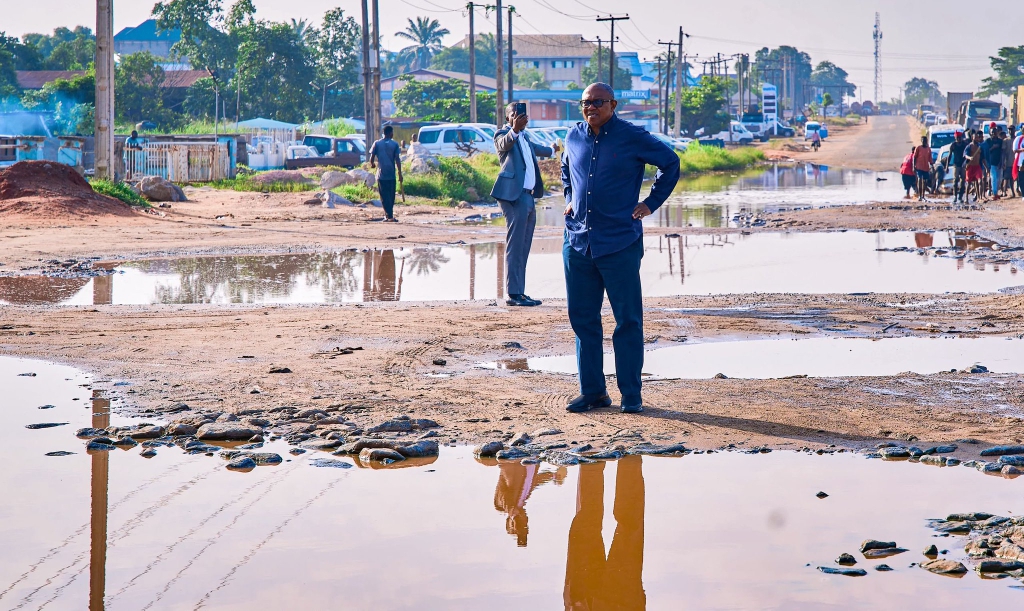
At the heart of Obi’s argument is the stark reality of Nigeria’s current road network.
He specifically pointed to the Asaba-Benin Road, a critical artery connecting the South-East and South- South regions—including Akwa Ibom, Anambra, Rivers, Imo, Ebonyi, Cross River, Abia, Enugu, and parts of Benue and Kogi States—to the commercial hub of Lagos.
Despite its undeniable economic significance, substantial sections of this highway remain in a lamentable condition.
For years, the road has been a major impediment to commerce and travel, precipitating persistent traffic congestion and inflicting undue hardship on commuters, businesses, and transport operators.
Obi argues that such critical
infrastructure should not be left to deteriorate while the government embarks on new, capital-intensive ventures.
“Our efforts should be directed towards the reconstruction and maintenance of our current road infrastructure before we announce plans for new road projects,” Obi stated.
“The Nigerian populace requires functional and motorable roads, not merely projects that garner public attention”.
This perspective resonates deeply with many Nigerians who face the daily consequences of neglected maintenance.
According to infrastructure analysts, neglecting road maintenance can increase repair costs by up to 18 times after just five years, making a strong economic case for prioritizing rehabilitation.
The Government’s Stance: Expansion and Economic Catalysts
Conversely, the Federal Government, spearheaded by the Ministry of Works under Minister David Umahi, maintains that new construction and dualization projects are essential for long-term economic growth.
The administration’s flagship project, the Lagos-Calabar Coastal Highway, exemplifies this vision.
Proponents of the coastal highway argue that it will significantly improve transportation along the southern corridor, reduce travel time, and stimulate economic development across a densely populated region.
State officials, such as Akwa Ibom Governor Umo Eno, have lauded the project as a catalyst for an economic boom, emphasizing its potential to open up previously unreachable areas and enhance tourism.
Furthermore, studies on road dualization in Nigeria have shown tangible benefits. Research indicates that dualization projects can enhance property values, boost commercial activities, and create employment opportunities along the newly developed corridors.
For the government, these new projects are not merely superficial improvements for political gain, but necessary steps to modernize Nigeria’s transportation network and accommodate future growth.
Finding the Balance
The discourse between maintaining the old and building the new is not unique to Nigeria, but it is particularly acute given the country’s vast geography and economic challenges.
While Nigeria’s road network spans approximately 200,000 kilometers, only a fraction of it is paved and adequately maintained.
The challenge lies in balancing the immediate need for functional, safe roads with the strategic vision of expanding the national network.
While new highways like the Lagos-Calabar route promise future economic dividends, the immediate economic losses incurred daily on dilapidated routes like the Asaba-Benin road cannot be ignored.
Ultimately, a sustainable infrastructure policy may require a dual approach: securing dedicated, transparent funding for the rigorous maintenance of existing critical arteries, while strategically pursuing new projects that offer undeniable, long-term economic value.
As the debate continues, the primary metric for success must remain the tangible improvement in the daily lives and economic mobility of the Nigerian populace.