

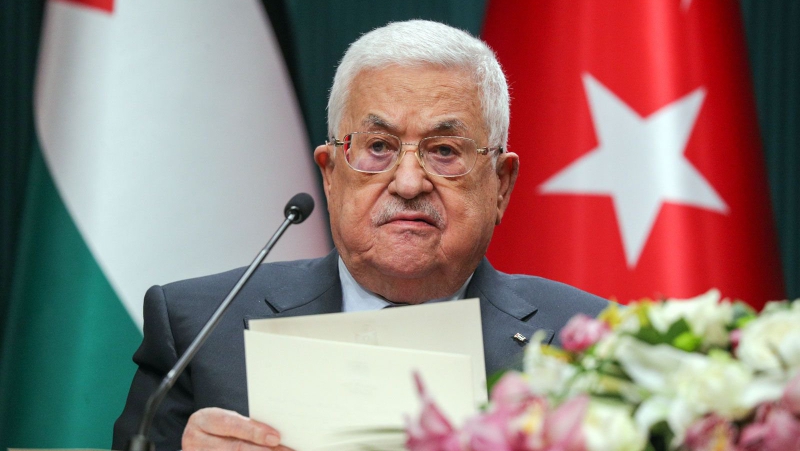
The United States has extended its visa ban on senior Palestinian officials for a second consecutive year, preventing Palestinian President Mahmoud Abbas and other members of the Palestinian delegation from attending the 81st session of the United Nations General Assembly in New York in person.
Washington says the Palestinian Authority (PA) and the Palestine Liberation Organization (PLO) have failed to meet commitments linked to the peace process. The Palestinian side rejects that justification as politically motivated and damaging to diplomacy.

The European Union has now urged the United States to reverse course, arguing that its obligations as host of the UN require reconsideration of the decision.
The dispute has not removed Palestine from the UN debate. The General Assembly voted 152 to 3, with four abstentions, to permit Abbas and other high-level Palestinian officials to participate by video.
The arrangement applies to the coming session and to relevant UN meetings over the following year if the officials are prevented from travelling to the United States.
Why Washington says it denied the visas
In a 16 September statement, the U.S. State Department said the PLO and PA had once again failed to comply with commitments assessed under Palestine Liberation Organization Commitments Compliance Act of 1989 and the Middle East Peace Commitments Act of 2002. It said the sanctions were imposed under Section 604(a)(1) of the latter law.
The department identified several grounds for the extension. It accused the PA and PLO of pursuing actions at international organisations that, in Washington’s view, contradict commitments associated with UN Security Council Resolutions 242 and 338.
It also criticised Palestinian efforts to secure international recognition of statehood outside direct negotiations with Israel and described cases brought before the International Criminal Court (ICC) and the International Court of Justice (ICJ) as an attempt to “internationalize” the conflict.
Washington further alleged that Palestinian institutions continue to provide stipends or other benefits to people the U.S. describes as terrorists and to their families. It cited what it called the glorification of terrorism and terrorists in public statements and school textbooks.
The department said the PA’s failure to reform and its conduct “undermine
the prospects for peace.”
A State Department report to Congress issued in May used similar language. It alleged that Palestinian officials supported “lawfare” against Israel through the ICC and ICJ, encouraged unilateral recognition of a Palestinian state, promoted incitement, glorification of violence, and maintained payments and benefits for prisoners and their families.
These are U.S. government allegations and policy findings; Palestinian officials dispute the premise that pursuing accountability through international institutions violates their rights or peace commitments.
The U.S. position is also shaped by its campaign against the ICC. Washington and Israel are not parties to the court, and the Trump administration has sanctioned ICC officials after the court issued an arrest warrant for Israeli Prime Minister Benjamin Netanyahu over alleged war crimes and crimes against humanity in Gaza.
Who is affected—and who is not
A Palestinian official told Reuters that Abbas’s visa had been denied. The decision follows the 2025 action in which Washington denied or revoked visas for Abbas and about 80 other Palestinian officials linked to the PLO and PA.
The State Department did not publicly name every official covered by the latest extension. Its statement referred broadly to PLO members and PA officials. It also said that a standing waiver remains in place for personnel notified to the PLO Observer Mission to the United Nations.
That means the mission’s already accredited regular staff can continue working at UN headquarters even though individual senior officials have been barred from entering the country.
This distinction matters. The U.S. action restricts the travel of named or covered officials; it does not eliminate Palestine’s diplomatic presence at the UN.
Palestinian diplomats who are already accredited can represent the mission, while Abbas and other affected leaders
can address the Assembly remotely.
The host-state dispute
The visa ban has revived a long-running legal and diplomatic dispute over the 1947 UN Headquarters Agreement.
The agreement generally requires the United States to facilitate access to UN headquarters in New York for representatives of member and observer states attending official UN business.
The European External Action Service said on 19 September that it regretted the extension of the visa denial for a second year and urged Washington to reconsider it “in light of its existing headquarters agreements with the UN and its obligations as host state.”
Palestinian officials and rights groups have made a stronger argument, saying that denying entry to high-level delegation invited to participate in UN meetings violates the agreement and politicises access to multilateral diplomacy.
Amnesty International called for the decision to be reversed and described it as an abuse of the United States’ position as host country. Washington disputes that interpretation.
Reuters and the BBC reported that the United States regards visa restrictions as permissible on security, extremism and foreign-policy grounds. The State Department also says the waiver for the PLO’s UN mission remains intact.
The result is a contested balance between the host country’s duty to
provide access and its claimed authority to restrict particular individuals.
The Palestinian and UN response
The Palestinian Foreign Ministry described the sanctions as unjustified and said they run counter to efforts to rebuild trust, develop Palestinian-U.S. relations and create the political conditions for a two-state solution.
Palestinian officials have argued that decades of U.S.- mediated negotiations failed to end the occupation or produce an independent Palestinian state, and that seeking international recognition and legal accountability is a legitimate
diplomatic course.
Palestine welcomed the General Assembly resolution authorising remote participation. Its foreign ministry said the measure prevented an attempt to exclude Palestine from the Assembly’s annual session and preserved the Palestinian voice in the body’s
deliberations.
The vote provides a practical workaround but does not settle the underlying dispute. Abbas can speak, but he cannot appear in person alongside other world leaders.
The arrangement also establishes a continuing mechanism for remote participation if future Palestinian
officials face the same travel restrictions.
What the decision signals
The second-year ban underscores the widening gap between Washington’s approach to the PA and PLO and the position of a growing number of countries that support Palestinian
statehood and greater international involvement in the conflict.
It also comes as the Gaza war continues to shape diplomacy, with the ICC, the humanitarian crisis and efforts to advance a two-state solution at the centre of international debate.
For the Trump administration, the visa policy is a tool to impose consequences on Palestinian officials whom it says have abandoned reform and peaceful negotiation.
For the Palestinian leadership and its European critics, the policy is an obstacle to diplomacy that risks making the United States’ role as UN host appear selective and politically conditional.
The immediate outcome is clear: Palestine will be heard at UNGA81, but Abbas and other affected officials will speak from outside the United States. The broader question—whether
Washington can reconcile restrictions with its obligations to the UN—remains unresolved.