

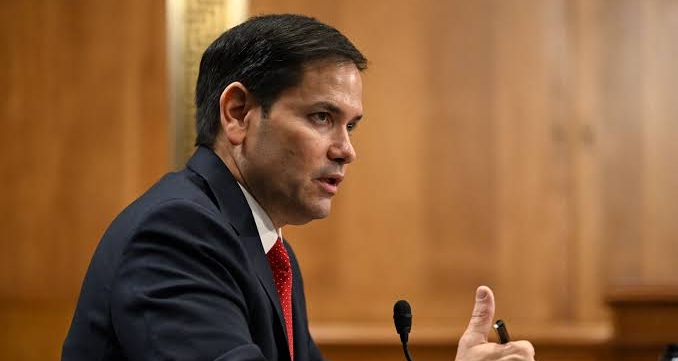
Secretary of State Marco Rubio accused international institutions, activist groups and what he called a “global elite” of weaponizing international law to weaken the United States and erode its sovereignty.

Speaking at the Federalist Society’s 2026 National Lawyers Convention at Washington’s Mayflower Hotel, Rubio drew parallels between the conservative legal movement’s rise and the Trump administration’s battle against int’l courts, nongovernmental organizations and what he described as activist judges.
Rubio said the Federalist Society’s success demonstrated that political power extends far beyond elections and government offices.
Universities, media organizations, think tanks, nonprofits and corporate institutions, he argued, help shape the ideas and legal assumptions that govern society over generations.
“Elections decide who holds office for a season,” Rubio said. “But elections do not decide by themselves what our institutions teach or what our lawyers believe.”
Turning to foreign policy, Rubio claimed that international law has increasingly been used not as a neutral framework, but as a tool to constrain American power.
He cited criticism of the administration’s immigration policies, military operations and handling of international disputes as examples of what he called a coordinated effort to undermine U.S. interests.
Rubio sharply attacked the International Criminal Court, describing it as an “unelected world tribunal” that seeks authority over nations that never accepted its jurisdiction.
He defended the administration’s decision to sanction the court and warned that the United States would reject any attempt to impose its rulings on American citizens.
“Stop quoting laws to men with swords,” Rubio said, invoking a quotation attributed to the Roman general Pompey. The remark drew laughter and applause from the audience.
The secretary also condemned domestic courts and advocacy groups that, in his view, use legal action to block the administration’s agenda.
He argued that the same political forces criticizing the Constitution in previous years now invoke constitutional principles when doing so advances their objectives.
Rubio framed the dispute as part of a larger struggle over America’s national identity.
He rejected what he characterized as a passive, inward-looking vision of the country and instead portrayed the United States as a nation defined by ambition, expansion and an unwillingness to accept limits imposed by foreign institutions.
“America has always—and I believe will always—be a nation of irrepressible ambition,” he said.
Earlier in the event, Rubio’s daughter, Danielle, introduced him and highlighted his family’s Cuban-American roots, his career in public service and his commitment to faith and family.
Rubio, who served in the Senate before becoming secretary of state, was confirmed to the post in 2025.
His speech offered a broad defense of the administration’s “America First” approach while urging conservatives to build influence across universities, the legal profession, civil society and culture—not just win elections.
The remarks, according to the supplied transcript, conclude abruptly before the speech’s final argument is completed.