

The African Democratic Congress (ADC) has demanded an urgent explanation from the Independent National Electoral Commission (INEC) over a reported mismatch between the commission’s official number of polling units and those listed on its Results Viewing Portal (IReV) after Saturday’s nationwide mock accreditation exercise.

The party said the discrepancy raises fresh questions about the commission’s readiness for the 2027 general elections, particularly the ability of IReV and the Bimodal Voter Accreditation System (BVAS) to recognise and transmit results from every polling unit.
The concern followed preliminary findings by Yiaga Africa, which independently monitored the November 28 exercise in 300 sampled polling units using its Process and Results Verification for Transparency methodology.
The group also used its Election Results
Analysis Dashboard to track the upload of polling-unit results. According to Yiaga Africa, INEC’s official figure was 177,299 polling units, while IReV listed 176,846 — a difference of 453 units.
The observer group called on INEC to clarify and reconcile the figures, warning that the inconsistency could affect the receipt and publication of results from excluded locations.
Yiaga Africa also found a gap in the registration-area configuration for the exercise. While the mock was designed to cover 8,838 Registration Areas, its review showed that only 8,791 had been configured on the IReV backend.
The 47-area shortfall comprised 18 existing areas across 11 states and 29 additional areas in Delta State. The group further reported an interchange of Local Government Area codes for Oju and Ohimini in Benue State.
The ADC National Publicity Secretary, Mallam Bolaji Abdullahi, said the findings vindicated the party’s earlier concerns about alleged discrepancies in the creation and configuration of polling units.
The party described the 453-unit difference as evidence of “secret” polling units, but that characterisation remains an allegation by ADC; the observer report establishes a data mismatch, not the circumstances that produced it.
“How can INEC guarantee credible elections when its results portal does not recognise every polling unit where votes will be cast?” the party asked. “What happens to the votes from these 453 polling units?”
ADC gave INEC 14 days to publish a reconciled national register of polling units and Registration Areas, including their identification codes.
It also demanded confirmation that IReV and all BVAS devices are aligned with the reconciled records, independent verification by political parties, accredited observers, and supplementary mock exercise covering
all affected locations.
The party further called for strict enforcement of polling-unit result uploads and sanctions against electoral officers who fail to comply.
It commended Yiaga Africa for monitoring the exercise and urged INEC to respond with corrective action rather than assurances.
INEC Chairman Prof. Joash Amupitan gave a generally positive assessment of the exercise after monitoring it in Plateau State.
He said he was satisfied with the performance of BVAS, particularly the improvement in fingerprint authentication and the use of facial recognition where fingerprint verification failed.
He added that the purpose of the mock was to identify gaps and correct them before the 2027 elections. His reported comments did not, however, specifically address the 453-unit difference between INEC’s official figure and the IReV
listing.
The broader observer findings pointed to operational and technological weaknesses, although Yiaga Africa said BVAS functioned satisfactorily in most of the locations it observed.
Only 36 per cent of the sampled polling units had commenced the exercise by
9:30 a.m., rising to 64 per cent by 10 a.m. In one Kaduna location, officials reportedly arrived at 1:40 p.m., while officials had not arrived at a Cross River polling unit by 1:30 p.m. In another Cross River location, officials arrived without voting materials.
On device performance, Yiaga Africa said voter processing took one to two minutes in 68 per cent of the observed polling units, three to five minutes in 27 per cent and six to 10 minutes in four per cent.
But it also recorded malfunctions, including a case in Sokoto where accreditation stopped for about an hour before a SIM-card replacement restored the device.
At a polling unit in Ekiti, one of two BVAS devices failed, affecting voters assigned to a device configured for 512 registered voters.
The organisation also reported a procedural breach at Majema II polling unit in Tsanyawa Local Government Area of Kano State, where a presiding officer allegedly declined to scan and upload the result at the polling unit and instead directed observers to an INEC office.
Yiaga Africa said some officials also relied on personal mobile-phone hotspots to connect BVAS devices, raising concerns about the security and reliability of election-data transmission.
The mock exercise recorded other reported incidents, including low voter participation, alleged distribution of ₦3,000 to participants in parts of Akwa Ibom and Nasarawa, and the arrest of an individual accused of tearing a ballot paper in Oyo State.
Yiaga Africa attributed the low turnout partly to limited public mobilisation and the short period between the publication of the designated polling units and the exercise.
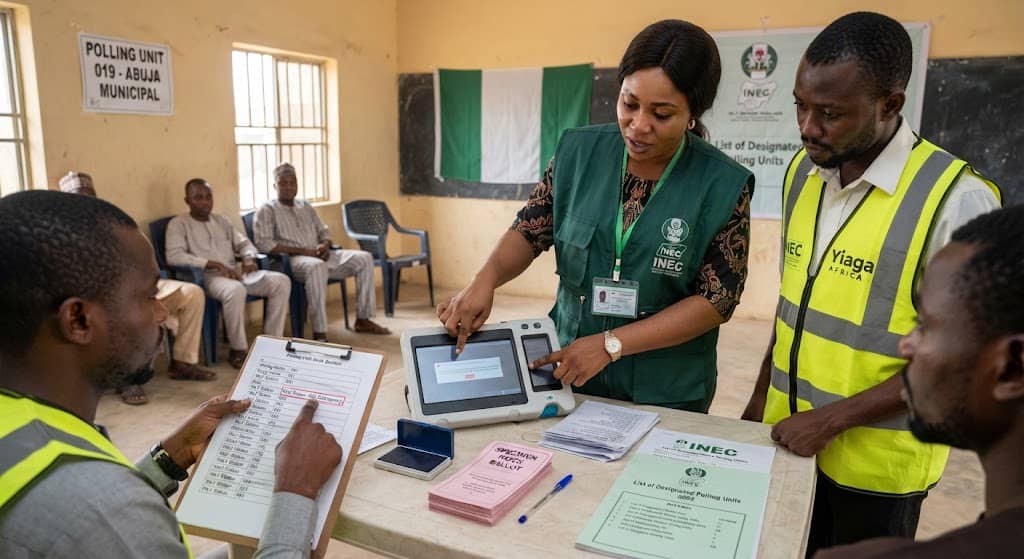
INEC had presented the mock accreditation as a test of upgraded election technology and operational procedures ahead of 2027.
In announcing the exercise, INEC Chairman Prof. Joash Amupitan said the commission was seeking to verify that accreditation and electronic results transmission were functioning properly.
He also said the commission had introduced validation safeguards to prevent inaccurate or over-voted result sheets from being uploaded to IReV.
As of publication, the available reports contained INEC’s general satisfaction with the mock exercise but no detailed commission response to the 453-unit allegation or ADC’s 14-day demands.
INEC’s website had published the list of polling units designated for the November 28 exercise, but the reported mismatch between the official total and the IReV listing remains unresolved in the public record reviewed for this report.
Yiaga Africa recommended that INEC reconcile its geographic datasets, strengthen technical support and connectivity, improve training and supervision, and provide clear procedures for resolving result-upload errors.
It also urged the commission to introduce system controls preventing results from being uploaded before the stipulated 2:30 p.m. threshold.
With the 2027 presidential and National Assembly elections scheduled for January 16 and the governorship and State Assembly elections for February 6, the dispute has turned a technology test into an early test of INEC’s transparency.
For ADC and the observer community, the central demand is straightforward: every polling unit must be identified, configured and independently verifiable before election day.