

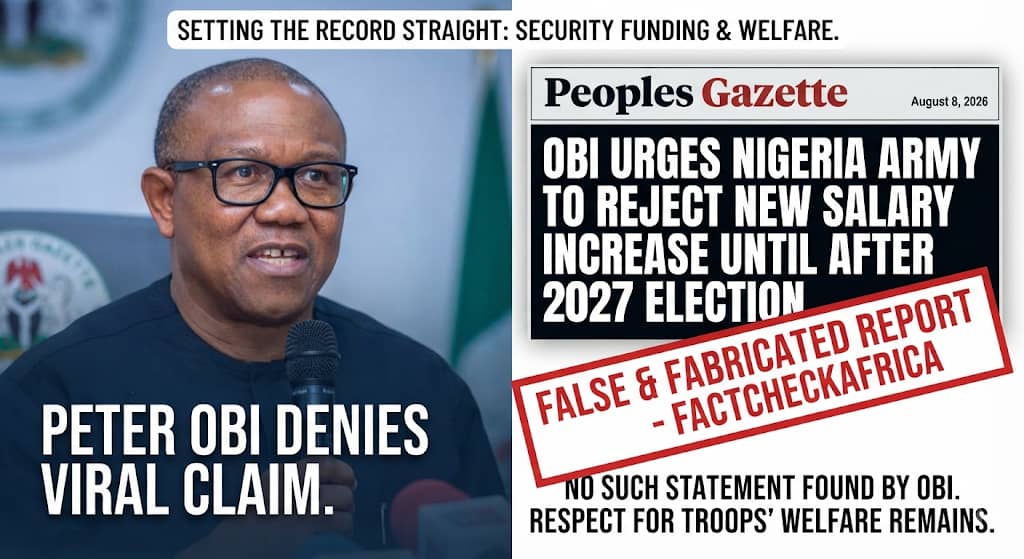
Peter Obi has rejected a viral report claiming that he urged Nigerian soldiers to refuse the Federal Government’s newly approved salary increase until after the 2027 general election, calling the allegation false and misleading.
In a clarification posted on X and reproduced in the statement provided for this report, the presidential hopeful said he had “never said military should reject salary increase.”
He stressed that his respect for Nigeria’s security forces was unwavering and that he had consistently advocated better equipment, motivation, protection and welfare for personnel serving under difficult conditions.
“Those who ensure Nigeria’s security must never be relegated to a secondary
concern,” Obi said, promising that the welfare, resources, safety and honour of soldiers would be a “paramount priority” if he were elected president.
The controversy emerged after a graphic circulated online attributing to Obi the claim that “Nigeria army should reject the new approved salary increase until after the 2027 election.”
The graphic was designed to resemble a Peoples Gazette publication and was
dated August 8, 2026.
However, FactCheckAfrica reported that no matching story could be found on the newspaper’s website and that searches of Obi’s public statements, interviews, speeches and media coverage produced no evidence that he made the remark. The organisation rated the claim false.
The FactCheckHub also listed the allegation as a false claim, although the article page available during this review returned a 404 error.
Its indexed result nevertheless stated that checks found no evidence Obi had asked the military to reject the pay increase.
A real pay rise behind a fabricated quote
The false attribution gained traction against the backdrop of a genuine military pay announcement.
President Bola Tinubu approved salary increases ranging from 30 per cent
to 80 per cent for about 250,000 members of the armed forces, with implementation scheduled for September 1, 2026.
The approved structure is graduated by rank, with the largest percentage increase directed at junior personnel. Soldiers from the rank of private to staff sergeant will receive an 80 per cent increase.
Personnel from colonel down to warrant officer will receive a 50 per cent increase, while officers above the rank of colonel, including brigadier-generals, major generals, lieutenant-generals and generals, will receive a 30 per cent increase.
The State House said the measure will raise the armed forces’ annual wage bill from ₦660 billion to ₦924 billion—an increase of ₦264 billion.
Tinubu said the package was intended
to recognise the sacrifices of troops confronting terrorism, banditry and kidnapping, while reiterating his administration’s pledge to prioritise troop welfare and military modernisation.
Reuters placed the decision within Nigeria’s broader security crisis, noting that Boko Haram and Islamic State West Africa Province continue to attack in the northeast, armed bandit groups operate across parts of the northwest, and ransom kidnappings remain a serious problem in north-central Nigeria.
The report also noted that successive
governments have struggled to contain insecurity despite increased deployments and spending.
Obi’s concern: protection, not rejection
In his clarification, Obi linked his position to the danger faced by troops in the field, referring to the loss of soldiers to insurgents after what he described as a delayed rescue effort, asking how those defending the country could be left exposed when they themselves needed protection.
That emphasis is consistent with the context identified by FactCheckAfrica, cited an April 2026 statement in which Obi expressed concern about the safety and welfare of the armed forces after Brigadier-General O. Braimah and other soldiers were killed in a Boko Haram attack.
It found that the statement focused on protecting servicemen and valuing their lives—not on asking them to reject improved pay.
The confusion may also have been fuelled by Obi’s previous criticism of proposed salary increases for political office holders.
In August 2025, he described a proposed pay rise for politicians as insensitive and argued that government should give greater priority to ordinary Nigerians and security personnel. But that position concerned the remuneration of elected officials, not the salaries of soldiers.
The political reaction
The immediate reaction has largely centred on verification rather than a substantive debate over whether soldiers should accept the new pay package.
Fact-checkers have rejected the quote, while social-media posts and reposts helped spread it by presenting fabricated headline as if it were a report from a recognised newspaper.
The episode illustrates how a real government announcement can provide a credible-looking backdrop for a false
political attribution.
Tinubu’s administration has presented the pay increase as a direct response to the sacrifices of military personnel.
Obi’s clarification, meanwhile, seeks to reclaim security-welfare argument by insisting that soldiers need more than salaries: they need timely rescue, reliable equipment, adequate protection and a government prepared to stand by them in moments of peril.
For voters, the central fact is straightforward: there is no credible evidence that Peter Obi told Nigerian soldiers to reject the approved salary increase until after the 2027 election.
What he has now said is that the allegation is untrue and that, under his
leadership, the security forces would receive greater attention, protection and institutional respect.