

The ongoing political rivalry between Nigeria’s ruling camp and opposition has once again spilled onto the international stage, this time involving lobbying efforts in the United States.
The escalating war of words highlights a deepening schism as both sides trade accusations regarding foreign interference, legal histories, and the sanctity of Nigeria’s sovereignty.
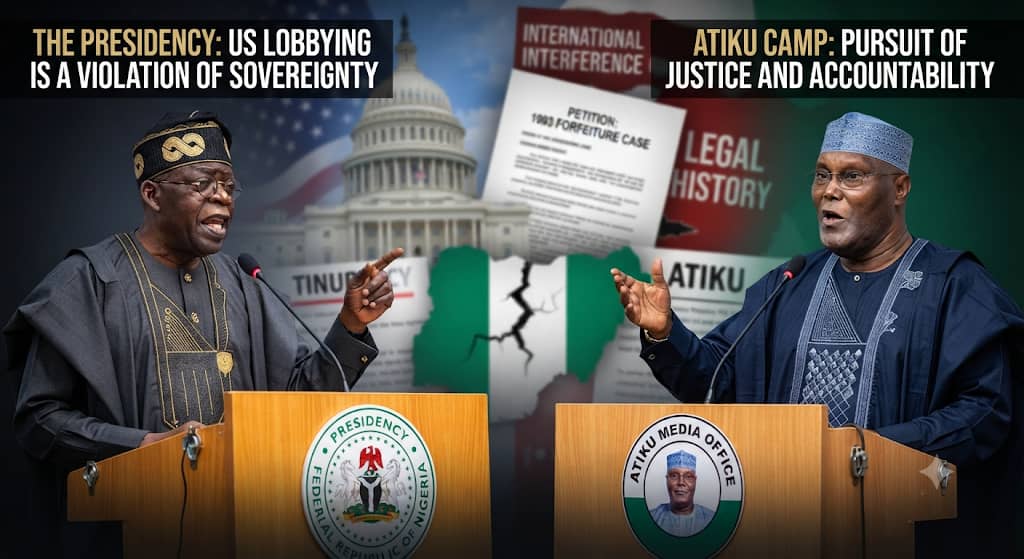
The latest flare-up began with a blistering statement issued on July 23, 2026, by Bayo.Onanuga, Special Adviser to the President, Bola Ahmed Tinubu on Information and Strategy.
The Presidency’s statement strongly condemned the actions of the former Vice President and the Presidential candidate of the African Democratic Congress (ADC), Atiku Abubakar.
According to Onanuga, Atiku’s US-based lobbying group recently submitted petitions to President Donald Trump and US State Department concerning a civil forfeiture case dating back to 1993.
The Tinubu camp characterized this move as an act of desperation by a perennial political aspirant.
He argued that the 1993 matter was fully resolved over three decades ago without any criminal conviction, and that reviving it was an attempt to rewrite history.
Furthermore, the Presidency dismissed the act of reporting a sitting Nigerian president to a foreign leader as a violation of national sovereignty and an “affront to the intelligence of Nigerians”.
The statement went further to question Atiku’s own legal standing, referencing his connection to the past US Senate investigations into foreign corruption and suggesting that his political ambitions were driven by a need for diplomatic immunity.
In a swift and equally sharp retort, the Atiku Media Office responded on the same day, accusing the Tinubu administration of attempting to “whitewash” a narcotics trafficking scandal.
The opposition camp challenged the Presidency’s claim that the 1993 case was long settled, arguing that the administration’s defensive posture indicated a desire to bury the records of alleged heroin trafficking links.
The Atiku camp drew a direct parallel to the Tinubu Presidency’s own allegations regarding a $460,000 forfeiture in the United States.
They questioned why the President would block efforts to revisit the case, particularly noting that a change in US leadership between 2023 and 2027 could potentially reopen investigations into past allegations.
The opposition statement framed their actions not as a betrayal of sovereignty, but as a necessary pursuit of justice, asserting that issues of criminal justice are never entirely discarded.
This exchange illustrates a significant escalation in political tactics, moving beyond domestic policy debates to international legal maneuvering.
The Tinubu administration views the use of foreign lobbyists as a self-defeating and unpatriotic strategy that undermines national dignity.
Conversely, the Atiku camp views international legal avenues as a legitimate mechanism to hold leadership accountable and ensure.transparency.
As both camps continue to leverage international platforms to score domestic political points, the Nigerian public is left to navigate a political landscape increasingly defined by international litigation and public relations battles.