


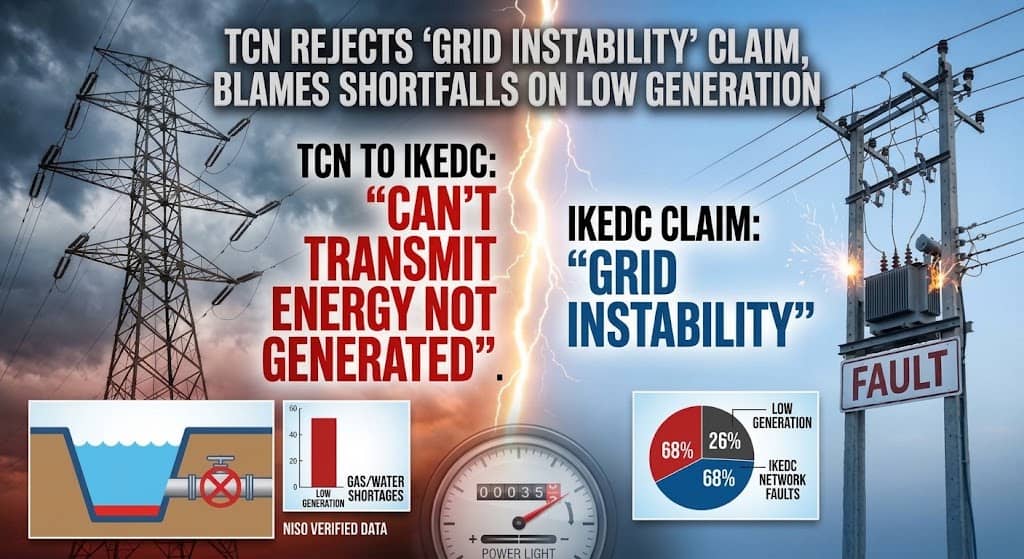
The Transmission Company of Nigeria (TCN) has rejected Ikeja Electric’s claim that recent outages affecting several Band A feeders were caused by “grid instability,” insisting that the disruptions were largely the result of declining power generation.

In a statement issued on Friday, TCN said Ikeja Electric’s public notice, published on November 5, wrongly attributed outages recorded on November 3 and 4 to the transmission company.
TCN argued that, under Section 67 of the Electricity Act 2023, only the Nigerian Independent System Operator (NISO) has the authority to determine the root cause of disturbances, shortfalls and interruptions on the national grid.
According to TCN, NISO had already linked the current reduction in electricity supply to constraints in gas availability to thermal power plants and lower output from hydroelectric stations caused by reduced reservoir inflows.
The system operator said the decline in generation had reduced the amount of electricity allocated to distribution companies, leading to fewer supply hours and increased load shedding across distribution networks.
“TCN can only transmit the energy made available to it and cannot transmit energy that is not generated,” the company said.
TCN added that its review of outage records showed no evidence of a TCN equipment failure or trip.
Of the interruptions recorded across feeders supplying Ikeja Electric, 68 percent were attributed to frequency-control load shedding caused by low generation.
Another 26 percent were linked to Ikeja Electric’s non-compliance with load allocations issued by NISO’s National Control Centre, as well as faults and maintenance on the company’s own network.
The remaining six percent involved scheduled TCN maintenance, switching or line limitations.
The transmission company said the records for the 33kV feeders listed in Ikeja Electric’s notice told a similar story.
Of 46 recorded interruptions, 29 were caused by low-generation load shedding, while 14 were traced to Ikeja Electric—nine involving non-compliance with allocated load and five involving faults or trips on its network.
The remaining three interruptions, TCN said, resulted from scheduled maintenance on the Ogba–Alimosho transmission line.
TCN also cited the Rack Centre feeder as an example, saying the interruption was caused by a cable fault on Ikeja Electric’s network and was repaired by the company’s own crew.
It noted that Ikeja Electric’s notice itself assigned some faults involving the MTN, Iju Water Works and Rack Centre feeders to the distribution company.
TCN accused Ikeja Electric of misleading customers and undermining confidence in the electricity market by attributing generation-related shortfalls to the transmission network.
It urged all distribution companies to rely on verified information from NISO when explaining supply disruptions to customers, while advising electricity consumers to consult NISO’s official platforms for accurate updates.
Despite the dispute, TCN expressed sympathy for customers affected by reduced supply hours and said it remained committed to transmitting all available electricity safely and reliably within existing operational constraints.