

The world’s climate crisis arrived in Barbados with a stark message: the countries least responsible for global warming are being forced to pay the highest price.

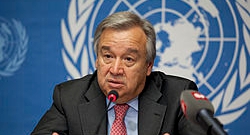
Speaking alongside Barbadian Prime Minister Mia Mottley on Sunday, United Nations Secretary-General António Guterres condemned the failure of COP31 in Antalya, Türkiye, to reach an overarching agreement—warning that governments had fallen short just as climate impacts accelerate.
“Governments failed to rise to the level of ambition this crisis demands,” Guterres said.
From Barbados, his words carried particular weight. Small island states have contributed little to the emissions driving climate change, yet they face stronger storms, rising seas, damaged economies and mounting costs to protect their people.
Across the Caribbean, record temperatures and intensifying disasters are colliding with rising debt, high interest rates, fuel-price shocks and a growing security threat from organized crime and trafficking.
Guterres said the world cannot address the climate emergency while continuing to expand its dependence on coal, oil and gas. “We can’t put out the fire while pouring fuel on it,” he said, calling for a rapid, fair and orderly transition to renewable energy.
He also urged major emitters to lead, wealthy nations to deliver climate finance—especially for adaptation—and governments to slash methane emissions, one of the fastest ways to slow warming.
For Barbados and its neighbors, climate action is not an abstract debate. It is a question of survival, economic stability and justice.
Mottley has repeatedly pressed for a global financial system that gives developing countries a stronger voice and access to more affordable financing.
Guterres praised that effort, pointing to the Bridgetown Initiative as a model for reforming international finance and addressing unsustainable debt.
“Justice demands far greater support for adaptation, loss and damage, and a just transition to renewable energy,” he said.
The UN chief also addressed the crisis in Haiti, where violence, weakened state authority and years without national elections have left millions facing deep insecurity.
He called for the full deployment of the Gang Suppression Force and sustained support for Haiti’s security institutions, while insisting that security measures alone cannot solve the crisis.
Haiti, he said, needs a Haitian-led political process capable of restoring democratic institutions, rebuilding state authority and giving young people an alternative to gang control.
The visit also marked a deepening partnership between Barbados and the United Nations.
The two sides signed a new five-year Sustainable Development Cooperation Framework and agreed to a 25-year lease for UN House in Barbados—what Guterres described as a signal that the organization is committed to the region for the long term.
Barbados is also hosting a special summit on artificial intelligence, focused on safety, responsible governance and ensuring that developing countries share in the technology’s benefits.
As the island prepares to host that discussion, Guterres offered a broader reminder: influence is not measured by size. “Size does not determine significance,” he said.
For Barbados, that principle has become both a national identity and a global challenge. Its leaders are demanding that the countries with the greatest power accept the greatest responsibility, before the next storm, crisis or broken promise arrives.