


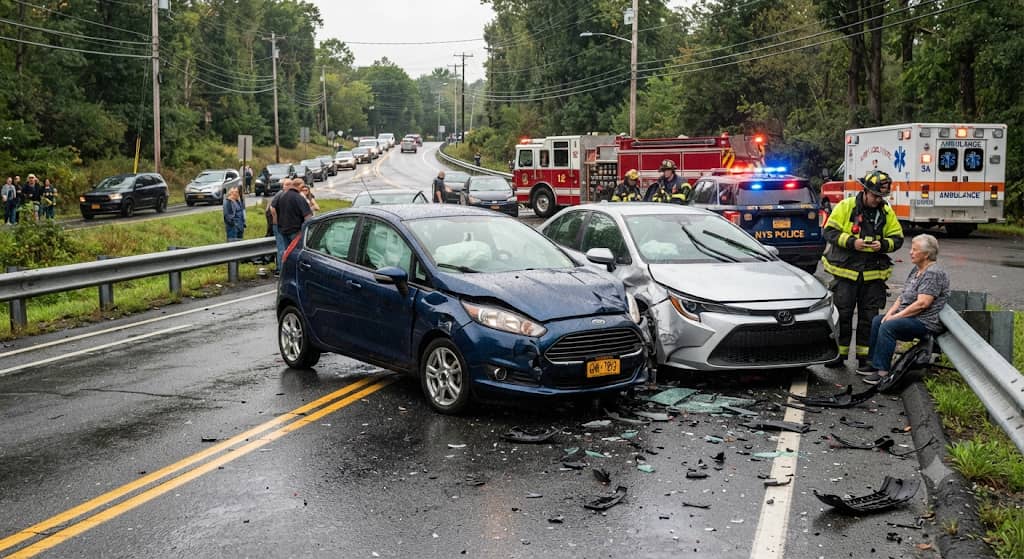
Despite a global surge in vehicles, road traffic deaths worldwide have declined by 21% over the past 15 years, prompting the United Nations General Assembly to adopt a landmark declaration on Monday aimed at halving road fatalities and serious injuries by 2030.
The announcement coincided with the release of new data from World Health Organization (WHO) revealing that 1.16 million people still lost their lives in road traffic crashes in 2025.
Road traffic injuries continue to be the leading cause of death for children and young adults aged 5 to 29 globally.
“This progress shows that change is possible when countries invest in safe road systems,” said WHO Director- General Dr. Tedros Adhanom Ghebreyesus.
“In the last 15 years we’ve made real progress in reducing road deaths, despite surging vehicle numbers and major shifts in how people move.”
The newly adopted UN resolution, titled “Progress declaration of the high-level meeting on improving global road safety,” passed with 162 votes in favor.
It reaffirms the target set during the Second Decade of Action for Road Safety (2021-2030) to reduce traffic deaths by at least 50%.
Jean Todt, the UN Secretary-General’s Special Envoy for Road Safety, emphasized the urgency of the situation. “Resolutions have been adopted.
“Commitments have been made.
Declarations have been endorsed. But, actions are still too poor,” Todt warned the assembly.
The Rise of New Mobility and Regional Disparities
The landscape of global road transport has transformed dramatically between 2011 and 2025, with over a billion new motor vehicles added to the world’s roads.
The rise of ridehailing and delivery apps has led to a tripling of motorcycle usage globally. Consequently, motorcyclists now account for nearly a third of all road fatalities.
Dr. Etienne Krug, Director of the Department of Health Determinants, Promotion and Prevention at WHO, highlighted the vulnerability of pedestrians and cyclists.
“More than half of all road deaths are people who aren’t even in a car ‒ they are walking, cycling or riding a motorcycle. When roads are designed as if only car drivers matter, these people are left dangerously exposed,” Dr. Krug stated.
While global numbers show improvement, progress remains highly uneven across different regions. According to WHO data, the European Region led the way with a 36% drop in road deaths between 2011 and 2025.
The Western Pacific Region also recorded a significant decline of 15%, while the South-East Asian Region saw a modest 2% reduction. In the Americas, road death rates remained essentially unchanged over the same period.
Most.concerning, however, is the African Region, where road deaths rose by 17% during those 15 years. This alarming increase has been largely attributed to the proliferation of motorbike taxis and inadequate road safety laws and enforcement.
The “Safe System” Approach
To combat these disparities, the new UN declaration commits member states to adopting the “safe system” approach.
This methodology shifts the focus from blaming individual road users to designing a transport system that accounts for human error.
The goal is to ensure that when mistakes occur, the impact remains within survivable limits. The commitments outlined in the declaration include:
• Implementing national road safety strategies with explicit targets, timelines, and budgets.
• Establishing dedicated lead road safety agencies.
• Improving data collection and analysis to better inform policy.
• Developing and enforcing stronger legislation regarding speed, impaired driving, and helmet use.
• Ensuring that all new and upgraded road infrastructure meets minimum safety standards.
As nearly 60% of the global population now resides in urban areas, the pressure on transport systems designed primarily for private vehicles continues to grow.
The WHO and the UN are urging a shift toward safer mobility options, noting that promoting walking, cycling, and public transport can significantly improve public health, reduce congestion, and enhance the quality of life in cities.
Dr. Ghebreyesus in his message concluded with a firm message: “All road deaths are preventable and none are acceptable.