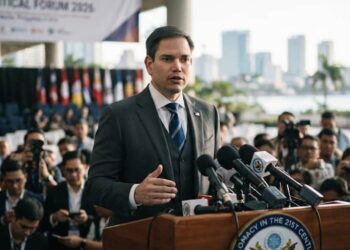


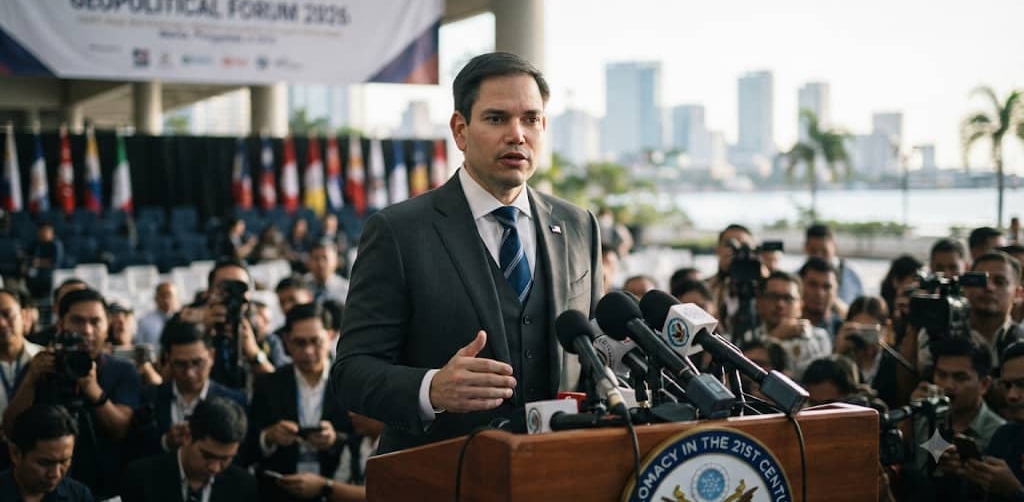
In a sprawling, open-air convention center under the sweltering Manila sun, the United States Secretary of State, Marco Rubio has stepped to the podium with the weight of the world on his shoulders.
The backdrop was the Philippines, a nation standing at the geographic and strategic epicenter of the most volatile geopolitical crossroads of the 21st century.
The year was 2026, and the globe was a tinderbox. From the Strait of Hormuz to the South China Sea, the waters were boiling. Yet, as Rubio faced the press corps, his demeanor was one of calculated calm.
He had just concluded a marathon session of high-stakes diplomacy —back-to-back engagements with the architects of America’s greatest rivalries and the leaders of its closest allies.
“Look, these are the two most powerful countries in the world,” Rubio told those reporters, his voice steady. “We have to have a relationship.”
He was referring, of course, to China. The meeting with his Chinese counterpart, Wang Yi, had stretched for hours.
In a world accustomed to the snap of diplomatic tensions, the sheer length of the encounter sparked immediate speculation of a fiery confrontation.
But Rubio dismissed the notion, offering a pragmatic translation of the reality: “Translations always take longer.”
Beneath the mundane explanation lay a profound strategic truth. The U.S. and China were navigating a dangerous dance of “great differences.”
From Taiwan’s coastal waters to the
intellectual battle against communism, the ideological chasm was vast. Yet, the U.S. was laying the groundwork for a pivotal September visit by President Xi to Washington.
The goal was not to erase the differences, but to manage them with surgical precision so they “never get out of control.”
While Washington looked East to manage the dragon, its eyes were equally fixed on the Middle East, where the air was thick with the smoke of a simmering, if not outright, conflict with Iran.
Rubio’s briefing took a sharp turn toward the perilous straits where commercial ships were being blown up, their hulls ruptured by Iranian missiles.
The stakes could not be higher. It was a battle for the lifeblood of the global economy, with 20 percent of the world’s oil transiting those very waters. “Iran’s in a lot of trouble,” Rubio declared, painting a portrait of a regime hollowed out by
hyperinflation and two decades of squandered wealth.
The money meant for the Iranian people had been funneled into a massive conventional shield of drones and missiles a shield designed to mask a covert nuclear program.
“We’re defending that shipping,” Rubio stated firmly, outlining a dual-track strategy of open water protection and the targeted degradation of Iranian launch sites.
The message to Tehran was clear: the era of dictating global commerce was over. But the door to diplomacy, Rubio insisted, remained ajar, provided Iran abandoned the illusion that it could
dictate terms from behind a crumbling conventional shield.
As the press conference waned, the intricate web of global alliances was laid bare. The U.S. was courting Russian Foreign Minister Lavrov for a potential peace in Ukraine, reaffirming its ironclad treaty commitments to the Philippines against Chinese aggression in the South China Sea, and urging regional allies to step up their naval defenses.
The narrative that emerged from the podium in Manila was not one of the unilateral dominance, but of a masterful, agonizing balancing act.
It was a portrait of an America navigating a multipolar world where military force and diplomatic dialogue were not mutually exclusive, but entirely interdependent.
United States Secretary of State had walked the tightrope over the abyss of global conflict, proving that even in an era of unprecedented tension, the most powerful tool in the arsenal remains the ability to keep the conversation going.