

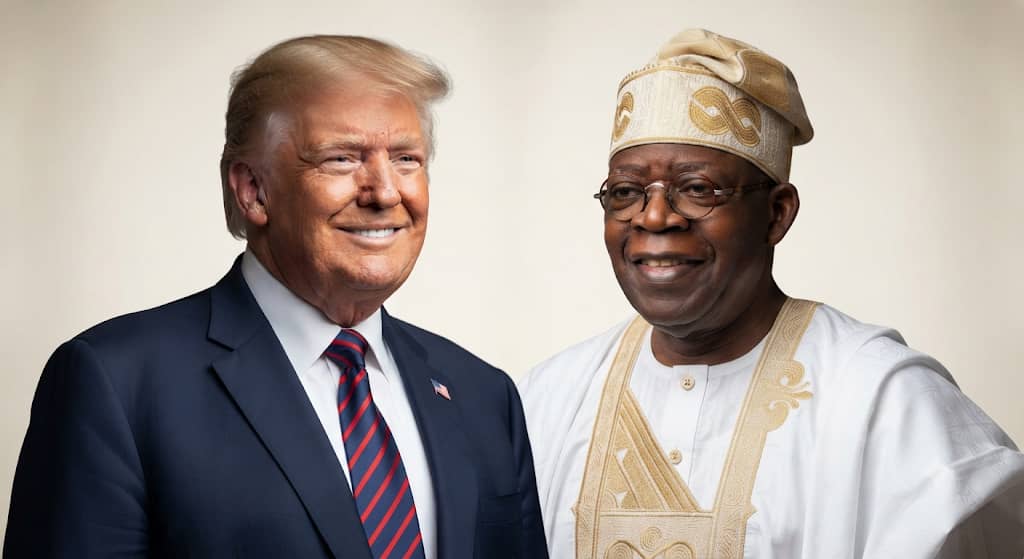
In a significant boost to Nigeria’s ongoing war against insurgency, the United States President, Donald Trump has praised the President Bola Ahmed Tinubu for his “decisive leadership” in combating terrorism.
The commendation, delivered via a letter on July 6, 2026, underscores the deepening security cooperation between the two nations as they confront the escalating violence threatening West Africa.
A Shared Fight Against Extremism
In his letter to President Tinubu, Trump commended the Nigerian leader’s resolve to tackle the issues plaguing the nation, specifically highlighting the violence affecting Christian communities.
“It is a true honour to stand with you in the fight against these terrorists and to make the Federal Republic of Nigeria stronger and more prosperous,” Trump wrote, expressing pride in deploying US Special Operations Forces.
He noted that these elite units have
equipped the Armed Forces of Nigeria with the necessary skills, tools, and intelligence to protect their homeland.
The praise reflects a concerted effort to fortify the US-Nigeria relationship, which has flourished recently despite global complexities.
This collaboration is anchored by the
historic US-Nigeria 2026 Defence Cooperation Roadmap, establishing a robust framework to confront terrorism.
Joint Operations Yield Tangible Results
The bilateral security cooperation has already produced notable successes. A highlight of this partnership was the coordinated attack on Islamic State (ISIS) hideouts in the Lake Chad area on May 16, 2026.
This joint operation, involving US Africa Command (AFRICOM) and Government of Nigeria, resulted in the elimination of Abu-Bilal al-Minuki, the director of global operations for ISIS, along with several other senior leaders and numerous
militants.
Following the successful strikes, AFRICOM Commander General Dagvin Anderson praised the exceptional value of the US-Nigeria partnership.
He noted that the operation not only
degraded local ISIS capabilities but also disrupted the group’s broader global network.
Navigating the Security Landscape
While the joint military successes are celebrated, broader security landscape in Nigeria remains fraught with challenges.
The country is grappling with a compounding security crisis that spans multiple regions.
Beyond the Boko Haram and Islamic State West Africa Province (ISWAP) insurgency in the northeast, Nigeria faces severe banditry and kidnapping in the northwest, and intercommunal violence in the Middle Belt.
The violence has not been confined to specific religious groups; organizations monitoring political violence note that most victims of jihadist attacks are Muslims, as the operations concentrated in the predominantly Muslim north.
However, attacks on Christian communities have drawn significant international attention and concern.
Strategic Withdrawal and Continued Support
In a recent development, the United States has withdrawn most of the troops it deployed for the May operations in Nigeria.
According to AFRICOM, the withdrawal of these combat forces does not signal a retreat but rather a shift in strategy. The US will continue to provide crucial intelligence sharing and technical assistance to Nigerian forces.
General Anderson emphasized that the Nigerian military has remained “very active” since the May operation, continuing to prosecute targets independently.
The US approach aims to provide specialized capabilities while allowing African partners to lead their security operations.
Looking Ahead
The collaboration between Washington and Abuja is viewed as a model for future security cooperation in Africa.
With both nations sharing a mutual goal of confronting terrorism, the ongoing partnership is critical in stabilizing not just Nigeria, but the entire West African
region.
As the US continues to share intelligence and expertise, Tinubu’s administration faces formidable task of consolidating these security gains and addressing the root causes of the widespread violence.