

A devastating wave of coordinated terrorist attacks swept across the Sahel region over the weekend of July 17 and 18, 2026, leaving a heavy toll of civilian and military casualties in both Niger and Mali.
The ambushes, claimed by the al-Qaeda affiliates, separatist groups, underscore a rapidly deteriorating security situation that has drawn fierce condemnation from the African Union and raised alarm across the international community.
A “Bloody Friday” in Niger
In Niger, Friday, July 17, marked one of the deadliest days in recent memory for the western Tillabéri region.
According to local reports, violence erupted in the Dorodji area of the Dosso region, where armed assailants targeted civilians in three villages: Dorodji Koira Béri, Dorodji Sékou Koira, and Dorodji Koira Zéno.
Initial figures suggest at least 33 civilians were killed, with reports indicating that some victims were massacred while performing prayers.
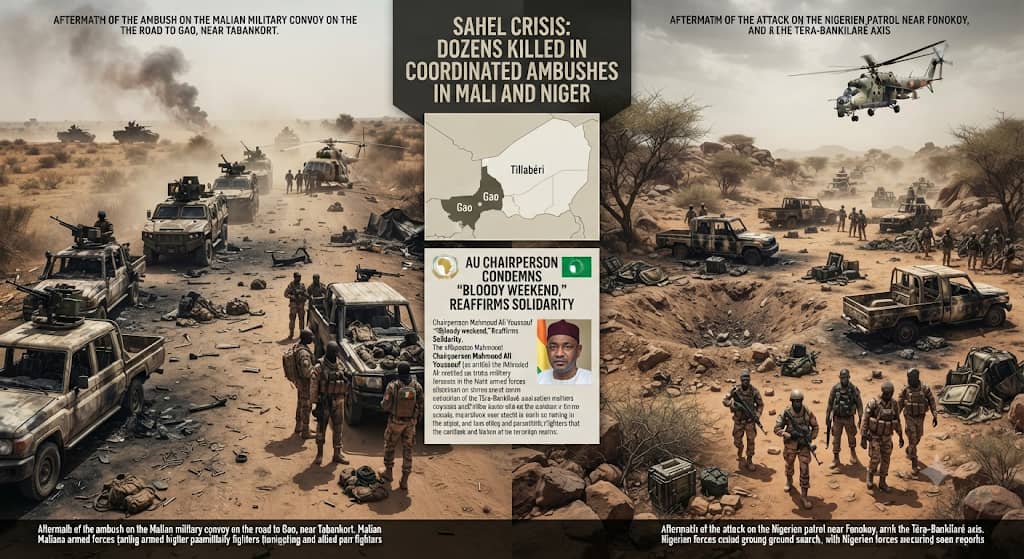
Concurrently, a major ambush targeted a patrol of Nigerien defense and security forces along the Téra-Bankilaré axis in the Tillabéri region, near the village of Fonokoy.
Security sources reported that 53 members of the defense forces were killed, 61 were wounded, and two remain missing.
The Nigerien Ministry of Defense confirmed the attack, stating that a counter-offensive supported by air power neutralized at least 15 assailants.
The Tillabéri region, bordering Burkina Faso and Mali, has long been flashpoint for violence driven by groups affiliated with the Islamic State and al-Qaeda.
The scale of the July 17 attacks highlights the persistent capability of these armed groups to execute complex operations that simultaneously terrorize civilian populations and inflict heavy losses on state security apparatuses.
Ambush on the Road to Gao
The violence spilled over into neighboring Mali the following day. On Saturday, July 18, a Malian military convoy traveling from the strategic northern town of Anefis to the city of Gao was ambushed near Tabankort.
The attack was jointly claimed by the al-Qaeda-linked Jama’at Nusrat al-Islam wal-Muslimin (JNIM) and the separatist Azawad Liberation Front (FLA).
Sources close to the rebels claimed that more than 50 soldiers and allied Russian paramilitary fighters from the Africa Corps were killed in the assault, with dozens more taken hostage.
JNIM and the FLA released footage purportedly showing Malian soldiers
surrendering and being fired upon while lying on the ground.
The Malian army confirmed the ambush and stated that retaliatory airstrikes killed at least 20 insurgents, though they did not immediately release official casualty figures for their own forces.
The ambush is part of a broader escalation by JNIM and Tuareg-led separatist groups, who joined forces in April 2026 to launch nationwide attacks aimed at destabilizing the militaryled government in Bamako.
The ongoing conflict has triggered a severe humanitarian crisis in Mali, leaving over five million people in need of assistance.
The African Union Responds
The resurgence of violence has prompted swift international reaction. H.E. Mahmoud Ali Youssouf, Chairperson of the African Union Commission, issued a strong statement condemning the attacks in both nations.
“The Chairperson reaffirms the African Union’s full solidarity with the States and peoples of the Sahel, who continue to face a terrorist threat that undermines the security, stability and development prospects of the entire region.
He recalls that terrorism constitutes a transnational threat requiring a collective, coordinated and sustained response, grounded in African solidarity and the principle of shared responsibility.”
Youssouf extended heartfelt condolences to the governments and citizens of Niger and Mali, paying tribute to the soldiers who sacrificed their lives.
He urgently called for strengthened regional cooperation, emphasizing the need for enhanced intelligencesharing, border security, and efforts to combat terrorist financing.
A Region at a Tipping Point
The July 2026 attacks serve as a grim reminder of the entrenched instability in the Sahel.
Despite the formation of the Alliance of Sahel States (AES)—a mutual defense pact between Niger, Mali, and Burkina Faso—and the influx of foreign military support, including Russian paramilitaries in Mali and recent U.S. equipment deliveries to Niger, extremist groups continue to operate with devastating effectiveness.
As the death toll rises and communities are displaced, the governments of Niger and Mali face mounting pressure to protect their citizens and restore order in regions where the state’s presence is increasingly contested by heavily armed insurgencies.