

The Transmission Company of Nigeria (TCN) has targeted maintenance with fresh equipment supplies to strengthen electricity transmission across its Benin Sub-Region, even as planned works temporarily disrupt power supply in parts of Edo and Enugu states.

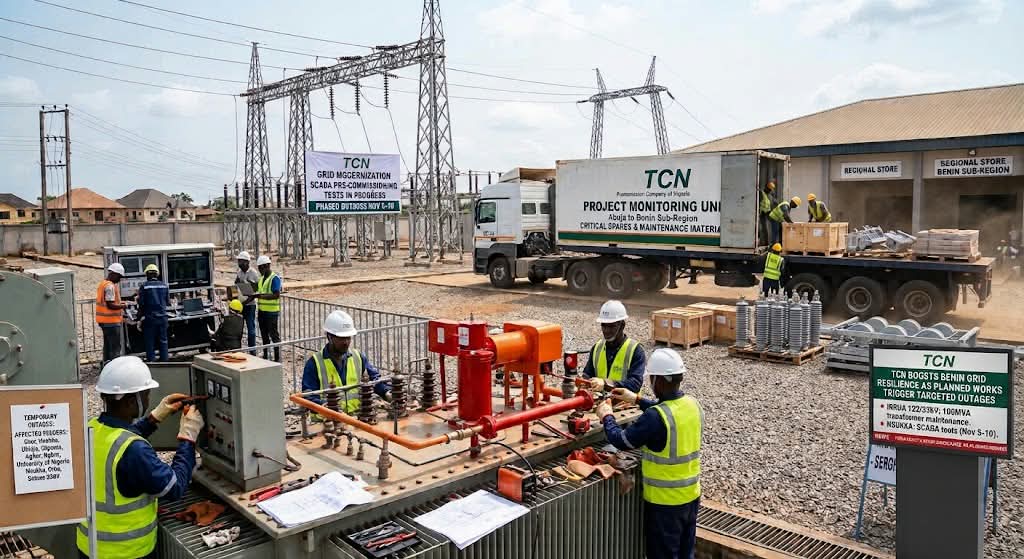
At the Irrua 132/33kV Transmission Substation, TCN maintenance crews worked on the 100MVA transformer from November 2 to 3. The exercise enabled contractors to commission a SERGI fire-protection system installed on the transformer.
The work temporarily affected bulk power supply to the Ehor, Uzebba, Ubiaja, Ekpoma and Agbor 33kV feeders, leaving the Benin Electricity Distribution Company unable to serve customers connected to those lines during the maintenance period.
In a separate notice, TCN announced phased outages at the Nsukka–New Haven 132kV Transmission Substation from November 5 to 10 to allow contractors to conduct SCADA pre-commissioning tests.
The interruptions are expected to remain limited to areas directly affected at any given time, while other locations continue receiving bulk electricity.
Customers supplied through the Nsukka 132kV Substation, the University of Nigeria, Nsukka, and the Orba and Sumas 33kV feeders are expected to experience interruptions on affected days. TCN said there will be no outage on November 8 and 10 as the work progresses.
Alongside the planned interventions, TCN’s Benin Sub-Region has received a truckload of critical spares and maintenance materials from its Project Monitoring Unit in Abuja.
The delivery includes 330kV and 132kV tripping coils, rapid-pressure relays, current-transformer ratio clamps, gantry structures and porcelain insulators.
The equipment has been secured in the regional store and is ready for deployment during routine or emergency maintenance.
According to TCN, the new supplies will help crews respond more quickly, reduce downtime and improve the reliability of bulk power delivery to distribution companies across the region.
Together, the maintenance projects and equipment delivery signal a broader effort to improve grid safety, resilience and service reliability—though customers in the affected areas must endure short-term disruptions as the upgrades are carried out.