


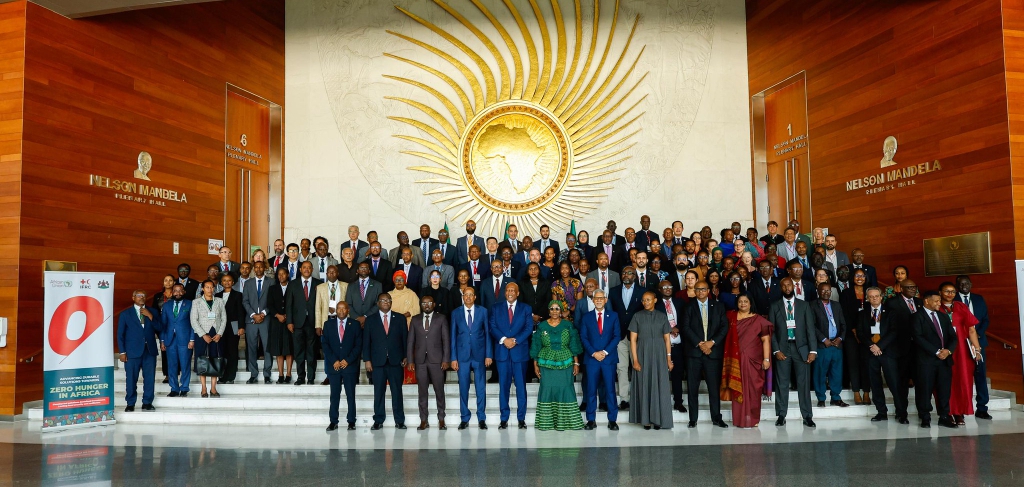
African Union leaders and the International Federation of Red Cross and Red Crescent Societies have called for a fundamental change in how Africa tackles hunger: away from repeated emergency relief and toward prevention, resilient food systems and sustained, country-led investment.

The appeal came at a high-level AU‒IFRC convening in Addis Ababa on 3 November, organised under the theme “Advancing Durable Solutions Towards Zero Hunger in Africa.”
The meeting brought together African governments, Red Cross and Red Crescent societies, development finance institutions, donors, philanthropic organisations and private-sector partners.
Its stated aim was to align investment with national priorities and turn locally led solutions into programmes capable of operating at scale.
IFRC Secretary-General and CEO Jagan Chapagain said the urgency was underscored by the scale of food insecurity across the continent.
Citing the 2025 State of Food Security and Nutrition in the World report, he said an estimated 306.5 million people in Africa were undernourished in 2024, while more than half of the continent’s population experienced moderate or severe food insecurity.
“We must act before the crisis, not only after it. And we must address its root causes, not only the symptoms,” Chapagain told the opening session.
He said the next drought, flood, El Niño event or humanitarian emergency could not be the trigger for action each time, arguing that investment must instead help communities prepare for shocks, protect livelihoods and recover more quickly.
King Letsie III of Lesotho, who serves as the African Union Champion for Nutrition and the IFRC Champion for Food Security, made a similar case in his keynote address.
He said humanitarian assistance would remain essential wherever lives were at risk, but warned that emergency relief must be paired with investments that protect people from falling
back into crisis.
“Africa cannot move endlessly from one food emergency to the next,” the King said, calling for a transition “from repeated crisis response to prevention, from dependency to self-reliance, and from fragmented projects to resilient, inclusive and sustainable food systems.”
King Letsie said the challenge was not simply to increase food production. Food must also be accessible, affordable, safe and nutritious throughout the year.
He urged governments and partners to support small holder farmers with technology, climate-smart practices,
finance, infrastructure and reliable markets, while investing in storage, processing, transport and other systems that reduce food losses between harvest and household.
He also called for greater use of indigenous and traditional foods that are nutrient-rich and better adapted to heat, drought and irregular rainfall.
Such crops, he said, could diversify
diets, protect biodiversity, strengthen local businesses and reduce unnecessary dependence on imported food.
Both speakers placed national leadership and community participation at the centre of the proposed response.
Chapagain said solutions must reflect country realities and build on local knowledge, while King Letsie stressed that governments should define priorities and lead implementation rather than have programmes designed at a distance by external partners.
The King urged the Africa Zero Hunger Initiative to expand beyond the Horn of Africa and become firmly embedded across all five of the continent’s regions.
He cited existing work, including the AU‒IFRC food and nutrition resilience process launched in 2022, the Horn of
Africa Food and Nutrition Resilience Programme, and the “Africa Zero Hunger: United for Durable Solutions” campaign.
The IFRC leader highlighted the role of national Red Cross and Red Crescent societies, which have permanent community networks and millions of volunteers.
Their local presence, he said, allows them to connect government priorities with the realities of households facing hunger, climate shocks and displacement.
The proposed Food Security Resilience Platform is intended to bring country priorities, partners and resources together.
The related Food and Nutrition Resilience Programme currently focuses on integrated resilience programming in Ethiopia, Kenya, Somalia and South Sudan, with Lesotho also identified in Chapagain’s remarks as part of the expanding effort.
The AU’s official event outline said the platform and programme should help coordinate financing, technical cooperation and strategic partnerships, while supporting the adaptation and scaling of practical solutions.
Expected follow-up included consideration of an Addis Ababa Communiqué, voluntary commitments and agreed actions linked to the Pan- African Initiative Towards Zero Hunger.
Financing emerged as a central test of the initiative. King Letsie called on public authorities, development banks, climate- finance mechanisms, bilateral and multilateral partners, philanthropies and businesses to move beyond parallel projects.
He urged them to combine co-financing, guarantees, risk-sharing, project preparation, technology and technical assistance around government-validated opportunities.
The proposed investment approach is also intended to create jobs. Irrigation, logistics, storage, food processing, agricultural technology and market development could generate employment and entrepreneurship for Africa’s young people, while helping farmers and communities withstand climate and economic shocks.
The AU Commission Chairperson, Mahmoud Ali Youssouf, reinforced the economic and political dimension of the agenda, saying Africa had the resources and potential not only to feed its people but also to become a global food basket.
He cited the Kampala CAADP Declaration for 2025‒2035 as a framework for transforming agriculture and strengthening food security.
In a separate meeting with Chapagain on the margins of the convening, Youssouf called for stronger food systems through climate-resilient agriculture, improved intra-African trade, better connectivity, strategic partnerships and stronger agricultural value chains.
The two officials also discussed modern technologies, including artificial intelligence, for agricultural productivity, health surveillance and humanitarian response.
Water security was another central thread. King Letsie linked the AU’s 2026 focus on sustainable water availability and safe sanitation to the continent’s food and nutrition goals, arguing that food security cannot last without reliable water systems, sound governance, adequate sanitation and public health.
The speakers also pressed for accountability. King Letsie proposed that every commitment should have a responsible institution, a financing pathway, a realistic timetable and defined results, with progress reviewed after 90 days, six months and 12 months.
Chapagain said success should be measured by whether families are more food secure, livelihoods are stronger, children are receiving adequate nutrition and communities are better prepared
for the next shock.
“Zero Hunger will not be achieved by one organization, one programme or one meeting,” Chapagain said.
“It requires transformative leadership from governments, sustained investment from partners and collective action that connects national ambition with local solutions.”
The Addis Ababa meeting therefore ended with a demanding test for the AU‒IFRC partnership: whether its platforms, programmes and commitments can move beyond declarations and deliver sustained improvements in the lives of farmers, children, women, young people and displaced communities.
For King Letsie, the measure of success will not be the number of speeches delivered or pledges announced.
It will be whether families can secure nutritious food, farmers can face the next drought without losing their livelihoods, and communities once trapped in recurring emergencies can build lasting resilience.