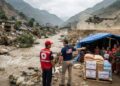



The United States has pledged more than $3.6 million in life-saving humanitarian assistance for flood-hit Nepal, as rescuers confront a rapidly deepening disaster that has killed hundreds, left thousands missing, and cut off communities along the Nepal‒Tibet border.
In a post published August 29, the U.S. State Department said its embassies in Nepal and China were working to assist Americans and support relief operations.
The package includes up to three months of emergency food assistance for as many as 10,000 flood affected households, the department said.
The flood “There is no higher priority for us than the safety of American citizens,” the State Department wrote. “The United States is standing with the people of Nepal.”
The announcement expands an earlier U.S. response. Reuters reported on August 27 that Washington had initially committed $500,000 and was sending a disaster-response adviser to Nepal.
The State Department’s latest message did not provide a line-item breakdown of the additional assistance, but its timing underscored the growing urgency as
rescue teams struggle with damaged roads, destroyed bridges, power outages, and unstable mountain terrain.
The disaster began on August 26 when an apparent glacier-related ice-and-rock collapse sent a torrent of water, mud, and debris through river valleys in northern Nepal swept away homes, bridges, hydro -power facilities, and transport links.
Reuters reported that Nepal had resumed search-and-rescue operations after rain and fog temporarily halted
helicopter flights, while China said the risk from a flood-created lake near the border had eased but remained under observation.
Nepal is now asking for specialized help beyond conventional search and rescue. Foreign Minister Shisir Khanal said the country needs technical teams to reach people trapped in tunnels, restore transportation and communications, conduct DNA testing, and preserve or
identify bodies.
India and China have sent tunnel experts, while India has also supplied food, blankets, medicines, and other relief materials.
The financial challenge will extend well beyond the emergency phase. Nepal’s Finance Minister Swarnim Wagle told Reuters that rebuilding could cost $4 billion to $5 billion, although the estimate remains preliminary while officials assess the damage.
The United Nations has separately committed $2 million for immediate assistance, according to NBC News.
The human toll is especially acute among foreign visitors and families unable to contact relatives.
Nepal’s Foreign Ministry said in an August 27 update that 596 foreign nationals were still missing, including 66 Americans, while cautioning that the figures remained subject to verification as communications and rescue operations developed.
On August 29, the State Department said it was not aware of any confirmed American deaths, but NBC News reported that approximately 100 Americans remained unaccounted for and five had been rescued.
For families waiting outside morgues and emergency centers, the uncertainty has become its own form of trauma.
One relative quoted by NBC News said there was still “a ray of hope” that missing loved ones would be found. A family member of two Texas travelers
said, “This cannot happen to them.”
Aid agencies warn that the crisis will not end when the floodwaters recede. CARE Nepal said families had lost homes, possessions, and livelihoods, while damage to water and sanitation systems was raising concerns about waterborne disease.
The organization said its response was prioritizing women, girls, older people, and people with disabilities, groups often exposed to heightened risks after displacement.
The State Department’s message drew a mixed but highly engaged response on X. Some users expressed sympathy and gratitude, while others criticized the increase from the initial $500,000 commitment.
Another reply focused on refugees and immigration rather than the relief effort. Those comments represent a small sample of visible reactions, not scientific measure of public opinion; the post had recorded roughly 79,000 views and 1,900 likes when reviewed.
For Washington, the operation carries a dual responsibility: helping Americans still awaiting word from Nepal and China while delivering practical assistance to communities facing one of the region’s most devastating recent disasters.
For Nepal, the immediate race is to find
the missing, stabilize threatened settlements, and get food and medical help through a landscape where the roads themselves have disappeared.