


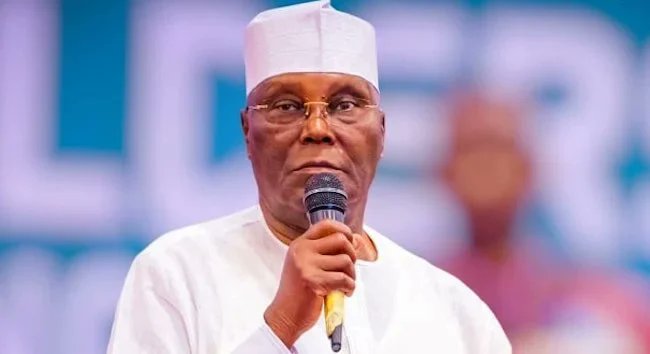
The Presidency has challenged former Vice President Atiku Abubakar to clarify his pledge to “reopen” Nigeria’s land borders if elected, arguing that the country’s borders are already open and that security controls should not be confused with a closure.
Atiku, the African Democratic Congress presidential candidate, made the pledge while addressing supporters in a video circulated online, according to Daily Trust.
He said border restrictions had harmed young traders and argued that restoring cross-border commerce could also improve security by reviving livelihoods.
“All what we call transborder trade is a legitimate business,” Atiku said, referring to traders operating across Nigeria’s borders with Cameroon, Chad, Niger and Benin. “So I said I am going to reopen the borders and I will.”
He also linked the proposal to a plan to develop ports in southern Nigeria. Atiku said alternative routes through Calabar, Uyo and Port Harcourt could reduce the cost and time of moving goods to the North-East, contrasting them with the longer road journey from Lagos to Yola.
In a statement issued on August 28, presidential adviser on media and public
communication Sunday Dare said most of Nigeria’s land borders had been reopened on March 14, 2024.
The Presidency also cited President Bola Ahmed Tinubu’s opening of the Kamba border in Kebbi State on February 14, 2026.
“The facts are straightforward: Nigeria’s land borders are already open,” the statement said, asking which crossings Atiku intended to open and whether he was instead proposing to relax existing controls.
The government said Atiku should identify the measures he would remove and explain how his administration would guard against terrorism, arms trafficking, smuggling, human trafficking and other organised crime.
It stressed that an open border is not the same as an uncontrolled border, and called for a combination of customs and immigration checks, intelligence-sharing, surveillance, technology and joint security operations.
Independent analysis supports both sides of the policy debate
Tukur Abdulkadir, a professor of international relations at Kaduna State University, told Deutsche Welle in April 2024 that communities around the Nigeria-Niger frontier had suffered after sanctions disrupted established economic ties.
“The relationship has spanned centuries, so immediately after the imposition of the sanctions, there were cries everywhere. Local farmers suffered greatly,” Abdulkadir said.
He added that “a semblance of normality has returned” around the Jibiya-Maradi border and that businesspeople could move freely between the neighbouring countries.
His comments underline Atiku’s argument that functioning border crossings can support livelihoods and regional commerce, although they do not address specific security arrangements Atiku would introduce.
Traders have similarly described reopening as a relief. Rafi’a Hussain, a businesswoman interviewed by DW, said: “I thank God for this development and feel delighted to have this border reopened.”
She added that people were moving “freely, peacefully and without any harassment” from officials.
Business-sector representatives, however, have also cautioned that easier movement requires stronger enforcement.
Muda Yusuf, then chief executive of the Centre for the Promotion of Private Enterprise, said in 2022 that reopening the borders could strengthen West African economic integration, but warned against a return to the conditions that had encouraged smuggling and other abuses.
“The security agencies at the borders should be more effective and efficient in policing the borders while ensuring that we adopt more technological options in the management of our borders such as the use of scanners [and] ICT systems,” Yusuf said.
Yusuf also called for informal traders to receive guidance on documentation and
compliance, and for interpreters to be used where necessary in dealings with Frenchspeaking neighbouring countries.
His position suggests that the argument is not simply between open and closed borders, but over whether the govt can make legitimate trade easier while improving enforcement at official and unofficial crossings.
Security researchers have raised a similar concern. The Institute for Security Studies reported that the Amchidé-Banki market on the Nigeria-Cameroon border supports trade in livestock and food products but can also provide supplies for Boko Haram.
The analysis called for Nigeria and Cameroon to reinforce physical security and intelligence capabilities to prevent militants from exploiting growing cross -border trade.
A separate analysis by Onyekachi E. Nnabuihe, a senior lecturer at Caleb University, concluded that Nigeria’s 2019 border closure did not eliminate smuggling.
Instead, the study found that traders and smugglers adapted through unofficial routes, intermediaries and informal payments. It also linked the closure to disruptions in formal trade, livelihoods and the cost of food and other essentials.
That research complicates the Presidency’s argument that tighter controls are essential for security. It suggests that blanket restrictions can push trade outside formal channels,
where monitoring is more difficult.
At the same time, the security analysis from the Institute for Security Studies indicates that reopening without effective intelligence and physical
protection could expose border communities and trade routes to armed groups.
Presidency’s criticism centres on its interpretation of his pledge rather than on a detailed policy proposal reproduced in the government’s response.
The exchange highlights a broader policy tension ahead of Nigeria’s next political contest: how to facilitate trade and movement across the country’s borders while maintaining safeguards against insecurity and transnational crime.
The Presidency said the present Government should be judged by measurable outcomes in security, economic recovery, border management and citizens’ welfare, while insisting that the debate should be grounded in verifiable facts rather than slogans.
Editor’s Note: Claims attributed to the Global Terrorism Index 2026 and official border-opening dates have not been independently verified here.