

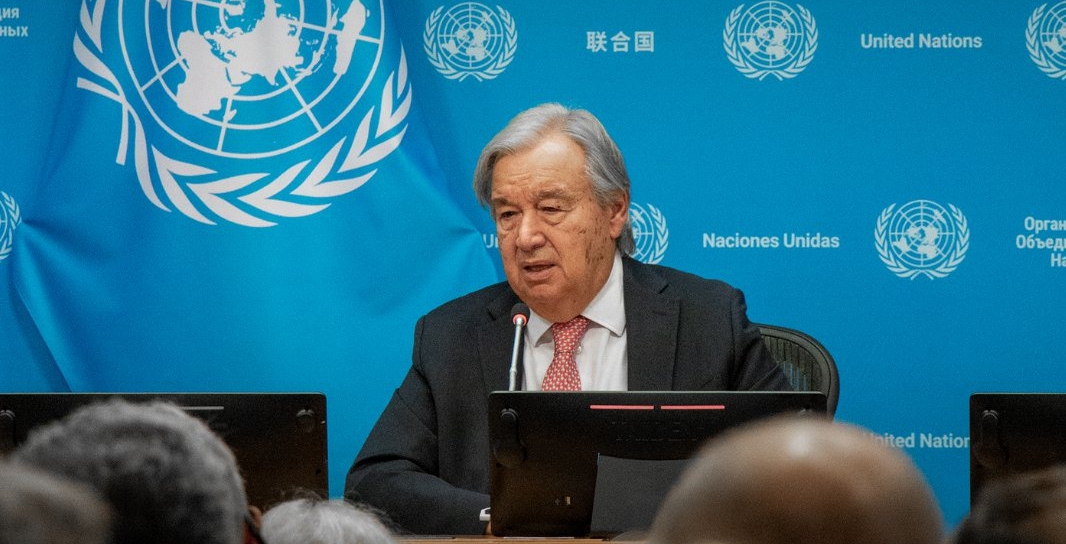
United Nations Secretary-General António Guterres opened the General Assembly’s 81st session with a warning that global power is being redistributed faster than the institutions responsible for managing it can adapt, leaving the world exposed to deeper conflict, inequality, climate disruption and artificial-intelligence risks.
In his address to the opening of the General Debate, Guterres said the world’s “faultlines” were widening into “canyons” after a decade marked by prolonged wars, attacks on civilians, weakened respect for international law, intensifying inequality, climate shocks and the rapid spread of artificial intelligence.
He presented those crises not as
separate emergencies but as connected consequences of how power is held, denied and used.

“The defining challenges of our age are not separate from the question of power. They are expressions of it,” Guterres said.
A world moving toward multipolarity
Guterres identified three major shifts reshaping the international system. Influence is spreading among a larger number of states and regions; private corporations and individuals are gaining unprecedented reach over politics, economies, information, technology and civic life; and humans are increasingly delegating consequential decisions to machines, including artificial- intelligence systems and autonomous weapons.
He argued that global institutions still reflect the balance of power that existed largely after the Second World War rather than the realities of the 21st century.
That mismatch, he said, is the central challenge facing international cooperation at a time when threats are converging and collective-action mechanisms are under strain.
The Secretary-General said the move toward a multipolar world is irreversible but could take two very different forms.
One would be a fragmented, transactional system marked by mistrust, fractured markets, weakened institutions and zero-sum competition.
The other would be what he called “networked multipolarity”: multiple centres of influence operating within shared rules, international law and dense economic, political, social and technological connections.
Guterres urged major powers to recognize the limits of military, economic and technological strength. None of those forms of power, he said, can independently secure peace, stability or security.
A more representative multilateral system centred on the United Nations would be needed to manage competition while preserving cooperation in areas where countries remain interdependent.
He pointed to the UN Charter, international law, human dignity and justice as the foundation for governing power in the modern era.
The fundamental choice, he said, is
whether power will be restrained by law and cooperation or exercised through force and coercion.
Conflicts put the international system under pressure
The first of the four tests Guterres outlined was the ability to govern power over war and peace.
He called for an immediate end to fighting, expanded humanitarian access and the restoration of navigational rights in accordance with international law.
Addressing the Middle East, he said conflicts were cascading across the region and that ceasefires had too often amounted to little more than “lesser fires,” with civilians continuing to bear the cost.
He highlighted the situation in the Occupied Palestinian Territory, referring to the Hamas attacks of 7 October and the subsequent Israeli military campaign in Gaza.
Guterres described the scale of death and destruction in Gaza as unlike
anything he had witnessed during his tenure as Secretary-General.
He cited legally binding provisional measures issued by the International Court of Justice in the case concerning the Genocide Convention in Gaza and said all parties must comply with
international law and the Court’s orders.
He also condemned violence, displacement and settlement expansion in the occupied West Bank, warning that they were undermining prospects for peace and raising the risk of ethnic cleansing.
Guterres said the two-state solution must not be allowed to disappear. He also condemned Russia’s full-scale invasion of Ukraine as a violation of UN Charter, noting continuing attacks on civilians and damage to homes, energy and water systems and transport infrastructure.
Such attacks, he said, threatened food and energy supply chains beyond the
immediate conflict zone.
He described Sudan’s conflict as a struggle for power that had become a war on civilians, citing mass displacement, spreading hunger, strikes on hospitals and homes, sexual violence and ethnically motivated attacks.
He urged the international community not to allow Myanmar’s violence, mass displacement and expanding transnational crime to fall from view.
The Secretary-General called for the protection of civilians and humanitarian personnel, unimpeded aid access, progress on nuclear non-proliferation and disarmament, and accountability without double standards. He also renewed his call for reform of the Security Council.
Africa, he said, remains without a permanent seat despite the continent’s central place in the modern international system.
A Security Council without permanent African representation is “unjust and indefensible,” he argued, because the body’s structure has not kept pace with the transformation of the world since the UN was founded.
Inequality is a question of power
The second test concerns the concentration of wealth and the unequal distribution of opportunity. Guterres argued that inequality should not be treated solely as an economic problem.
It is also a question of who gets to make decisions, access resources and
participate in public life.
He said billions of people remain without adequate food, clean water, education, decent work, health care and dignity despite unprecedented global wealth, knowledge and technological capacity.
Many developing countries are burdened by unsustainable debt, exposed to disasters they did little to cause and excluded from affordable financing.
Guterres called for faster and fairer debt relief, stronger multilateral development banks and a financial system capable of directing long-term capital to countries that need it most.
He also called for special drawing rights to benefit countries facing the greatest financing needs.
He placed gender inequality within the same framework, describing discrimination, violence, exclusion and restrictions on women and girls as a global abuse of power.
He said women’s rights were being rolled back, their voices silenced and their bodies used as battlegrounds.
At the same time, Guterres highlighted what he described as major institutional achievement: the United Nations had reached gender parity across its senior leadership, headquarters and professional staff for the first time.
He said the change came from
removing barriers and rejecting the assumption that leadership must continue to look as it had in the past.
“Equality is not a dream. It is a decision,” he said, urging governments, parliaments, businesses and peace processes to apply the same principle.
Climate change exposes an intergenerational imbalance.
The third test is climate change, which Guterres described as a profound imbalance between generations and between those who have benefited most from pollution and those suffering its worst effects.
He warned that the world was approaching a near-certain breach of the 1.5-degree Celsius temperature limit and said climate impacts were arriving earlier and with greater force than many had expected.
The risks include accelerating glacier melt, extreme weather, pressure on food and water systems and rising costs for energy, food and insurance. Guterres also identified the growth of renewable energy as a countervailing shift in global power.
Solar and wind resources are not controlled by a single state, he said, and
renewables are now the cheapest source of new electricity in much of the world.
The transition away from fossil fuels could therefore strengthen energy security and reduce dependence on concentrated fuel supplies—provided it is managed fairly.
He called on governments to adopt national plans aligned with the 1.5- degree goal, with clear timelines and protections for affected workers and communities.
He accused major oil companies of profiting from the climate crisis and contrasted nearly half a trillion dollars in
profits earned by five large Western oil companies since Russia’s invasion of Ukraine with $34 billion in international public adaptation finance reported for developing countries in the latest year cited.
Guterres called for polluters to pay more for the damage they have caused and urged governments to end deforestation, invest in electricity grids and storage, and reduce methane emissions.
Developed countries, he said, must triple adaptation finance and make the Loss and Damage Fund effective at scale.
He also warned that the extraction of critical minerals must not reproduce colonial patterns of exploitation, arguing that producing countries and affected communities should retain more of the value created from their resources.
Artificial intelligence needs global safeguards
The fourth test is artificial intelligence, which Guterres said was concentrating power in data, computing capacity and algorithms while advancing faster than governments’ ability to understand its consequences.
He acknowledged AI’s potential to improve medicine, accelerate scientific discovery and expand opportunity. But he said the central danger is not technology itself; it’s technology without accountability, oversight or transparency.
Guterres called on governments—particularly those with the greatest AI capabilities—to establish channels for dialogue, information-sharing and cooperation on safety risks.
He compared the challenge to the Cold War-era management of nuclear dangers, when rival powers created mechanisms to reduce misunderstanding, control escalation and prevent catastrophe.
He urged leading AI countries to cooperate on testing and evaluation and to develop common safeguards. Because the technology’s effects cross borders, he said, global coordination is essential and the United Nations is the only forum in which every country has a voice in shaping shared rules.
Guterres pointed to the Global Digital Compact, the Global Dialogue on AI Governance and the Independent International Scientific Panel on AI as foundations for further work.
He called for responsible pacing of AI development, additional safeguards against loss of human control and a multilateral AI risk-management framework backed by credible, independent oversight.
A choice between fracture and cooperation
Guterres closed by returning to the address’s central question: whether governments will allow power to be governed by law, cooperation and responsibility, or permit it to operate
through force, coercion and indifference.
His proposed answer was a stronger and more representative multilateral system capable of managing competition without allowing rivalry to become permanent confrontation.
The Secretary-General’s message was that no state, corporation or technology can resolve the world’s largest problems alone—and that the legitimacy of global governance will depend on whether institutions adapt to the new distribution of power.
“Artificial intelligence must be shaped by humanity, with humanity, and for all humanity,” Guterres said.