
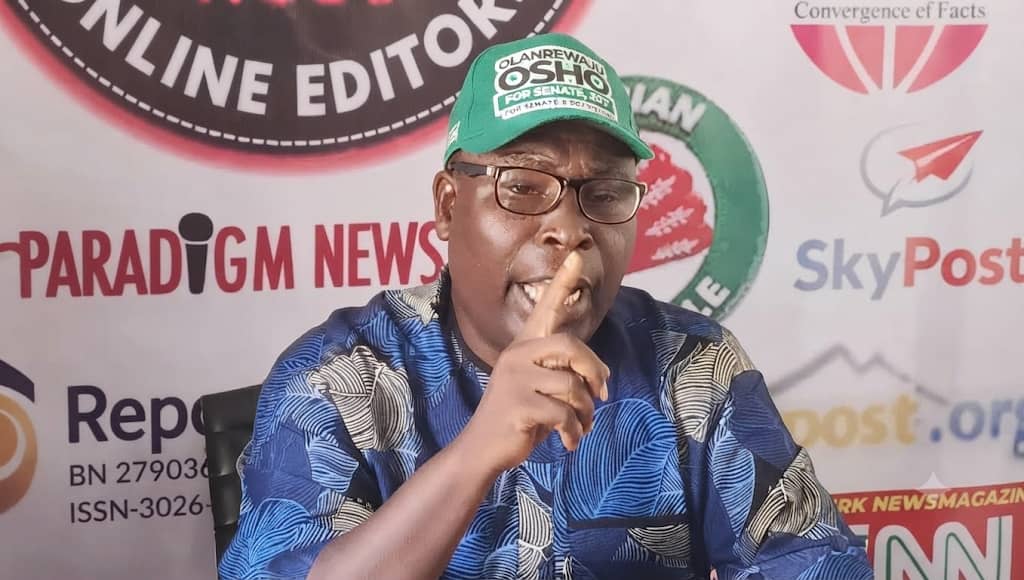
Olanrewaju Osho, the Social Democratic Party (SDP) senatorial candidate for the Federal Capital Territory (FCT), says he is seeking election to transform the nation’s capital through stronger representation, targeted legislation, effective oversight and sustained engagement with residents.
Osho made the declaration on Monday during a roundtable discussion with members of the Association of Corporate Online Editors (ACOE) at the association’s office at EFAB Mall, Area 11, Abuja on Monday.
He said his ambition was driven less by a desire for political office than by the need to address the FCT’s longstanding developmental challenges.
He described his campaign as “Fix FCT,” a platform focused on practical solutions to problems affecting residents across the territory’s six area councils.
Senator’s Role Should Match FCT’s Scale, Osho Says
Osho said the FCT required a senator who understood the territory’s size and
responsibilities and who was prepared to approach the role with a mindset comparable to that of a governor.
He noted that the FCT differed from Nigeria’s states because it had neither an elected governor nor a legislature. That institutional structure, he argued, made the senator’s responsibility to represent residents particularly significant.
His proposed legislative agenda would rest on four pillars: representation, legislation, engagement and oversight.
“My priority would be to ensure that government resources allocated to the territory were properly utilised for the benefit of residents,” Osho said.
Promise of Regular Engagement Across Six Councils
The candidate pledged to maintain regular contact with residents and said he would meet people in each of the six area councils at least twice a year.
The meetings, he said, would provide a channel for residents to raise concerns and allow him to monitor the progress of
development projects. Osho said representation should extend beyond attendance at the National Assembly.
Elected officials, he argued, should inspect public infrastructure, track government projects and ensure that public spending produced its intended benefits.
Calls for Broader Development Strategy
Osho criticised what he described as the absence of a comprehensive development structure for the FCT. He said the territory’s development agenda should not be defined primarily by road construction.
He identified healthcare, employment, youth development, women’s empowerment, tourism, sports and support for older people as sectors requiring greater attention.
Wealth Should Not Determine Access to Leadership
The SDP candidate also challenged the view that only wealthy people could contestelections successfully or provide effective leadership.
Osho said he was not a businessman and had spent most of his career in public service and the media. Leadership, he maintained, should be assessed by competence, integrity and the ability to solve problems rather than by personal wealth.
He linked his commitment to public service to his road-safety advocacy. Osho said he founded Safety Beyond Borders after a colleague died in a road accident.
The incident, he explained, convinced him that individuals had a responsibility to help address wider social problems. He added that he and his wife had invested substantially in road-safety advocacy since the organisation was established.
Renewable Energy Proposed as Part of Power Solution
On electricity, Osho said a senator could help address the power crisis through legislation, oversight and support for policies aimed at expanding electricity generation and distribution.
He advocated wider adoption of renewable energy, including solar power, by households and businesses able to use alternative sources.
He also proposed incentives such as tax
rebates to encourage investment in renewable-energy systems.
Pledge to Work With FCT Minister
Osho promised to collaborate with the FCT Minister and other government officials, saying personal differences should not be allowed to obstruct development.
He urged residents to look beyond party affiliations when assessing candidates and to focus instead on their records, competence and capacity to deliver results.
“FCT residents should look beyond political parties and assess candidates based on their records, competence and capacity to deliver results,” he said.
Osho said his broader objective was to build a people-driven movement that would transform the FCT and also give residents a stronger voice in governance.