

In Ebonyi State, the case for continuity in 2027 is increasingly being argued not only from political platforms but along roads, bridges and expanding urban corridors.

The argument is simple: when public investment becomes visible in the daily movement of people, farm produce and commercial vehicles, infrastructure moves from being a promise to becoming a political record.
That is the space occupied by Senator Engr. David Umahi, Minister of Works and former governor of Ebonyi State.
His political value to President Bola Ahmed Tinubu’s re-election effort in the state rests on a combination of local familiarity, engineering experience and a
federal infrastructure programme that has placed several strategic South-East corridors back at the centre of national development planning.
A record that began in Ebonyi
Before his appointment as Minister of Works in August 2023, Umahi had already made road construction a defining feature of his eight-year administration in Ebonyi.
A Federal Ministry of Information report, citing former Enugu State lawmaker and South-East political spokesman Josef Onoh, attributes more than 1,500 km of concrete roads, over 20 flyovers, Ebonyi State International Airport and Abakaliki Ring Road to Umahi’s tenure as governor.
These figures should be presented as an attributed assessment rather than as an independently audited total, but they capture the scale and visibility of the
infrastructure agenda associated with his administration.
The importance of that record is not merely numerical. Ebonyi’s road programme was designed to connect communities beyond the state capital, open up agricultural areas and improve access to markets and public institutions.
The Abakaliki Ring Road, urban flyovers
and concrete road network also gave residents a familiar point of comparison when Umahi moved from the state government to the federal cabinet. That continuity matters politically.
A minister who previously governed Ebonyi can explain federal projects in the language of local geography: the routes people use, the bottlenecks that delay trade, the bridges that isolate communities during the rainy season and the urban junctions that turn into daily traffic traps.
It allows the administrationinfrastructure message to be communicated through practical experience rather than abstract policy language.
Turning federal roads into economic corridors
At the federal level, Umahi’s central argument is that road construction should be treated as economic infrastructure.
The Federal Information Centre reported in June 2026 that the Tinubu administration was reviving major South -East road projects conceived years earlier but left incomplete.
Among them is the Calabar‒Ebonyi‒Benue Trans-Saharan Superhighway, described as a corridor intended to connect the South-East, South-South
and North-Central regions while improving the movement of agricultural goods and commercial traffic.
This is significant for Ebonyi because the state’s economic future depends on connections beyond its administrative boundaries.
Better roads can reduce travel friction between producers and markets, make movement between Ebonyi and neighbouring states more predictable, and strengthen Abakaliki’s position as a distribution and commercial centre.
The benefit is not limited to motorists. It extends to farmers, traders, transport operators, students, artisans and businesses that depend on reliable access to customers and suppliers.
Umahi has also promoted concrete pavement technology as a response to the familiar cycle of road failure and repeated repairs.
The argument is that a well-designed concrete road can offer greater durability under heavy traffic and difficult weather conditions.
The Federal Information Centre reported that work on South-East projects was continuing during the rainy season, while also noting that construction quality, drainage, maintenance and proper engineering supervision remain essential to the long-term performance of any
road.
That qualification is important. The political strength of the infrastructure message will depend not simply on announcing concrete roads, but on demonstrating that projects are completed to specification, maintained and made useful to the communities they are intended to serve.
The new Ebonyi project pipeline
The clearest example of the federal government’s direct commitment to Ebonyi is the additional package of road works approved in 2026.
According to the Federal Information Centre, the Federal Executive Council approved projects valued at about ₦248 billion, covering 39 kilometres of concrete road infrastructure.
The package includes an 18- kilometre dualisation of the Enugu‒Abakaliki‒Ogoja Road from the EBSU Gate area through Spera-In-Deo to Margaret Umahi International Market; a 21-kilometre dualisation from Onueke towards Ezza South and Ezza North; and retaining walls, drainage and shoulder works on the Okposi‒Amasiri Road.
The value of these projects is both physical and symbolic. Physically, they target routes that connect residential areas, markets and communities.
Symbolically, they show a federal
government responding to specific needs in Ebonyi rather than treating the South-East as an afterthought in national infrastructure allocation.
The same report stated that the Onueke Flyover was more than 60 per cent complete at the time of the inspection and that a 125-kilometre Legacy Road Project was progressing from Ndibe Beach through Ebonyi to the Benue boundary.
It also reported the approval of an
additional two-kilometre dual carriageway intended to ease traffic congestion. These are ongoing works, not completed projects, and their credibility will ultimately be judged by delivery, safety and public use.
The projects also create a broader narrative about inclusion. Tinubu’s political message in Ebonyi can be framed around the proposition that the South-East is receiving a stronger place in the federal development agenda, while Umahi’s role is presented as the bridge
between the President’s decisions and the region’s engineering and infrastructure priorities.
Why the message resonates in Ebonyi
For Ebonyi voters, infrastructure is not an isolated policy issue. It affects the cost and speed of transporting food, access to schools and hospitals, attractiveness of communities to investors, and the ability of local businesses to operate beyond their immediate neighbourhoods.
A road that remains passable in the rainy season can mean the difference between a farmer reaching a market and losing produce. A bridge or flyover can reduce
delays that impose hidden costs on thousands of people every day.
This is why Umahi’s advocacy for Tinubu has a practical foundation. He is not asking Ebonyi residents to support an unfamiliar agenda.
He is pointing to a federal programme whose roads and bridges are located in places that residents can identify. He is also drawing on his own previous record in the state, where public works became the most visible expression of his administration.
The strongest campaign presentation, however, should avoid claiming that every project is finished or that infrastructure alone resolves all economic and social challenges.
It should acknowledge that some projects remain under construction, that financing and contractor performance must be monitored, that communities deserve transparency about timelines and disruptions. Such candour would make the message more credible, not less.
A development argument for 2027
The political conclusion is straightforward. Umahi’s infrastructure record gives Ebonyi APC a development -based argument for supporting President Tinubu in 2027: the state can
point to a governor-turned-minister who understands its needs, a federal administration that has approved and advanced major road investments, and a pipeline of corridors intended to connect Ebonyi more effectively to the wider Nigerian economy.
The campaign should therefore present the partnership in concrete terms. Tinubu provides the federal authority and financing architecture.
Umahi provides technical supervision, political advocacy and local knowledge. Ebonyi’s people provide the daily test of whether the roads, bridges and junctions are actually improving movement and opportunity.
The most persuasive message is not that every challenge has disappeared. It is that a visible development direction has been established and that continuity can protect, complete and expand it.
In that sense, the argument for Tinubu in Ebonyi is an argument for consolidating infrastructure gains, finishing ongoing projects and ensuring that the South- East remains part of Nigeria’s next phase of economic connectivity.
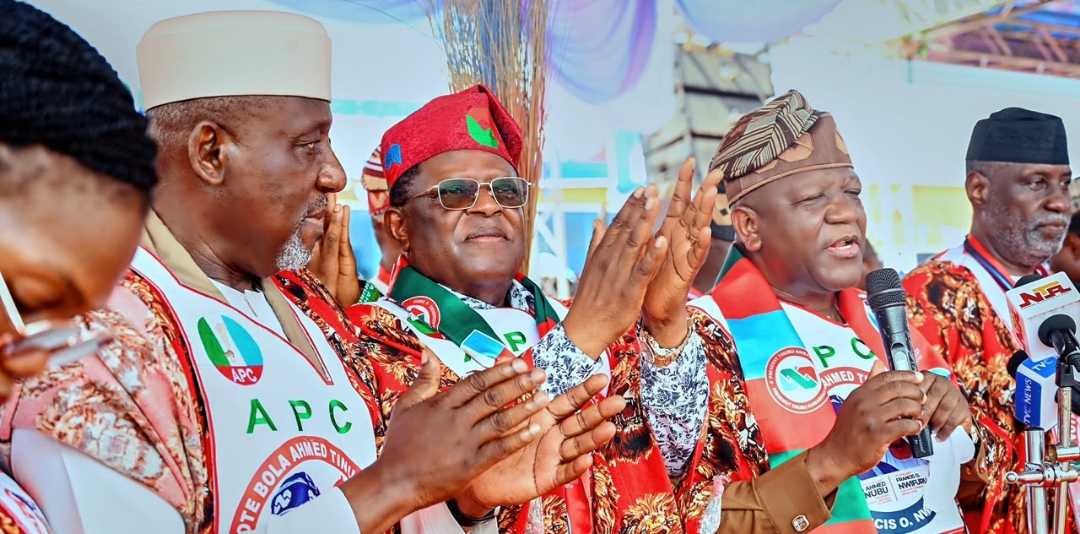
As the APC rally in Abakaliki demonstrated, political support is strongest when it is connected to lived experience.
For Umahi, the road to a Tinubu victory in Ebonyi will be built not only with speeches, but with evidence that projects are delivered, communities are connected and federal commitments produce lasting public value.