

Minister of Works David Nweze Umahi has defended the Federal Government’s financing, procurement and engineering decisions on its major highway projects, saying external financiers over- subscribed funding for the first and second sections of the Lagos-Calabar Coastal Highway by more than $100 million.

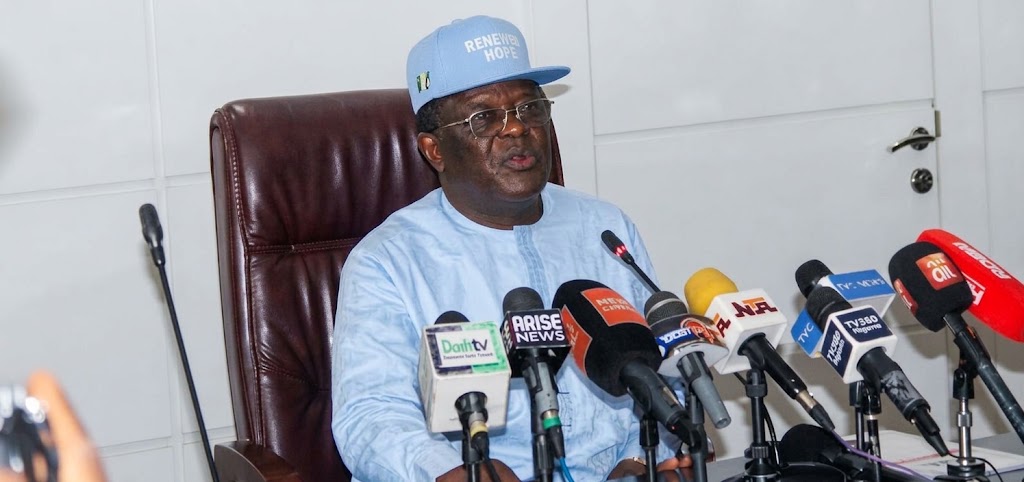
Umahi, who spoke at a press briefing in Abuja on Wednesday, said the financing response demonstrated the confidence of international lenders in transparency, bankability and technical design of the projects.
He rejected allegations of impropriety and said the government was borrowing to finance infrastructure investment, not recurrent expenditure.
“When the first and second sections were put forward for external funding of 70 per cent, it was oversubscribed by external financiers by over 100 million US dollars,” the minister said, presenting the response as evidence that the project had passed the scrutiny of prospective lenders.
Under the financing model outlined by Umahi, the Federal Government provides 30 per cent of the cost in naira, while external lenders provide the remaining 70 per cent.
The government expects to recover the investment through tolling and the development of economic opportunities along the corridors, including industrial, housing, tourism and energy projects.
Four flagship corridors
Umahi said the administration was advancing four interconnected “legacy projects” intended to link major economic corridors across the country: the Lagos-Calabar Coastal Highway, the Sokoto-Badagry Superhighway, the Trans-Sahara route and the North-East corridor running from Akwanga towards Maiduguri.
He said the projects had been planned as a connected network rather than as isolated roads, allowing movement across several geopolitical zones and opening access to trade routes, industrial sites, agricultural areas and tourism destinations.
The minister said the Federal Government inherited 2,068 ongoing road projects with a combined value of about N13 trillion, maintained that borrowing for infrastructure was justified where the investment would generate long-term economic returns.
Lagos-Calabar project records progress
According to Umahi, Section One of the Lagos-Calabar Coastal Highway, covering 47.47 kilometres from Victoria Island, Lagos, had been completed and was ready for commissioning.
Section Two covers 55 kilometres to the boundary between Lagos and Ogun states. The section includes the main pavement as well as flyovers, overpasses and underpasses.
Umahi said the 55-kilometre dualised pavement was expected to be completed by the following month, although work on some major structures would continue.
He attributed the extended work on the structures to subsoil investigations, design revisions and the need to accommodate heavy industrial traffic.
Around the Dangote Refinery, Umahi said, the design had been changed to accommodate oversized trucks associated with the facility.
A structure at the location would have an approximately 86-metre span supported by counterforts, he added.
The minister also described a complex traffic conflict involving rail lines from the deep-sea port, refinery service routes, the seven-toll-gate route, service lanes and traffic linked to the Lekki Free Trade Zone.
He said the ministry had redesigned a flyover to resolve the competing routes.In the Ogun and Ondo axis, the project covers approximately 67 kilometres, including 27 kilometres in Ogun and about 40 kilometres in Ondo.
Umahi acknowledged petitions alleging that the Ondo alignment had been diverted but said the ministry had acted on engineering grounds.
He said the original route passed through areas containing pits more than 100 metres deep in some locations and lacked sufficient suitable sharp sand for construction.
The ministry consequently redesigned the alignment to avoid the most difficult terrain and was filling pits of more than 10 metres in depth before proceeding with the roadworks.
“We have no regret for decisions taken at Ondo,” Umahi said, arguing that the cost of building through exceptionally difficult terrain could not be compared with the cost of construction on normal ground.
Flood protection and Benin bypass
Umahi said the President Bola Tinubu had directed the ministry to route the continuation of the coastal highway from the end of the Ondo section into Edo through the existing East-West Road, instead of creating a new alignment.
He described the decision as a major engineering intervention, saying sections of the East-West Road had recently been submerged.
The ministry would raise the road by about two metres at vulnerable points to place it above current flood levels and improve its resilience to future climate-related impacts.
The route from Ondo into Edo will also connect with the 45-kilometre Benin bypass.
Umahi said the bypass would prevent through-traffic from entering Benin City, where motorists could spend as much as seven hours in congestion.
The total distance from the end of the Ondo section to the end of the Edo section is about 104 kilometres, according to the minister.
He said the bypass would improve traffic flow and support economic activity in Benin City and its surrounding areas.
From the boundary between Edo and Delta states to the boundary between Delta and Bayelsa, the government is preparing a 129-kilometre dual carriageway.
Umahi said route surveys and procurement were under way, with construction expected to begin by November after the completion of due process.
The coastal highway will then connect with existing dualised routes around Eleme and Port Harcourt before continuing through Akwa Ibom and Cross River.
The minister said an approximately 82-kilometre dualised section in Akwa Ibom was ongoing, while emergency palliative works had helped keep the route towards Calabar motorable ahead of full reconstruction.
Sokoto-Badagry work continues despite insecurity
The second legacy project, the 1,068-kilometre Sokoto-Badagry highway, is also progressing, Umahi said.The first section, a 120-kilometre dualised road beginning at Ilela in Sokoto State, was about 60 per cent complete.
The minister said insecurity remained a major challenge in the area but insisted that the government was determined to continue the work.
The 258-kilometre Kebbi section, which Umahi described as the largest section of the project, was more than 40 per cent complete.
The 62.35-kilometre Badagry section had also recorded more than 40 per cent progress, while the 180-kmetre Oyo section was about 10 per cent complete.
He said the Wara and Niger sections were the only portions yet to be fully engaged. Umahi expressed optimism that the first and second legacy projects could be completed if the administration secured a second term.
Trans-Sahara project expands east- central links
The third legacy project will connect the end of the Lagos-Calabar Coastal Highway at Calabar to Ndibe Beach and onward through Ebonyi, Benue, Enugu and Kogi states.
Umahi said the 123.5-kilometre section from Ndibe Beach to the Ebonyi-Benue boundary was about 40 per cent complete.
A further section of approximately 176 kilometres would run through parts of Benue, Enugu and Kogi before reaching the Ohe Bridge.
He said the President had approved a further 300-kilometre second carriageway.
The additional carriageway, Umahi explained, was necessary to improve the route’s effectiveness, make the investment bankable and meet the requirements of external lenders.
He said the corridor would support agricultural production and trade across Ebonyi, Benue and Cross River, describing it as a historic trade route with the potential to strengthen links between eastern and central Nigeria.
North-East highway extension approved
The fourth legacy project runs from Akwanga through parts of Kaduna, Bauchi, Gombe, Biu and Yobe to Maiduguri.
Umahi said President Tinubu had approved an extension of more than 400 kilometres of dualised roads through parts of Plateau and Taraba states.
The ministry is initially designing and advancing the first 120 kilometres of the extension.
A 125-kilometre Akwanga-Jos section awarded to CGC is ongoing, while a 135-kilometre Gombe-Biu section awarded to Hi-Tech is also under construction. The Gombe-Bauchi section is being designed for procurement, the minister said.
Umahi defends procurement and concrete roads
Umahi said the criticism surrounding the highway projects had partly arisen from misunderstanding of the procurement process.
He identified three procurement methods: open tendering, selective tendering and special procurement.
He said the first legacy project was handled through special procurement because of its technical complexity and the need for a contractor capable of working in a difficult coastal environment.
The remaining three legacy projects, he said, went through selective tendering. Under that process, companies were qualified by the Bureau of Public Procurement before competing for the contracts.
Umahi said contractors were expected to demonstrate the equipment and technical capacity to execute concrete pavement works.
The minister also defended the government’s preference for concrete over asphalt.
He said no contractor had been willing to guarantee that an asphalt road would remain serviceable for five years, while concrete roads could be guaranteed for between 50 and 100 years.
He said the price of concrete had risen from about N350,000 per cubic metre at the beginning of the programme to N460,000, adding that the same rate applied to indigenous contractors and that there was no discrimination in pricing.
New projects approved in the South-East
Umahi said the President had approved two additional major projects in the South-East within the previous few days.
The first is the Obanewi-Oga route towards Okigwe in Imo State. The second runs from Otuwacha in Anambra State to Ibaji in Kogi State.
He said the projects were part of the government’s broader effort to expand road connectivity and support economic activity in areas that had long required improved federal infrastructure.
Asaba route remains before the courts
On the route beneath Asaba, Umahi said the ministry was aware of the problems associated with the concessionaire and acknowledged that the dispute was before the courts.
He said the Federal Government was responding to the legal proceedings but also recognised the hardship faced by motorists who sometimes spend up to seven hours on the route.
Umahi’s briefing combined a progress report on the country’s biggest road projects with a forceful defence of the administration’s financing and construction strategy.
He said the scale of the programme, the response from external lenders and the long-term benefits expected from the corridors justified the government’s decision to borrow for infrastructure investment.