

Sub-Saharan Africa’s rapidly growing cities could become engines of economic growth and job creation, but only if governments move quickly to guide urban expansion, improve transport and housing, and give local authorities the money and powers to manage growth, the World Bank Group said in a new report.

The report, Sub-Saharan Africa’s Urban Awakening: Catalyzing Economic Growth and Job Creation, projects that the region’s urban population will rise by 748 million people between 2025 and 2050, reaching about 1.7 billion.
That would make the coming 25 years a
decisive period for a region where roughly 15 million young people enter the labor market each year.
The scale of the shift is comparable to the previous half-century. Between 1950 and 2025, Sub-Saharan Africa’s urban population grew by 742 million people.
By 2050, urbanization will be “almost complete,” according to the report, leaving govts with a limited opportunity to shape where people live, how firms operate and whether cities produce productive, better-paid work.
The report says urbanization is already associated with better economic prospects. Urban households spend substantially more per adult than equally educated rural households, a difference the World Bank links to access to more and better jobs.
Yet the region’s cities have not generated the productivity gains seen in other parts of the world, and too many urban jobs remain informal and low paid.
The World Bank estimates that Sub- Saharan Africa needs roughly 15 million new jobs every year simply to keep pace with its expanding young workforce.
The report warns that rapid population growth alone will not deliver those opportunities. Cities must become more productive by helping firms locate near one another and by making it easier for workers to reach those concentrations of employment.
“Much of the urban infrastructure needed for Sub-Saharan Africa’s future cities has yet to be built,” Paschal Donohoe, World Bank Group managing director and chief knowledge officer, said in the report’s accompanying release.
Decisions made now about where and
how cities grow, he said, can create jobs, raise productivity and attract private investment for decades.
Three urban challenges
The report divides the region’s urban areas into three broad categories—cities, their fastgrowing peripheries and smaller towns—and calls for policies tailored to each.
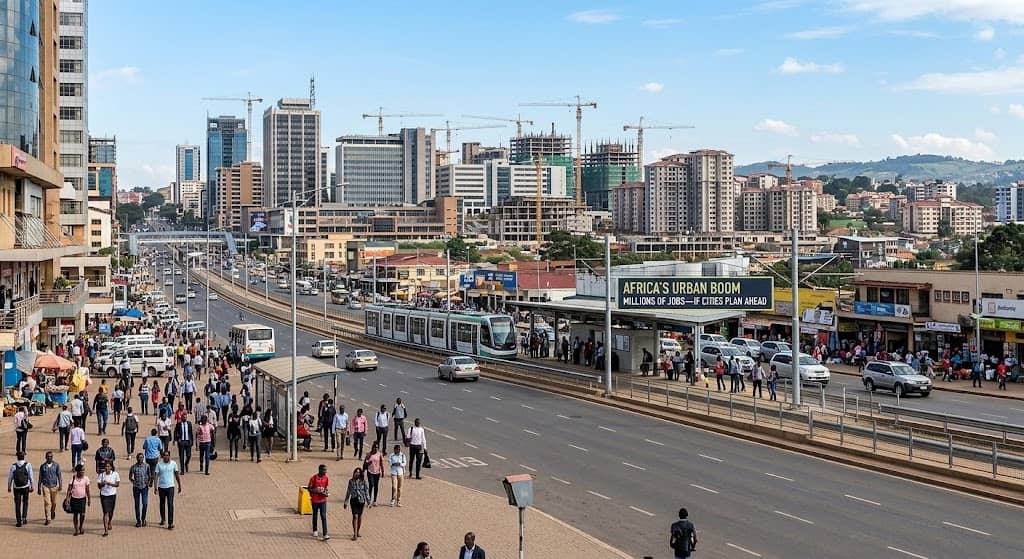
In major cities, the priority should be to create accessible, job-rich clusters. That means directing infrastructure and planning toward locations where businesses can operate efficiently, while expanding mass transit, integrating formal and informal transport and providing affordable housing close to employment.
Weak transport networks and restrictive land and development rules currently make it difficult for firms to cluster and for workers to reach jobs.
Only about 32 percent of Africans live within walking distance of public transport, while one-quarter of firms identify transportation as a major or very severe constraint.
The challenge is not limited to established urban cores. The report projects that the physical area of the region’s cities will expand by 90 percent between 2025 and 2050.
Their peripheries, which currently house about 165 million people, are expected to absorb much of that growth, but expansion has often been informal and unplanned.
Fragmented development raises infrastructure costs and makes it harder for cities to benefit from the concentration of businesses and workers.
To avoid locking in those problems, governments should map future expansion areas, protect land for roads and essential services and build arterial road networks before construction becomes entrenched.
The report also recommends reforms that allow landowners to pool and subdivide plots in an orderly way.
Such early planning can reduce the cost of extending utilities, protect flood plains and other high-risk areas, and give private investors clearer signals about where development will occur.
Smaller towns are the third policy space. Sub-Saharan Africa has more than 15,000 towns, but many lack the scale, connections and services needed to support firms and generate jobs.
The World Bank does not recommend spreading investment evenly across all of them. Instead, it calls for a selective approach that concentrates resources on places with strong economic or geographic potential, especially towns along transport corridors or near other
sources of economic activity.
Education and health services should remain a priority across towns, including those with fewer immediate economic opportunities.
Better human capital can help residents connect to stronger labor markets elsewhere. Rapidly growing towns also need clearer governance and more predictable financing so they can plan for expansion instead of responding after infrastructure gaps emerge.
Financing the transformation
The report says local governments will need stronger revenues and more reliable transfers from national governments.
One practical measure is to use low-cost digital technology to modernize property-tax systems. Better tax collection can increase local revenue, improve municipal creditworthiness and help cities attract private finance.
Public-private partnerships could also support integrated development in strategic locations, bringing private capital into housing, transport, land development and basic services.
The report stresses, however, that investment will need to be matched by stronger institutions, clearer accountability and urban planning that is credible enough for both residents and investors.
“Africa’s urban transformation will deliver on its promise only if cities have the institutions and resources to manage growth effectively,” Mark Roberts, a World Bank lead urban economist and lead author, said.
The stakes extend beyond individual cities. If governments act early, the coming urban expansion could connect more people to jobs and markets while lifting productivity across the region.
If they delay, informal growth, congestion, weak services and high infrastructure costs could become harder and more expensive to reverse.
The World Bank’s message is therefore less about population growth itself than about the choices surrounding it. Much of the urban space Sub-Saharan Africa will need by 2050 has not yet been built.
How that space is planned, financed and connected will help determine whether the region’s urban awakening produces a larger workforce without enough good jobs—or a more productive economy capable of employing it.