

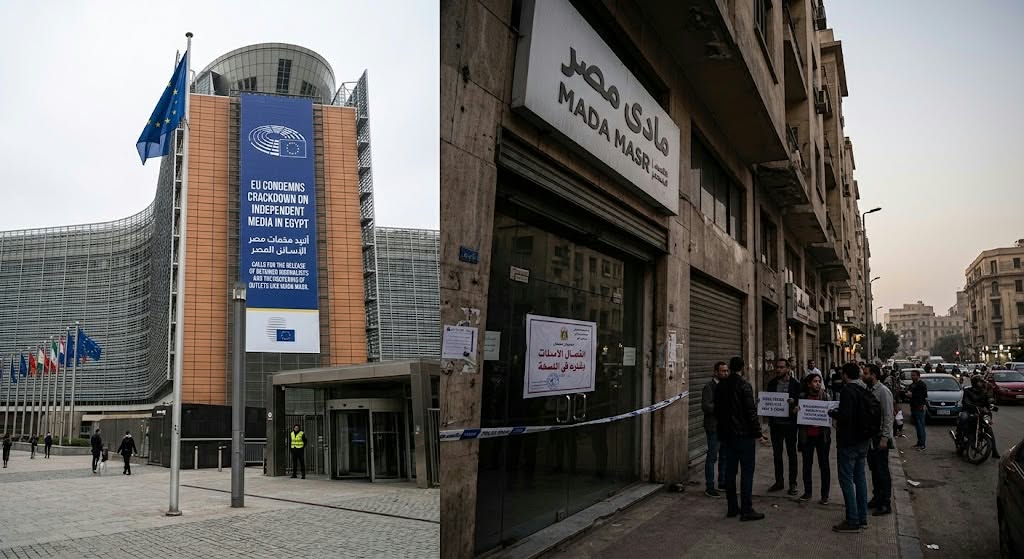
The European Union has condemned the Egypt’s expanding crackdown on independent journalism after authorities detained the entire newsroom of fact- checking platform Matsadaash and an Egyptian court ordered the closure of prominent independent outlet Mada Masr.

In a statement issued on October 29, the European External Action Service said six Matsadaash journalists arrested on September 28 and 29 remained in custody.
It also said Lina Attalah, editor-in-chief and co-founder of Mada Masr, was convicted on October 27, a ruling that led to the outlet’s closure.
The EU said freedom of expression is a fundamental right in both Egypt and the European Union and called the protection of independent media essential under the parties’ shared commitments to democracy, the rule of law and human rights.
Mada Masr ordered closed
The New Cairo Misdemeanour Court convicted Attalah of operating an unlicensed website and imposed a fine of 3 million Egyptian pounds, approximately US$53,400–54,500.
The court also ordered Mada Masr closed and its equipment confiscated, according to Reuters, the Committee to Protect Journalists and Amnesty International. Attalah was held for about five hours and released after Mada Masr paid the fine.
The case has drawn particular concern because Mada Masr is one of Egypt’s best-known independent newsrooms. Founded in 2013, it has reported on politically sensitive issues, including corruption, human rights and conditions in Egyptian prisons.
Its website has been blocked inside Egypt since 2017, but the newsroom continued publishing online. The outlet also participated in the 2021 Pandora Papers investigation.
Attalah’s lawyers said the court rejected requests to inspect the case file and submit further evidence, and appointed a lawyer despite her objection.
CPJ reported that journalists were excluded from parts of the hearing and that the defence was prevented from presenting procedural requests, including requests to call witnesses.
These accounts could not be independently verified in the available reporting, and Egyptian authorities did not immediately respond to requests for comment.
The licensing dispute is central to the case. Mada Masr says it applied repeatedly for a licence under Egypt’s 2018 media law, including applications in 2018 and 2020, but received no response from the Supreme Council for Media Regulation.
The outlet later learned that an application had been rejected and challenged that decision in court.
It said a further application filed in 2023, and another submitted in 2026 with documents officials had requested, remained unanswered.
Amnesty said the unresolved process raised serious concerns about using registration rules as a tool of prior restraint.
Attalah also faces a separate legal case. Mada Masr said she was informed after her release that one-year prison sentence had been issued against her in absentia in 2024 on charges involving false news and operating an unlicensed website. Her lawyers have challenged that ruling, with a retrial scheduled for November 11.
Six Matsadaash journalists detained
The arrests of the Matsadaash staff began with raids on the homes of Mohamed Ashraf Abu Emeira and Abdallah Qadry.
Authorities subsequently detained Islam Barakat and Omar Helal at their homes, while Mohamed Mahmoud, Mohamed Adel were arrested on the Cairo streets, according to CPJ. Phones and computers were also seized, the International Press Institute reported.
The Interior Ministry acknowledged the detentions on October 1. It accused Matsadaash—whose name means “Don’t believe it”—of being an unlicensed, foreign-run platform that spread false information and sought to destabilize Egypt.
The ministry also alleged links to the Muslim Brotherhood, which Egypt designated a terrorist organization in 2013. Matsadaash co-founder Abdelrahman Mansour denied the accusations and said the outlet had no affiliation with the group.
According to IPI, the six journalists were later charged with belonging to the Muslim Brotherhood, joining a terrorist group, funding terrorism, publishing false news and using social media to call for terrorist acts.
Lawyers said the journalists appeared before the Supreme State Security Prosecution on October 4.
They also said several detainees reported torture, lengthy interrogations and being forced to record confessions from prepared statements. Egyptian authorities have denied that the six were tortured, according to RSF.
The journalists’ continued detention has become a central concern for international press-freedom organizations.
CPJ called the arrest of an entire newsroom a grave escalation and said the authorities should disclose the journalists’ whereabouts, ensure access to lawyers and families, and drop charges arising solely from legitimate journalism.
RSF said the six had been subjected to enforced disappearance before the authorities acknowledged their arrests and described the allegations against them as baseless.
Wider implications
The two cases have unfolded within a broader pattern of pressure on Egypt’s remaining independent media. CPJ said 25 journalists were behind bars in Egypt by late October, the country’s highest figure since 2021.
RSF ranked Egypt 169th out of 180 countries and territories in its 2026 World Press Freedom Index. Hundreds of websites, including news outlets and civil-society organizations, remain blocked, Amnesty said.
RSF also linked the crackdown to the Egypt Forum, a government-backed event held from October 19 to 24. It said President Abdel Fattah el-Sisi praised a government-produced video warning about a fictional fact-checking site while Matsadaash’s newsroom was in detention.
At the same time, Attalah was summoned and interrogated for six hours before being released on bail, RSF reported.
Egyptian authorities maintain that the country supports freedom of expression but that media organizations must operate within the law, respect national security and combat misinformation.
Critics argue that the use of licensing, national-security and terrorism provisions against journalists is narrowing the space for independent reporting and turning administrative regulation into a means of censorship.
The EU’s statement adds diplomatic pressure to condemnation already issued by Amnesty International, CPJ, RSF, IPI and a coalition of rights and media organizations.
It also places the cases against the backdrop of the EU-Egypt Association Agreement and the Strategic and Comprehensive Partnership, both of which the EU says carry commitments to democracy, human rights and fundamental freedoms.
The immediate questions are whether the Mada Masr closure will be enforced, whether Attalah’s separate case will proceed on November 11, and whether Egypt’s courts will release or charge the six detained Matsadaash journalists on evidence unrelated to their reporting.