

In a bold vision set to redefine Nigeria’s landscape, President Bola Ahmed Tinubu’s administration is weaving a transformative national infrastructure network.
At its heart are four legacy road projects, meticulously designed to interconnect all six geopolitical zones, unlock unprecedented economic opportunities, bolster food security, and accelerate regional integration.
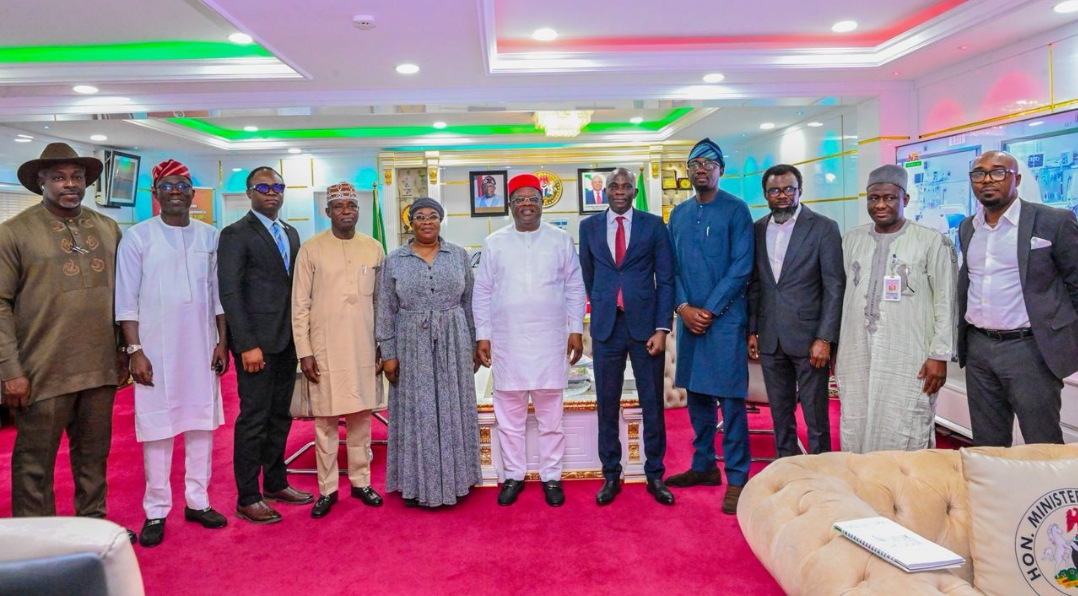
Senator Engr. David Umahi, the Minister of Works, recently articulated this ambitious plan during a pivotal meeting with a delegation from the ECOWAS Bank for Investment and Development (EBID).
The EBID team, led by Maimouna Sidibe, Head of the Basic Infrastructure Division, is currently appraising Section One of the Trans-Sahara Super Highway – a critical component of Tinubu’s landmark vision – ahead of crucial financing approval.
The Minister emphasized the deliberate interconnectedness of these projects, describing them as a seamless loop.
The 750-kilometre Lagos-Calabar Coastal Highway, for instance, will fluidly link with the Trans-Sahara Super Highway via Ndibe Beach in Cross River State.
Section One of this Trans-Sahara route, spanning 123.64 kilometres from Ndibe Beach to the Benue border, is already underway, with further sections through Benue, Kogi, and Nasarawa States having been awarded.
This historic corridor, in a statement, Umahi noted, is not merely a new construction but a revitalization of a route that has served as a major artery for trade and agricultural activities since colonial times.
“It has long existed and remains a major food corridor. It is critical to food sufficiency in our country,” he stated.
The highway promises to connect vital agricultural belts across the nation, including Ebonyi, Benue, and Cross River States, dramatically reducing travel time between Calabar and Abuja to approximately four hours.
Beyond mere transportation, the vision extends to harnessing existing dams along the corridor for irrigation and renewable energy.
This multi-faceted approach is set to catalyze industrialization, attract investment, and generate a multitude of direct and indirect jobs.
“There will be factories along the corridor, power projects, and significant traffic volumes on the road,” Umahi projected.
Further illustrating the network’s reach, the Trans-Sahara Super Highway will connect to the fourth legacy project through the Abuja-Akwanga Road corridor, extending through Jos, Bauchi, Gombe, Biu, and Maiduguri.
The Gombe-Biu section, a 125-kilometre six-lane highway, has already been flagged off, with procurement for the Bauchi-Gombe section in progress.
Additionally, plans are in motion to link the Lagos-Calabar Coastal Highway to the Sokoto-Badagry Super Highway via an innovative route encompassing a 3.5- kilometre tunnel, Ogogoro Island, and Snake Island.
“When you look at all of this on a map, you see a loop. All the geopolitical zones are included,” Umahi proudly declared. “If you start from Sokoto, you can access all six geopolitical zones within two days. It is a remarkable development.”
The EBID delegation, in turn, reaffirmed its commitment, with Maimouna Sidibe describing the project as a priority infrastructure investment.
The project has already received positive consideration from the bank’s first credit committee and is advancing through the appraisal stage, with final approval anticipated in early July.
Sidibe lauded the Federal Government’s dedication, noting that 30 percent of the counterpart funding obligations have already been fulfilled, and praised the quality of work, projecting a durability of at least 50 years for the road infrastructure.
With work on Section One of the Trans-Sahara Super Highway already exceeding 20 percent completion, the timely visit of the EBID delegation underscores the collaborative spirit driving this monumental undertaking.
Nigeria is not just building roads; it is constructing a future of interconnected prosperity and enduring legacy.