

The Democratic Republic of the Congo is set to receive 70,000 doses of Ervebo as authorities confront Ebola outbreak that has become the deadliest in the country’s history.
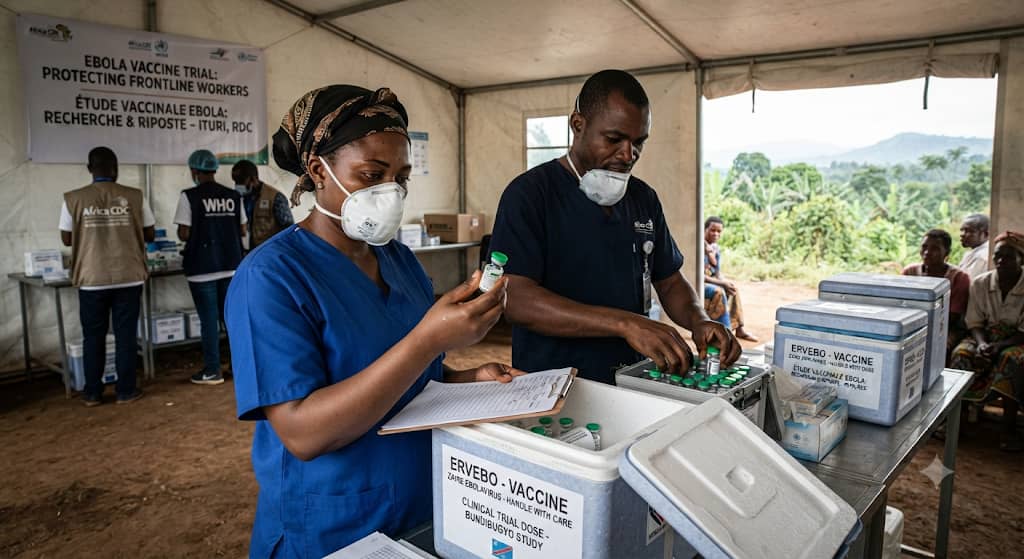
The allocation, announced by the World Health Organization and Africa Centres for Disease Control and Prevention on Thursday 20 August, includes 50,000 doses for frontline and health workers and 20,000 doses for a Phase 3 clinical trial.
The study will be examined whether Ervebo can protect against Bundibugyo virus disease, a form of Ebola for which the vaccine has not been specifically proven effective.
The urgency is underscored by the scale and speed of the outbreak. According to WHO data dated 12 August, the DRC had recorded 4,665 confirmed cases and 2,184 deaths, giving the outbreak a crude case-fatality ratio of 46.8 percent.
WHO said the disease had spread from the Mongbwalu health zone in Ituri Province to 54 health zones across six provinces.
During the week of 3–9 August alone, officials recorded 579 cases and 304 deaths—the highest weekly totals reported during the outbreak.
By 15–17 August, Africa CDC and UN reporting put the DRC’s totals at 4,945 confirmed cases and 2,325 deaths. That death toll surpassed the 2,299 fatalities recorded during the country’s 2018–2020 Ebola outbreak, previously its deadliest.
The outbreak is concentrated in Ituri, which accounted for most confirmed cases, but transmission has also been reported in North Kivu, South Kivu, Haut-Uélé, Tshopo and Bas-Uélé.
Response teams are expanding surveillance, contact tracing, laboratory testing, treatment capacity and community engagement.
However, insecurity, population displacement, cross-border movement, shortages and gaps in screening and treatment infrastructure continue to complicate containment efforts.
The vaccine allocation therefore represents both an emergency response and a scientific test.
Ervebo is licensed and recommended for Ebola virus disease caused by the Zaire ebolavirus, not specifically for Bundibugyo virus.
Early laboratory and animal studies suggest it may offer some protection, but its benefits for people facing the current outbreak remain uncertain.
WHO and the Africa CDC say anyone offered the vaccine must receive clear information about its potential risks, possible benefits and limitations before giving informed consent.
For the DRC, the immediate priority is to protect health workers and affected communities while slowing transmission.
For the wider region, the trial could provide evidence needed to determine whether an existing Ebola vaccine can become a useful defence against future Bundibugyo outbreaks.