

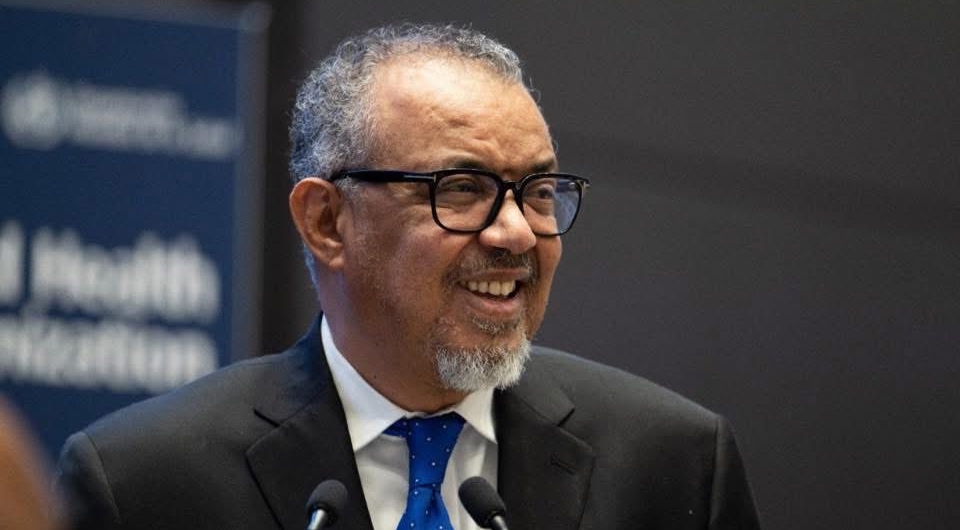
The World Health Organization’s Director -General, Dr Tedro Ghebreyesus has urged Governments to conclude negotiations on the remaining Pathogen Access and Benefit-Sharing (PABS) Annex to the Pandemic Agreement

While warned that the world’s ability to respond fairly and quickly to future outbreaks depends on completing the deal.
Opening the ninth meeting of the Intergovernmental Working Group on the Pandemic Agreement, the WHO chief said Member States had already made history by adopting the agreement but must now “finish the job” by resolving the outstanding annex.
“Ultimately, the reason for finishing this work is not legal or procedural. It is about protecting people,” the Director-General told delegates.The negotiations are taking place against the backdrop of continuing infectious-disease threats.
The WHO chief cited an outbreak of hantavirus earlier in the year and the ongoing Ebola epidemic in the Democratic Republic of the Congo as reminders that a pathogen threat in one country can quickly become a danger to populations worldwide.
“No country can protect itself from pandemics by acting alone,” the Director-General said, describing that as the central lesson of the COVID-19 pandemic.
Equity at the centre of negotiations
The WHO chief said COVID-19 exposed the consequences of weak links between the sharing of pathogen samples and equitable access to vaccines, treatments and other lifesaving tools.
Although vaccines were developed at unprecedented speed, many countries were left waiting while wealthier nations secured supplies, in some cases obtaining more than they needed.
According to the WHO, that inequity cost lives, prolonged the pandemic and increased the risk of new variants emerging.
The PABS Annex is intended to address that gap by creating a framework linking the sharing of pathogen-related information and materials with access to the benefits that result, including vaccines, diagnostics and treatments.
The WHO Director-General described the annex as the final major component needed to bring the broader pandemic- preparedness system into operation.
It should be based, the official said, on “transparency, predictability, mutual responsibility, mutual benefit — and trust. PABS is more than a piece of a puzzle,” the Director-General said. “It is the key that will unlock the door to a safer future.”
Building on post-COVID measures
The remarks highlighted a series of initiatives established or strengthened since the COVID-19 crisis.
These include the Pandemic Fund and the Universal Health and Preparedness Review, which support national preparedness; the WHO Hub for Pandemic and Epidemic Intelligence in Germany, which aims to strengthen surveillance and early warning; and programmes designed to expand access to vaccines and other medical tools.
The WHO also pointed to the Access to COVID-19 Tools Accelerator and COVAX, the interim Medical Countermeasures Network, the mRNA Technology Transfer Programme in South Africa and the Global Biomanufacturing Training Hub in the Republic of Korea.
Other measures include the WHO BioHub in Switzerland, intended to support the safe international sharing of pathogen samples, and the Global Health Emergency Corps, which is designed to strengthen international response capacity.
The WHO also said it had worked with the Coalition for Epidemic Preparedness Innovations to accelerate vaccine development for the current Ebola outbreak.
Together with amendments to the International Health Regulations adopted in 2024 and the Pandemic Agreement adopted last year, the initiatives form what the Director-General called a stronger global health-security architecture.
The PABS Annex, the official said, is the remaining piece required to connect those efforts into an operational system.
Three priorities for delegates
The Director-General set out three priorities for the two-week negotiating session.
First, governments should negotiate with the intention and expectation of reaching a conclusion. While acknowledging that “nothing is agreed until everything is agreed,” the WHO chief urged every delegation to arrive prepared to find solutions.
Second, delegates should distinguish between essential requirements and desirable provisions. Countries should be clear about what they cannot accept, while remaining flexible on other issues.
Third, the negotiations should keep public health as their guiding principle. The central test of the annex, the Director-General said, will be whether it enables the world to respond faster and more equitably when the next pandemic threat emerges.
The WHO chief welcomed the “constructive spirit” of recent informal meetings and thanked the working group’s bureau, co-facilitators and delegates for their efforts. The official also called on negotiators to maintain that approach during the formal discussions.
“Multilateralism, of course, is not easy, but it’s the only way, and the best way,” the Director-General said, adding that national sovereignty and international cooperation should be viewed as mutually reinforcing rather than opposing principles.
The appeal comes weeks after the United Nations General Assembly adopted a political declaration on pandemic prevention, preparedness and response.
According to the WHO, the declaration welcomed the Pandemic Agreement and called for the PABS negotiations to be completed. “The world is looking to you to finish what you began,” the WHO Director-General told delegates.