

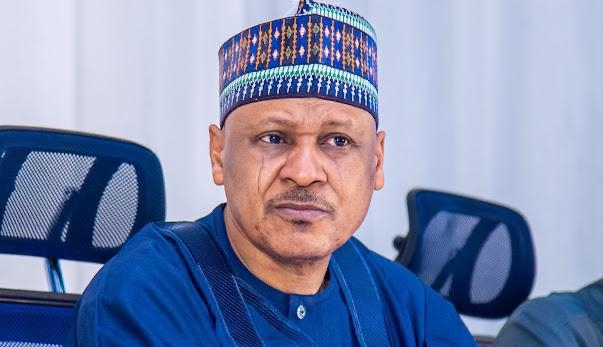
Day-two of the official launch of the International Media and Information
Literacy Institute (IMILI) solidified its foundation, with National Open University (NOUN) in Abuja becoming its intellectual home.
The event underscored Nigeria’s leadership in the lead for global battle against misinformation, disinformation, and the erosion of trust in the digital age, emphasizing a collective commitment to fostering critical thinking and responsible information engagement.
The Minister of Information and National Orientation, Mohammed Idris, in his remarks, hailed the event as “beginning
of what I believe will be a transformative journey for Nigeria, for Africa, and indeed for the global community.”

He reiterated the critical need for a “whole-of-society approach” to media and information literacy (MIL), asserting its essential role in a world grappling with
rapid technological change and a constant flow of information.
The Minister expressed Nigeria’s immense pride and responsibility in hosting the world’s first UNESCO Category 2 Institute dedicated to MIL, urging the nation to lead by example in upholding truth and informed citizenship.
He pledged the Ministry’s unwavering support for IMILI’s mandate, promising collaboration with UNESCO, development partners, academia, media, and civil
society to ensure tangible and measurable impact. Professor Uduma Uduma, Vice- Chancellor of the National Open University of Nigeria (NOUN), eloquently articulated the profound significance of IMILI’s establishment within the university.
He characterized the institute’s transition as moving “from abstraction to actuality. From conception to lived relevance,” highlighting NOUN’s selection based on
“rigorous evaluation and recognition of institutional capacity, reach, and philosophical alignment.”
Professor Uduma identified an “epistemic paradox” prevalent in the digital age, where an abundance of information coexists with a scarcity of understanding, and increased connectivity often diminishes clarity.  He powerfully framed MIL as an
“intellectual defense system,” a crucial safeguard against manipulation, and a vital platform for critical engagement.
As an African-leaning, open-distance learning institution, NOUN is uniquely positioned to democratize knowledge, seeing itself not merely as a university but as a “movement” dedicated to expanding human possibilities through
education.
He concluded by emphasizing that the struggle for truth and integrity in an age
of distortion is a moral imperative, and NOUN is committed to the providing academic leadership to ensure IMILI’s transformative role.Former Minister of Information and Culture, Lai Mohammed, shared his enduring commitment to combating fake news, disinformation, misinformation, which he considers the “greatest threat to national security and national unity.”
He recounted his efforts from 2017 onwards, including dedicating a National Council of Information Committee meeting to address these issues.
Lai Mohammed reiterated his conviction
regarding the necessity of social media regulation, clarifying that “regulation is not censorship,” but a vital measure in an era where unchecked information can rapidly cause significant societal problems. He noted with satisfaction that the European Commission had also recognized and addressed issues concerning content scrutiny on social media platforms.
Sharon Omotosho, Director of IMILI, provided a concise overview of the institute’s vision, referencing a lineage of international declarations, from the Grunwald Declaration (1982) to the Molina-Abuja Declaration (2022), that have paved the way for its creation.
She underscored IMILI’s dedication to supporting the implementation of the UNESCO International Media and Information Literacy Institute, which aims to foster collaboration, offer advisory services, and function as a global observatory for MIL scholarships.In essence, Day 2 of the IMILI launch solidified its operational framework and intellectual home, marking a collective resolve to empower knowledge societies through media and information literacy.
It served as a powerful call to action for the sustained commitment, the robust
partnerships, and the translation of visionary ideas into concrete efforts.
The IMIL institute is now poised to become a beacon of intellectual guidance, rigorously pursuing truth and courageously defending it within an increasingly intricate information landscape.