

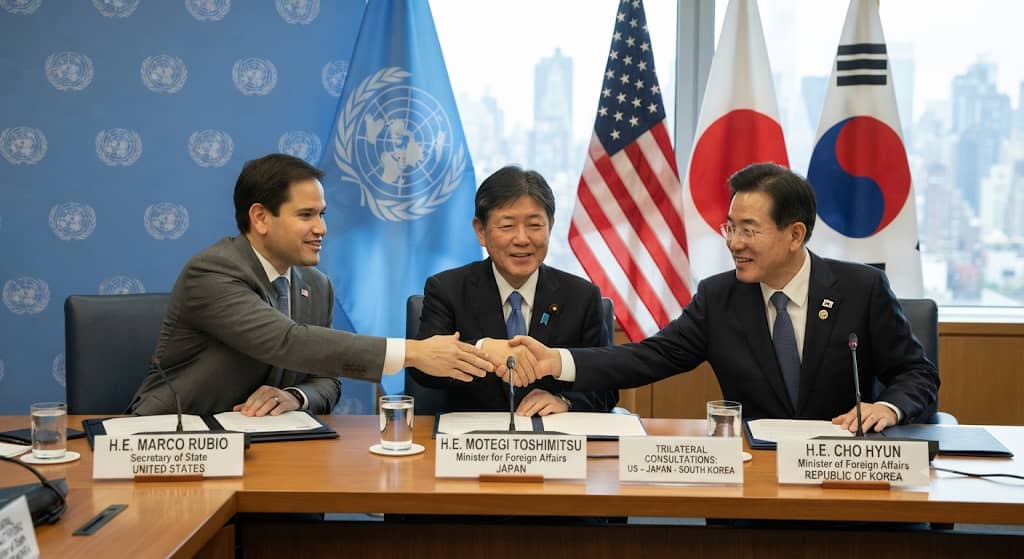
The United States, Japan and South Korea have pledged to deepen their security and economic partnership, presenting a united front on North Korea, Taiwan, supply-chain security and regional stability.
Meeting on the sidelines of the United Nations General Assembly, the US Secretary of State Marco Rubio, Japanese Foreign Minister Motegi Toshimitsu and South Korean Foreign Minister Cho Hyun reaffirmed their commitment to a free and open Indo-Pacific governed by the rule of law.

The three countries called for the complete denuclearization of North Korea and urged Pyongyang to end its support for nuclear and ballistic-missile programs. At the same time, they stressed that the door to dialogue remains open.
The ministers also condemned North Korean sanctions evasion, cyber operations and the use of overseas IT workers to generate revenue for the regime.
They renewed calls for the resolution of long-standing humanitarian issues, including abductions, detainees, prisoners of war and separated families.
Beyond security, the allies agreed to strengthen cooperation on critical supply chains, energy resilience and advanced technologies such as artificial intelligence, quantum computing, biotechnology and semiconductors.
They also backed closer coordination on small modular nuclear reactors and efforts to protect economies from coercion and market distortions.
The statement sent a clear message on the wider region. Washington, Tokyo and Seoul emphasized the importance of peace across the Taiwan Strait, opposed unilateral changes to the status quo and reaffirmed freedom of navigation and lawful commerce throughout the Indo-Pacific.
The partners further announced cooperation with the United Nations Office on Drugs and Crime to combat organized crime and scam centers in Southeast Asia, alongside new initiatives on disaster relief and maritime security.
With plans to continue meetings at every level, the three governments signaled that their partnership is moving beyond traditional defense cooperation—toward a broader alliance built on security, technology, resilience and shared influence.