

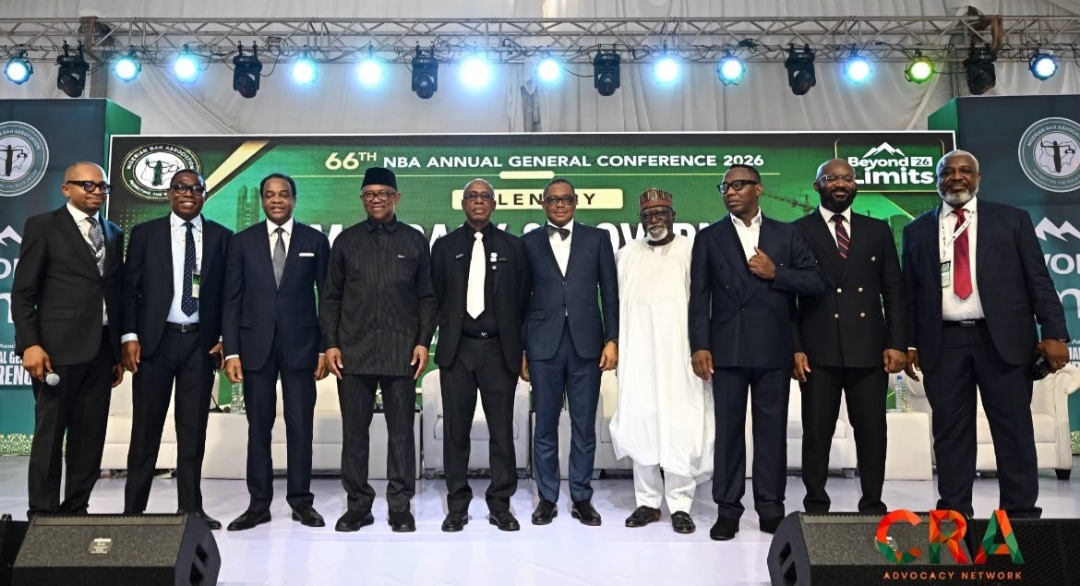
A political panel at the Nigerian Bar Association’s 2026 Annual General Conference in Port Harcourt turned confrontational on Monday, August 24, 2026.
As Omoyele Sowore, presidential candidate of the African Action Congress, challenged former Rivers State governor and former transport minister Rotimi Amaechi over his record in government and his position on fuel- subsidy removal.
Amaechi who is also the Vice Presidential Candidate of the African Democratic Congress (ADC) repeatedly rejected Sowore’s characterisation of his remarks and at one point told him to “close your mouth.”
The exchange occurred during a wider session on governance and economic policy that also featured Peter Obi and other opposition figures.
Coverage from Channels Television
placed the confrontation within a broader conference programme that included debates on Nigeria’s security architecture and the future of policing.
The NBA’s official conference website says the gathering was held in Port Harcourt from 21 to 28 August 2026 under the theme “Beyond Limits.”
How the confrontation began
According to reports by Tribune Online and Legit.ng, Sowore referred to an earlier comment by Amaechi suggesting that politicians who had held office and failed should not return to seek power.
Sowore said Amaechi had effectively acknowledged that, apart from himself
and another candidate, most of the politicians on the platform had been in government and had failed.
“They have no business coming out. You should be apologising to Nigerians,” Sowore said, according to Tribune Online and Legit.ng.
Amaechi immediately objected, accusing Sowore of distorting what he had said. “Stop lying. Stop lying, Sowore. I said, judge us by our achievements,” Amaechi replied.
The disagreement then shifted from the interpretation of Amaechi’s earlier comment to the record of his public service.
Railways become the flashpoint
Sowore attacked Amaechi’s tenure as transport minister, arguing that a railway project associated with him had failed to deliver meaningful benefits.
Tribune Online reported him as saying that Amaechi “built a rail line that went nowhere,” while Legit.ng carried
substantially the same account.
Amaechi rejected the criticism and cited the Lagos‒Ibadan and Abuja‒Kaduna railways as projects delivered during his time as minister.
He also defended his record as Rivers
governor, pointing to roads and primary schools built during his administration.
He challenged lawyers from Rivers State to inspect the projects and invited some lawyers from Ogun, Kaduna and other states to confirm whether the railway services were operating.
As Sowore attempted to continue, Amaechi cut him off and said: “Moreover, Sowore, when politicians are talking, close your mouth.”
The sources reviewed describe the episode as heated verbal confrontation. Legit.ng used the phrase “physical confrontation” in its headline, but the body of its report, like the Tribune and Channels accounts, primarily documents an angry exchange of words rather than independently establishing physical contact.
Fuel subsidy divides the panel
Fuel-subsidy policy was the substantive issue beneath the personal clash. Sowore argued that he had consistently opposed subsidy removal and accused successive governments of changing position while ordinary Nigerians bore the cost.
He said subsidy mainly benefited
elites and governors, and questioned the repeated promise that removing it would improve living conditions.
“Who are you subsidising? You are subsidising the elites. You are subsidising the governors,” Sowore said, according to Tribune Online.
He also argued that Nigeria had undergone repeated subsidy removals since the late 1980s without receiving the promised improvements.
His broader case was that political leaders who had previously controlled public institutions should be judged by outcomes rather than by fresh campaign promises.
Amaechi took a different position. While defending his record, he said he would not remove fuel subsidy because poor Nigerians needed support.
He argued that government was already subsidising the wealthy through waivers and that public policy should return power and benefits to ordinary citizens.
He also criticised Obi’s record as Anambra governor, alleging that lecturers and doctors had been on strike for 13 months.
Those claims were made by Amaechi during the exchange and were reported as political assertions; the reports reviewed did not independently verify them.
Obi supported subsidy removal in principle but argued that the proceeds must be transparently redirected to public services.
He said mismanagement of recovered funds, rather than the policy itself, was the central problem.
Tribune Online reported Obi as proposing that a portion of the recovered funds be invested in primary healthcare, including an example in which 5 per cent of ₦16 trillion would amount to ₦800 billion.
The wider 2027 political message
The confrontation formed part of a broader display of opposition positioning ahead of Nigeria’s 2027 presidential election.
A separate report by TheNigeriaLawyer said candidates and leading opposition figures at the conference would accept an election result only if the process was free, fair and credible.
Obi expressed confidence that he would win, while Amaechi said there would be no need to contemplate defeat because his political camp would win.
The same report said the session also exposed continuing pressure on opposition parties to unite behind a single candidate.
A participant questioned why the various opposition figures could not form one platform and suggested that Obi was the most popular among those present.
TheNigeriaLawyer expressly presented that popularity claim as the participant’s opinion, not as an established fact.
Taken together, the Port Harcourt session highlighted three tensions likely to shape the 2027 contest:
Disagreement over whether fuel-subsidy removal is necessary and how its proceeds should be used;
Competing claims about the achievements and failures of former officeholders; and unresolved question of whether Nigeria’s opposition parties can coordinate behind a common candidate.
The clash also underscored the political stakes of the NBA platform. What began as a disagreement over the meaning of Amaechi’s comment quickly became a contest over public-service records, economic credibility and the right of established politicians to seek power again.
Sowore’s attack was aimed at the record of former officeholders; Amaechi’s response was that voters should judge them by what they built. Neither side conceded the other’s central argument.