


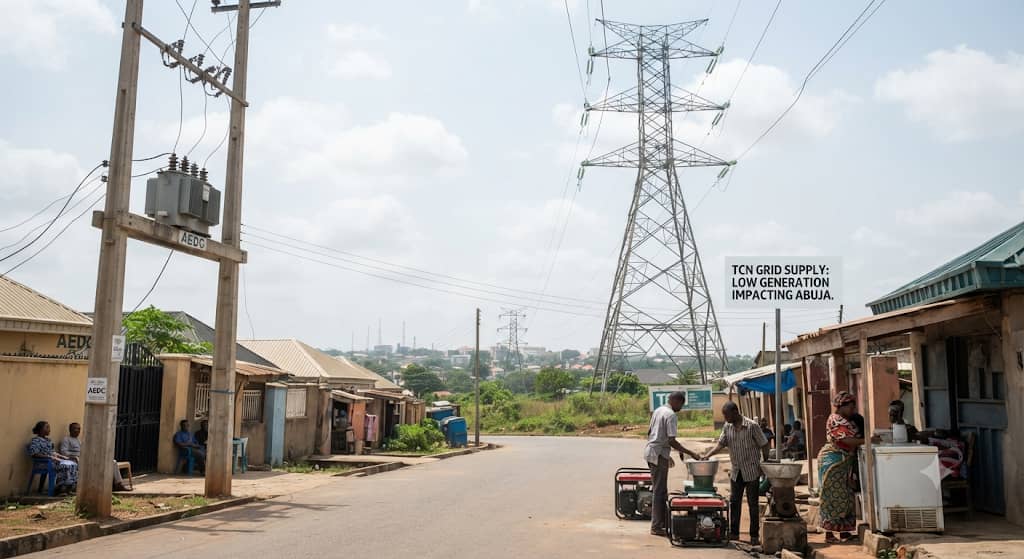
The Transmission Company of Nigeria (TCN) has rejected claims that a transmission-line fault caused the sharp reduction in electricity supplied to Abuja, saying the constraint was triggered by low power generation on the national grid.
TCN was responding to a statement issued by the Abuja Electricity Distribution Company (AEDC) on August 26, 2026, in which the DisCo attributed a drop in its allocation from approximately 641 megawatts to 314 megawatts to the alleged tripping of 330kV transmission lines supplying Abuja from the Shiroro Transmission Substation.
In a clarification signed by its management, TCN described the claim as “inaccurate and misleading,” insisting that all 330kV transmission lines within the Abuja Region remain in circuit.
“Contrary to the information contained in AEDC’s publication, no tripping of the 330kV transmission lines supplying the Abuja axis has occurred,” the company said.
TCN maintained that the reduced allocation and the resulting load shedding across AEDC’s feeders could not be blamed on any failure involving its transmission infrastructure.
Instead, the company said the drop was a direct consequence of inadequate generation available on the grid.
The clarification comes amid ongoing electricity supply challenges affecting consumers across the Federal Capital Territory and surrounding areas.
TCN urged stakeholders to provide accurate and clear information to the public, warning that incorrect attribution of system constraints could create confusion among electricity users.
The transmission operator reaffirmed its commitment to transmitting available bulk electricity efficiently and to preserving the stability, reliability and integrity of Nigeria’s national transmission grid.