

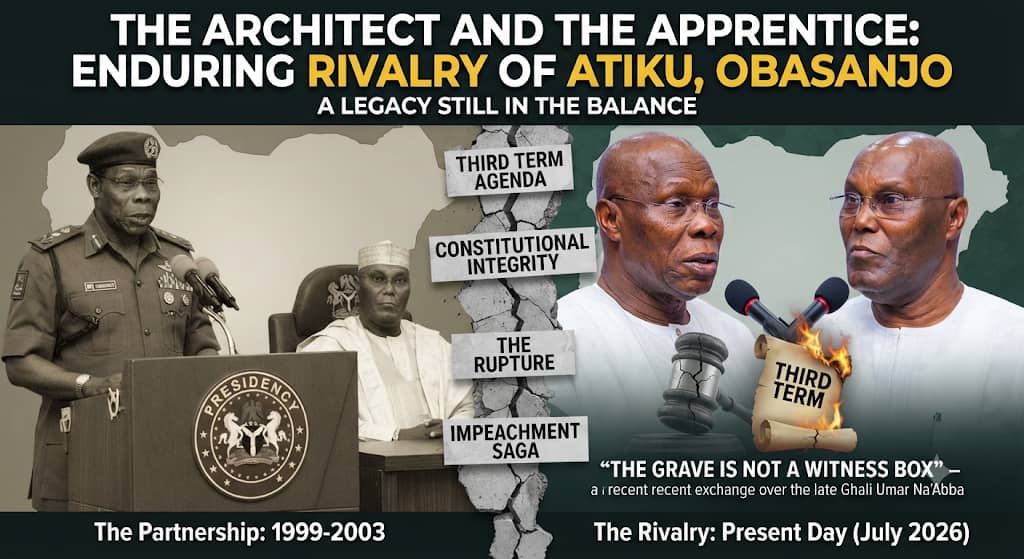
In the annals of Nigerian political history, few rivalries possess depth, complexity, and enduring bitterness of the decades- long feud between the former President Olusegun Obasanjo and his former Vice President, Atiku Abubakar.
What began as a profound partnership of mutual rescue and political resurrection has devolved into a bitter war of words, culminating in recent flurry of accusations as both men eye the 2027 presidential election.
At the heart of their fractured relationship lies a fundamental clash over constitutional integrity, personal loyalty, and the definition of political legacy.
The Crucible of Power: A Partnership Forged in Darkness
The roots of the Atiku-Obasanjo relationship trace back to the darkest days of Nigeria’s military dictatorship.
In 1995, under the brutal regime of General Sani Abacha, former President Obasanjo was accused of plotting a coup against the military junta.
The consequences were severe: Obasanjo was arrested, tried, and initially sentenced to death, a sentence later commuted to a 15-year prison term.
During this period of immense personal peril, Atiku Abubakar, then the Governor -elect of Adamawa State, stood firmly by Obasanjo.
According to accounts from both Atiku’s camp and various political analysts, Atiku provided crucial support to Obasanjo’s family, working tirelessly with other democrats to secure his release.
The geopolitical landscape shifted abruptly in June 1998 following the sudden death of General Abacha.
Obasanjo was released from prison and quickly mobilized to run for presidency. It was during this critical juncture that Atiku’s role became pivotal.
He received the newly freed former military ruler, providing not only logistical support but also mobilizing political structures and building alliances within the nascent Peoples Democratic Party (PDP).
This grassroots effort culminated in Obasanjo’s emergence as the PDP presidential candidate in 1999, with Atiku chosen as his running mate.
For the first few years of their administration, the duo projected unity. Together, they oversaw Nigeria’s fragile transition back to civilian rule, a period that also saw significant economic reforms, including a massive debt relief package from the Paris Club.
The Rupture: The Ghost of the Third Term
The fragile alliance began to crack during Obasanjo’s first term, fueled by mutual suspicions and diverging political ambitions. The breaking point, however, was the infamous “Third Term Agenda” of 2006.
As Obasanjo’s second term approached its end, there were widespread allegations that he was seeking to amend the Nigerian constitution to allow for a third term in office.
While Obasanjo has always publicly denied having any such ambitions, his actions sparked a political firestorm.
The National Assembly, led by a fierce opposition, viewed the move as a direct assault on Nigeria’s nascent democracy, especially given the country’s history of
military dictatorships and the fragile nature of its democratic institutions.
Atiku Abubakar emerged as one of the most vocal opponents of the Third Term Agenda.
Operating within the executive branch, Atiku challenged the sitting President, leveraging his position to frustrate the constitutional amendments.
His stance was not merely an act of personal rebellion; it was a defense of the established term limits that were crucial for Nigeria’s democratic consolidation.
The Senate and House of Representatives ultimately voted down the proposed amendments in May 2006, a victory for democratic institutions that critics hailed as a triumph of the rule of law over personal ambition.
For Atiku, this victory cemented his
reputation as a defender of constitution. For Obasanjo, it was a profound personal and political defeat, with the blame squarely placed on his Vice President’s shoulders.
The War of Words: Revisiting the Impeachment Saga
The fallout from the Third Term Agenda was severe. Obasanjo dropped Atiku from the 2007 presidential ticket, and the two men went their separate ways politically.
In the years that followed, Obasanjo frequently characterized his decision to choose Atiku as his running mate as the “biggest mistake” of his presidency.
The rivalry reached a fever pitch in late July 2026, with the emergence of bombshell allegations just ahead of the 2027 election cycle.
In a highly publicized interview, Obasanjo leveled a serious accusation against his former deputy: he alleged that during the 2002- 2003 crisis, Atiku had bribed late Speaker of the House of Representatives, Ghali Umar Na’Abba, with 5 million Naira to initiate impeachment proceedings against him.
Obasanjo claimed that he treated the threat with contempt, asserting that he had committed no impeachable offenses, and that the entire plot was orchestrated by Atiku to usurp power.
The timing of this revelation—coming nearly two decades after the fact and shortly after Na’Abba’s death—was seen by many as highly suspicious.
Atiku swiftly fired back. In a statement titled “The Grave Is Not A Witness Box,” Atiku vehemently denied the bribery allegations, calling them reckless and politically motivated.
He questioned why Obasanjo waited until the only person who could corroborate or deny the claim had passed away before leveling such a grave accusation.
Atiku maintained that Obasanjo’s relentless attacks were driven by an inability to forgive Atiku’s principled
stand against the Third Term Agenda.
The Economic Legacy Debate
Beyond personal grievances, the two men frequently clash over the economic legacy of the 1999-2007 administration.
Atiku often claims to have been the head of the economic management team that orchestrated Nigeria’s rapid growth and Paris Club debt relief during that era.
He frequently cites endorsements from technocrats like Ngozi Okonjo-Iweala, the former Finance Minister, to bolster his claims.
However, independent fact-checkers have repeatedly clarified the structure of the government during that time.
While Atiku chaired the constitutionally mandated National Economic Council (NEC), the specialized Economic Management Team (EMT) responsible
for the actual debt relief negotiations was led by Ngozi Okonjo-Iweala and presided over by President Obasanjo himself.
Despite this nuance, Atiku continues to claim ownership of the economic triumphs, while Obasanjo dismisses such claims as an attempt to rewrite
history.
A Legacy Still in the Balance
The ongoing conflict between Atiku Abubakar and Olusegun Obasanjo is a testament to the deeply entrenched nature of Nigerian politics.
It is a battle fought on the shifting sands of historical memory, where facts are often subordinated to political narratives.
For Atiku, the narrative is one of unwavering constitutionalism. He portrays himself as the man who rescued Obasanjo, only to be betrayed when he refused to compromise the
nation’s democratic foundations for a dictator’s ego.
For Obasanjo, the narrative is one of misplaced trust and ultimate betrayal by an ambitious subordinate who sought to undermine his leadership from within.
As the 2027 elections approach, the Nigerian public is forced to navigate this complex web of personal vendettas and political posturing.
The Atiku-Obasanjo feud serves as a stark reminder of the fragility of political alliances and the enduring scars left by the struggle to consolidate democracy in Africa’s most populous nation.