

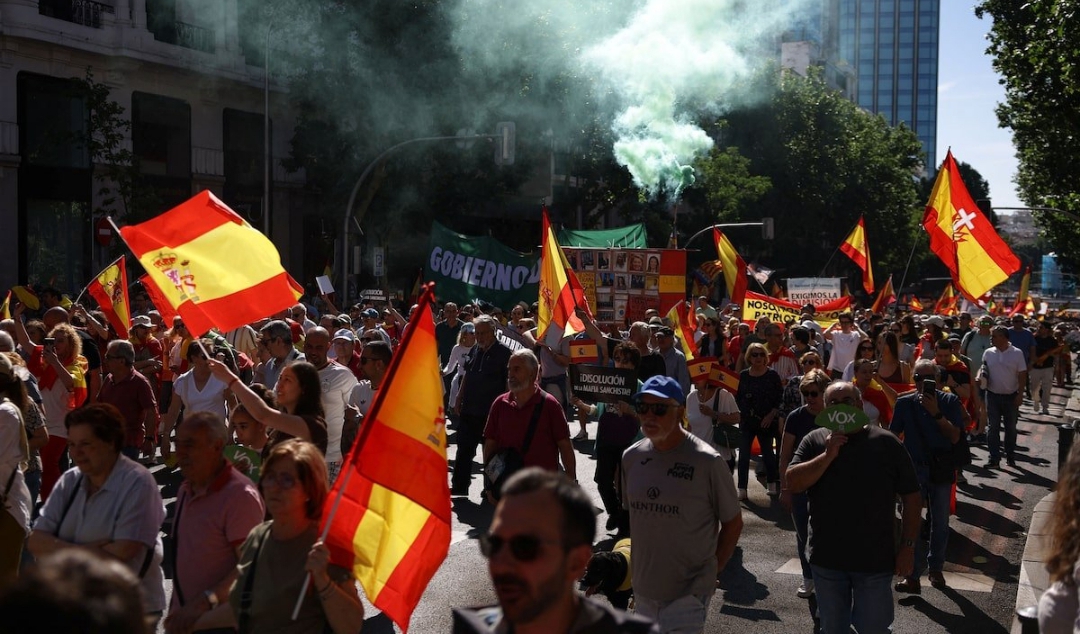
The Spanish capital erupted in massive anti-government demonstrations on Saturday as tens of thousands of the citizens flooded the streets of Madrid, demanding the immediate resignation of Prime Minister Pedro Sánchez.
The protests, characterized by a mix of patriotic fervor and intense public anger, mark a significant escalation in political pressure facing the Socialist-led govt following a series of high -profile corruption scandals.
Confirmation of Reports
The reports were first amplified globally by BRICS News (@BRICSinfo), which issued a “JUST IN” alert stating that Spain had erupted in anti-government protests with crowds demanding the Prime Minister’s exit.
Independent verification from international news agencies, including the Reuters and local Spanish outlets, confirms that the protests took place on Saturday, May 23, 2026, centered around the “March for Dignity” organized by the Spanish Civil Society association.
Protest Scale and Political Backing
The scale of the demonstration has become a point of contention between organizers and authorities, a common occurrence in Spanish political life.
Organizers’ Estimate: 80,000 participants. Govt Representative Estimate: Approximately 40,000 participants. The rally saw significant participation from Spain’s right-wing and far-right opposition.
Leaders from the People’s Party (PP) and the far-right Vox party were present, aligning themselves with the “patriot” movement.
Protesters were seen waving thousands of Spanish national flags and carrying banners with slogans such as the “Resignation of the Socialist Mafia” and “Government Resignation.”
Key Drivers: Corruption and Judicial Pressure
The immediate catalyst for this latest wave of unrest appears to be a deepening judicial crisis involving key figures in the Socialist Party (PSOE).
1. Zapatero Investigation: A Spanish court recently announced investigation into former Prime Minister José Luis Rodríguez Zapatero, a close ally of Sánchez, for alleged involvement in an influence-peddling and money- laundering network.
2. The Begoña Gómez Case: The Prime Minister’s wife, Begoña Gómez, has been under investigation for several months regarding her professional business dealings.
While Sánchez has dismissed these allegations as “politically motivated” attacks by far-right groups, the judicial proceedings have significantly damaged the government’s public standing.
3. Amnesty Controversy: Although not the primary focus of Saturday’s specific march, the underlying resentment remains high over the govt’s previous decisions regarding amnesty for Catalan separatist leaders, which protesters view as a betrayal of national unity.
Clashes and Security Response
While the majority of the “March for Dignity” was peaceful, tensions boiled over near the Moncloa Palace, the official residence of the Prime Minister.
• Injuries: At least seven police officers were injured during skirmishes with a small group of protesters who attempted to breach security barriers.
• Arrests: Police detained several masked individuals and confirmed at least three arrests for public order offenses.
• Moncloa Standoff: Security forces were forced to deploy in significant numbers to prevent demonstrators from reaching the palace gates, using barriers to redirect the crowd away from the Prime Minister’s residence.
The Prime Minister’s Stance
Prime Minister Pedro Sánchez has so far remained defiant. Having previously toyed with the idea of resignation in April 2024, he has since doubled down on his leadership, framing the protests and judicial investigations as a coordinated “smear campaign” by the rightwing opposition.
However, with the investigation into Zapatero adding a new layer of legal
complexity, the political stability of his administration remains increasingly precarious.